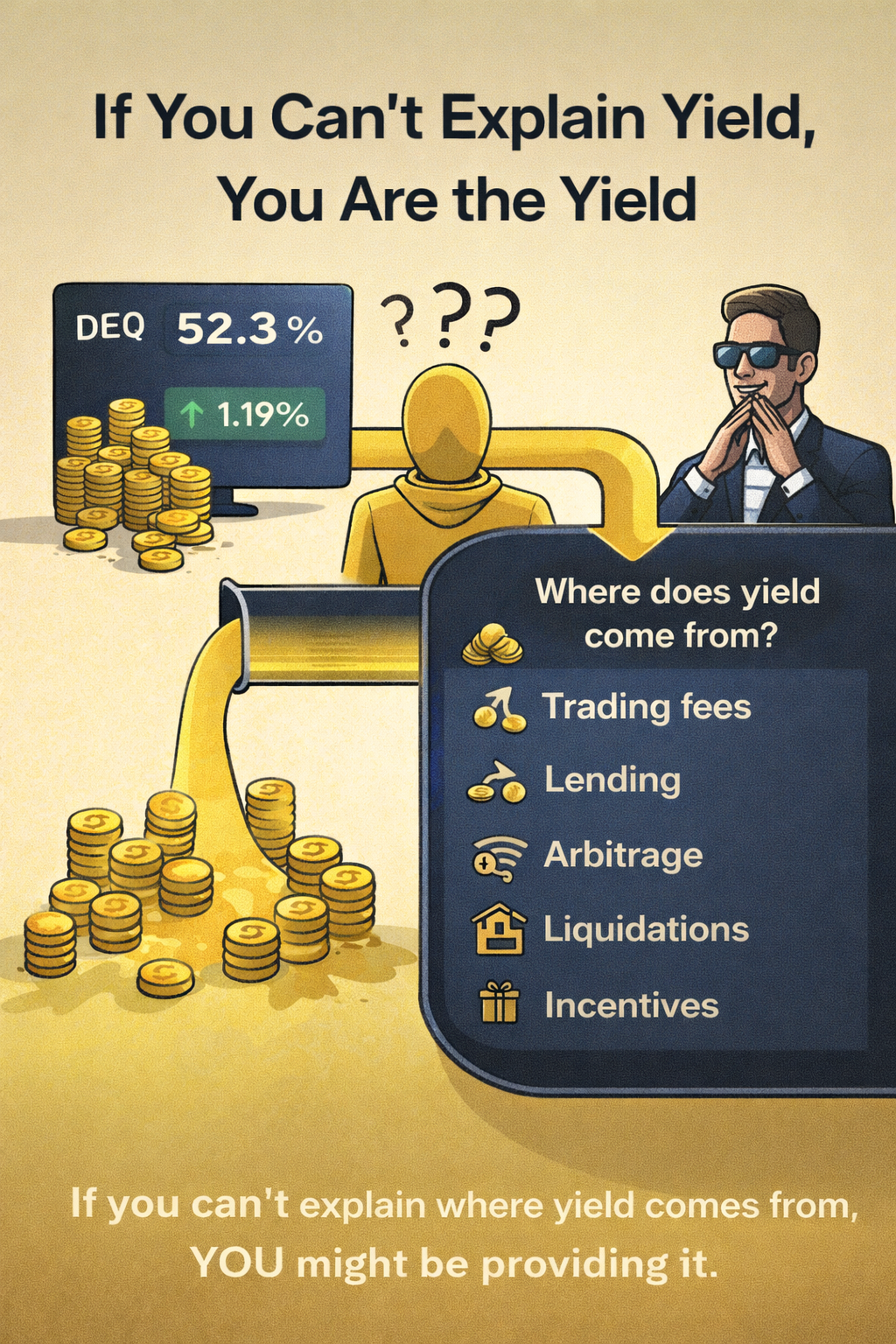
If You Can’t Explain Yield, You Are the Yield
--
DeFi made yield look simple.
Open a dashboard, see a high APY, deposit funds, and watch it grow. Everything feels smooth. Numbers update in real time. Returns seem to compound automatically.
But the more I look at it, the more I realize something feels off.
Most people — including me at the beginning — don’t ask the most important question:
Where is this yield actually coming from?
The Illusion
What we see in DeFi today is a very clean surface:
- High APYs everywhere
- Simple deposit → earn flows
- Almost no explanation behind the returns
It feels easy. Almost too easy.
But that’s exactly the point — yield is presented as simple, while the reality underneath is anything but.
The Gap No One Talks About
The number on the screen is not the number you take home.
There’s always a gap between displayed yield and real yield.
At first, I ignored it. Then I started noticing where it actually leaks:
- Fees eating into returns
- Impermanent loss when providing liquidity
- Rebalancing that quietly costs money
- Slippage and execution friction
- Market volatility changing everything
A 100% APY can quickly become something much smaller once all of this is accounted for.
And yet, most dashboards don’t show that part.
So… Where Does Yield Come From?
This is where things start to make sense.
Yield isn’t magic. It always comes from somewhere.
From what I’ve seen, it usually comes from:
- Trading fees
- Borrowers paying interest
- Arbitrage opportunities
- Liquidations
- Token incentives and emissions
But not all of these are equal.
Some feel real and sustainable. Others feel temporary — like they only exist to attract liquidity.
And that difference matters more than the APY itself.
The Part That Changed My Perspective
At some point, I came across an idea that stuck with me:
If you don’t understand the system, you might be the one paying for it.
That hit harder than expected.
Because when I looked closer, it made sense:
- Providing liquidity without fully understanding the risks
- Earning rewards while taking on hidden downside
- Joining pools without modeling what could happen
In those situations, the “yield” isn’t just income — it can be a transfer of value.
Sometimes, from you… to someone who understands the system better.
Same System, Different Results
What’s interesting is that people use the same protocols but get very different outcomes.
Some chase the highest APY they can find.
Others take time to understand structure, costs, and risk.
And then there are more advanced players who model everything before they deploy capital.
Same opportunities. Completely different results.
The difference isn’t access.
It’s understanding.
A Shift I’m Starting to Notice
It feels like DeFi is slowly moving away from pure yield chasing.
More people are starting to think in terms of yield engineering.
Not just “where is the highest APY?” but:
- What is the expected outcome?
- What risks am I taking?
- What are the real net returns over time?
It’s a different mindset.
Less hype, more structure.
Why Structure Matters
This is also why structured tools are starting to make more sense to me.
Instead of manually jumping between opportunities, systems like Concrete Vaults aim to:
- Automate allocation
- Manage strategies
- Rebalance positions
- Reduce human error
It’s not about removing control — it’s about removing guesswork.
Moving from intuition… to something more systematic.
The Way I See It Now
I don’t look at yield the same way anymore.
It’s not just a number on a dashboard.
It’s:
- Revenue
- Minus costs
- Adjusted for risk
And if I can’t clearly explain where that yield comes from…
Then I have to consider the possibility that I’m not earning it.
I’m providing it.