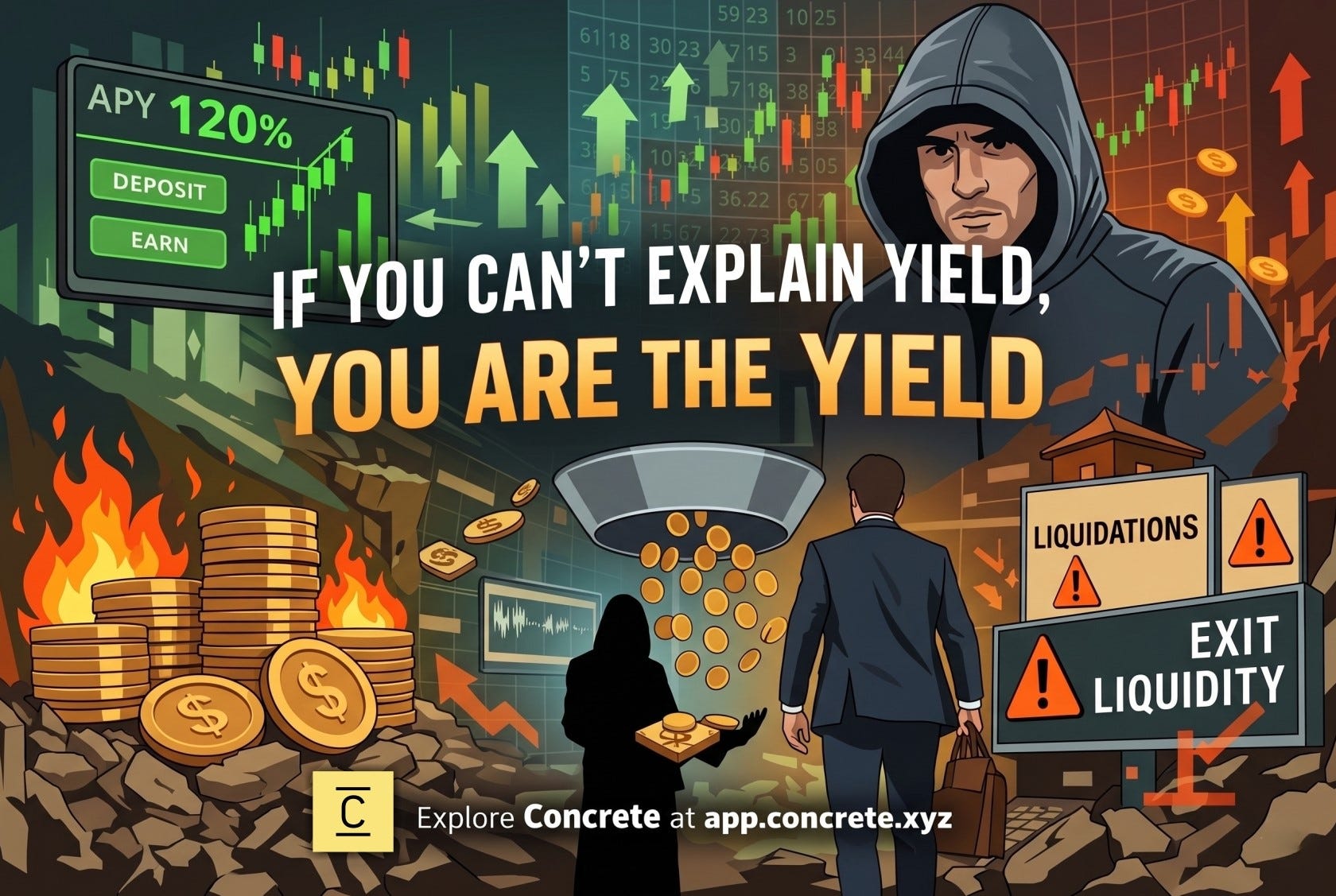
If You Can’t Explain Yield, You Are the Yield
 xst4 min read·Just now
--
If You Can’t Explain Yield, You Are the Yield
DeFi didn’t just make yield accessible.
It made it dangerously easy to misunderstand.
Today, yield looks simple.
Open a dashboard.
Deposit assets.
Watch numbers go up.
APYs update in real time. Returns appear to compound. Positions feel passive.
But that simplicity is an interface illusion.
Because beneath it, yield is not passive.
It is constructed, transferred, and often misunderstood.
And most users never ask the only question that matters:
Where is that yield actually coming from?
1️⃣ The Illusion of Effortless Yield
DeFi dashboards are designed for clarity — not for truth.
They show:
- High APYs
- Clean deposit → earn flows
- Instant feedback loops
What they hide:
- Strategy complexity
- Embedded risk
- Cost structure
- Dependency on market conditions
The result is a system where yield feels like a feature.
But it isn’t.
Yield is always the byproduct of someone else’s activity- or someone else’s loss.
2️⃣ The Gap Between Displayed and Real Yield
The number you see is not the number you earn.
Displayed APY is typically a gross projection, not a net outcome.
To get to reality, you need to subtract:
- Impermanent Loss
Price divergence between assets can quietly erode gains. - Rebalancing Costs
Active strategies incur gas, slippage, and timing inefficiencies. - Execution Friction
Entry and exit conditions matter more than most assume. - Volatility Exposure
High APY often comes paired with unstable underlying assets. - Incentive Dilution
Emissions decrease in value as more participants enter.
A simple example:
You enter a pool showing 120% APY.
Sounds irrationally good — because it is.
What actually happens:
- Reward token drops 60%
- You incur impermanent loss from price divergence
- Fees and slippage reduce execution efficiency
Final result?
Your “120% APY” becomes flat — or negative.
The dashboard showed yield.
Reality delivered outcome.
Those are not the same thing.
3️⃣ Where Yield Actually Comes From
Yield is not magic. It is sourced.
Every return in DeFi comes from one (or more) of these:
- Trading Fees → generated by real market activity
- Lending Demand → borrowers paying for capital
- Arbitrage → inefficiencies being exploited
- Liquidations → forced position unwinds
- Incentives / Emissions → protocols subsidizing participation
But here’s the distinction most ignore:
- Sustainable yield = driven by real demand
- Synthetic yield = driven by temporary incentives
When incentives disappear, synthetic yield collapses.
And if you didn’t know which one you were in-
you were never earning yield.
You were participating in distribution.
4️⃣ Hidden Value Transfer
This is where the system becomes uncomfortable.
Because yield is not created equally.
It is often transferred.
If you don’t understand how a strategy works, you are not neutral.
You are the counterparty.
You are the one:
- Providing liquidity without pricing risk
- Absorbing volatility while chasing incentives
- Entering late into crowded trades
- Acting as exit liquidity for more informed participants
This is the core truth:
In DeFi, yield is often a redistribution mechanism.
From:
- uninformed → informed
- reactive → strategic
- passive → structured
If you cannot explain the yield,
you are likely the one funding it.
5️⃣ Same System, Different Outcomes
Two users enter the same pool.
One walks away with profit.
The other exits with loss.
The system didn’t change.
Their approach did.
- One chased APY
- One modeled risk
- One reacted to UI
- One understood structure
- One followed incentives
- One analyzed sustainability
Institutions don’t rely on dashboards.
They:
- Simulate outcomes
- Model downside scenarios
- Optimize for net returns
Retail looks at yield.
Professionals look at structure.
That gap defines outcomes.
6️⃣ The Shift: From Yield Chasing to Yield Engineering
DeFi is evolving.
The early phase was about access:
Anyone can earn yield.
The next phase is about control:
Not everyone understands it.
This is where the shift happens:
From:
- chasing APY
To:
- engineering outcomes
That means:
- Modeling expected returns
- Managing risk exposure
- Adjusting strategies over time
- Optimizing for net, not headline yield
Yield is no longer something you “find”.
It’s something you construct.
7️⃣ Why Infrastructure Matters: Enter Concrete Vaults
At this point, manual participation breaks down.
Because the system is:
- fragmented
- dynamic
- and cost-sensitive
Without structure, you’re not optimizing.
You’re guessing.
This is where Concrete Vaults become necessary infrastructure.
They:
- Automate capital allocation
- Execute structured strategies
- Rebalance positions continuously
- Reduce human error and timing inefficiency
Instead of reacting to dashboards,
you gain structured exposure to strategy.
This doesn’t remove risk.
But it transforms it from:
- hidden → visible
- unmanaged → modeled
- reactive → controlled
And that shift changes outcomes.
8️⃣ The Only Insight That Matters
Yield is not a number.
It is:
- Revenue
- minus cost
- adjusted for risk
If you ignore any of these components,
you are not measuring yield.
You are reading a UI.
And in markets, that difference is expensive.
Because the moment you stop asking
where yield comes from-
you stop earning it.
And start becoming it.
🚨 Explore Concrete at app.concrete.xyz 🚨