If You Can’t Explain Yield, You Are the Yield.
--
The Yield Illusion: Why What You See Isn’t What You Get in DeFi
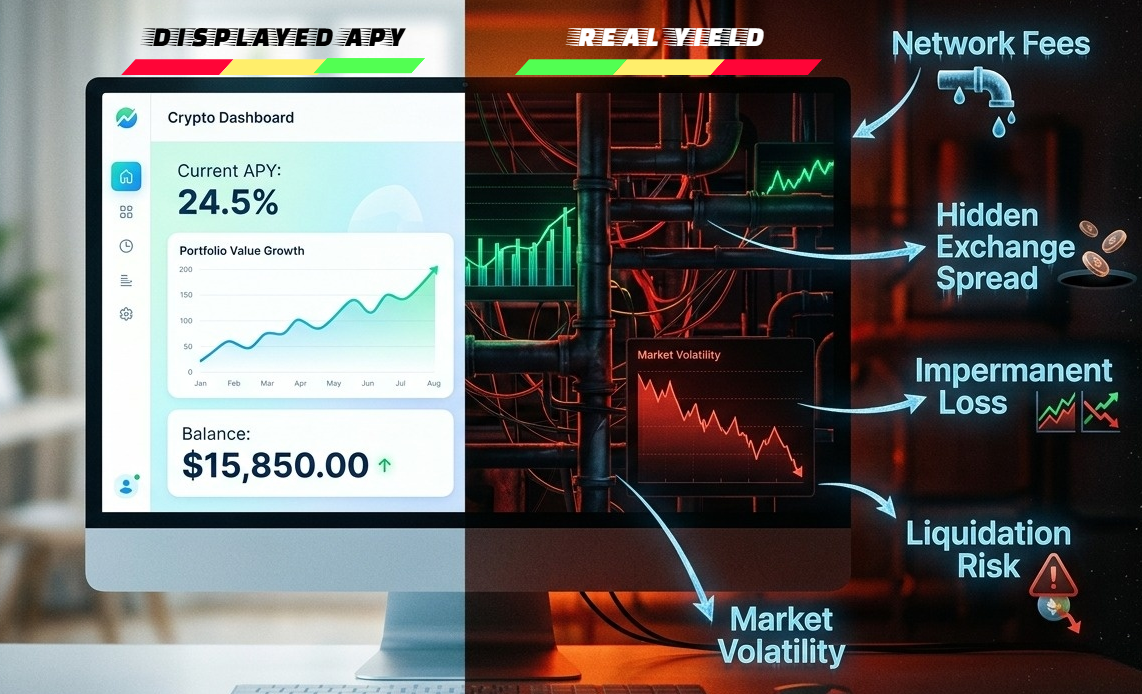
In the neon-glow of a DeFi dashboard, yield looks like a promise. You see a triple-digit APY, a “Deposit” button, and a simple flow that suggests wealth creation is a matter of clicks, not calculations. To the casual observer, DeFi yield is a magical perpetual motion machine: put assets in, watch numbers go up.
But beneath the polished UI lies a complex reality. Yield looks simple on the surface, but the machinery underneath is a high-stakes engine of risk, cost, and competition.
Breaking Down the Gap: The “Hidden Tax” on APY
The number displayed on your screen is rarely the number that hits your wallet. The gap between displayed yield and realized return is often a chasm carved out by factors many users overlook:
- Gross vs. Net Return: Dashboards rarely account for gas fees, protocol fees, or the cost of compounding.
- Impermanent Loss (IL): In liquidity pools, if the price of your assets diverges significantly, the “yield” you earned might not even cover the value you lost compared to just holding the assets.
- Execution Friction: Slippage during entry and exit can eat 1–2% of your principal instantly, requiring months of yield just to break even.
- Volatility Impact: A 50% APY on a token that drops 80% in value is a net loss.
When these factors are modeled, that shimmering 100% APY often compresses into a modest 5% net return — or worse, a quiet deficit.
Where Does the Money Actually Come From?
To find sustainable yield, you have to follow the value. Not all yield is created equal, and understanding the source is the first step to safety.
SourceSustainabilityCharacterization Trading Fees HighOrganic revenue from DEX volume.Lending Activity HighInterest paid by borrowers (often for leverage).Arbitrage/Liquidations MediumCapturing market inefficiencies; highly competitive. Incentives/Emissions LowOften “printed” tokens used to bootstrap liquidity; dilutive over time.
Export to Sheets
Sustainable yield is a share of actual economic activity. Temporary yield is often just a marketing budget disguised as a return.
The Hidden Value Transfer: Are You the Yield?
There is an old adage in poker: If you’ve been at the table for thirty minutes and you don’t know who the sucker is, it’s you.
In DeFi, if you don’t understand where the yield comes from, you might be the one subsidizing the system. You are “the yield” when you:
- Provide liquidity in high-volatility pairs without hedging.
- Chase high emissions while absorbing the downside of a crashing governance token.
- Participate in complex vaults without modeling the “worst-case” exit scenario.
In these cases, you aren’t just an investor; you are a risk-absorber for more sophisticated actors who are happy to pay you a small percentage to take the hit on their behalf.
Why Outcomes Differ: Chasers vs. Engineers
Two users can deposit into the exact same protocol and walk away with vastly different results.
- The Yield Chaser optimizes for the highest starting number. They ignore gas costs and exit liquidity, often “farming” themselves into a corner.
- The Yield Engineer analyzes the structure. They model net returns, account for rebalancing costs, and institutionalize their approach to risk.
The difference isn’t luck; it’s infrastructure and understanding.
The Shift Toward Engineered Yield
DeFi is moving away from the era of “yield chasing” and toward yield engineering. This evolution treats DeFi not as a casino, but as a sophisticated financial layer that requires:
- Continuous Modeling: Predicting outcomes based on price movement.
- Active Risk Management: Automated stops and hedges.
- Net-Positive Optimization: Focusing on what you keep, not what the dashboard shows.
Enter Concrete Vaults
This is where Concrete changes the game. Understanding the math is one thing; executing it 24/7 is another. Concrete Vaults bridge the gap by providing the infrastructure needed to turn “guessing” into “structured exposure.”
Concrete Vaults help solve the complexity problem by:
- Automating Allocation: Moving capital to where it is most efficient.
- Managing Strategies: Executing complex rebalancing that would be too costly or time-consuming for individuals.
- Reducing Manual Error: Eliminating the “fat-finger” risks and timing mistakes that plague manual farming.
The Core Insight
Yield is not just a single, static number. It is a formula:
Real Yield=(Revenue−Costs)±Risk Adjustment
When you stop looking at APY as a “gift” and start seeing it as a calculated net return, you stop being a participant in someone else’s strategy and start building your own.
Explore the future of engineered yield at app.concrete.xyz.