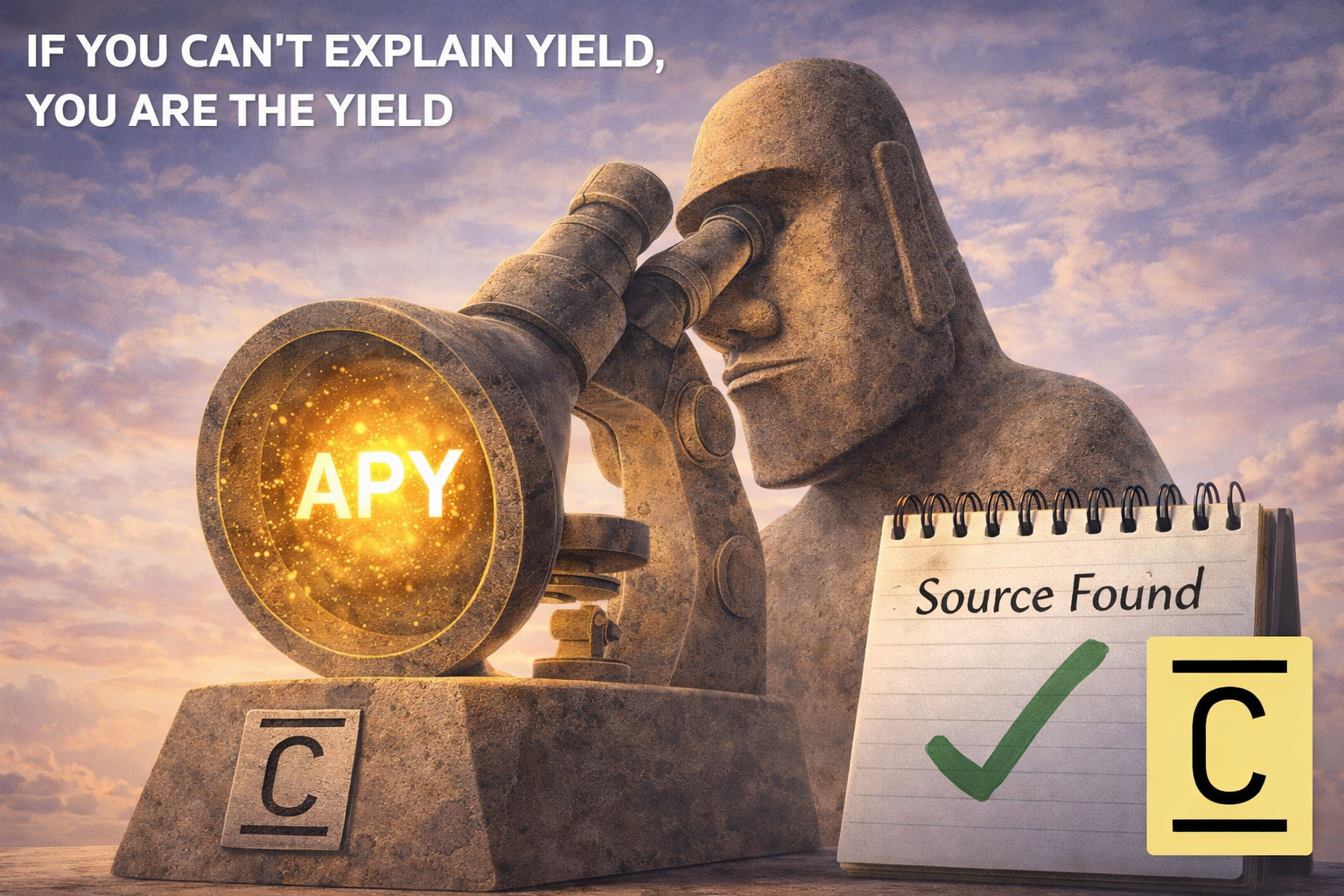
If You Can’t Explain Yield, You Are the Yield
 eliz4 min read·1 hour ago
--
DeFi Looks Simple — But What Are You Missing?
DeFi has mastered one thing exceptionally well:
Making complexity feel invisible.
You open an app.
You see a clean dashboard.
You click “Deposit.”
And suddenly — you’re earning yield.
No paperwork.
No intermediaries.
No friction.
It feels like finance has finally been simplified.
But that simplicity is, in many cases, carefully constructed.
Because beneath every “easy” yield opportunity lies a system that is anything but simple.
The Surface Experience
Today’s DeFi interfaces are designed for clarity:
- APYs update in real time
- Positions are visualized cleanly
- Earnings appear to compound automatically
From the outside, the process looks almost trivial:
Deposit → Earn → Withdraw
No need to understand market structure.
No need to think about counterparties.
No need to model outcomes.
But this is exactly where most users go wrong.
Because what you see is not the full system.
It’s just the interface layer.
The Hidden Complexity Behind Yield
Every yield-generating strategy in DeFi operates on underlying mechanics.
And those mechanics introduce variables that dashboards rarely show:
1. Gross vs. Net Yield
The APY displayed is almost always gross.
What you actually take home is net — after:
- fees
- slippage
- rebalancing costs
- volatility impact
That difference is where expectations break.
2. Impermanent Loss
Providing liquidity exposes you to price divergence.
Even if you earn fees, your position may:
- underperform holding
- lose relative value
In volatile markets, this effect can dominate your returns.
3. Execution Friction
Strategies assume ideal conditions.
Reality includes:
- liquidity constraints
- spread
- timing inefficiencies
Even small inefficiencies compound over time.
4. Volatility and Path Dependency
Returns in DeFi are not linear.
They depend on:
- how prices move
- when they move
- how your position reacts
Two users in the same pool can end with different outcomes.
So Where Does the Yield Come From?
Yield is not generated out of thin air.
It is sourced from real economic activity:
- Trading fees paid by users swapping assets
- Borrowing demand in lending markets
- Arbitrage opportunities across price gaps
- Liquidations in leveraged systems
- Token incentives and emissions
Each source has different characteristics.
Some are:
- sustainable
- tied to real usage
Others are:
- temporary
- dependent on incentives
- sensitive to market conditions
Understanding this distinction is critical.
Because not all yield is equal.
What You Might Be Missing
If you interact with DeFi purely through the interface, you may never ask:
- Who is paying for this yield?
- What risks am I absorbing?
- What happens if conditions change?
And that leads to a deeper issue:
You may be participating without understanding the system you are in.
The Hidden Transfer of Value
Markets are not neutral.
They redistribute value.
And in DeFi, that redistribution is often subtle.
If you don’t understand the structure, you may be:
- providing liquidity that others arbitrage
- earning incentives while taking downside risk
- entering positions without modeling outcomes
In other words:
You may think you are earning yield —
but you may actually be enabling someone else to earn it.
This is the underlying tension:
If you can’t explain the yield, you are the yield.
Same Protocol, Different Results
Not all participants experience the same outcome.
Some users:
- chase the highest APY
Others:
- analyze cost, structure, and sustainability
More advanced participants:
- simulate scenarios
- model expected returns
- manage risk dynamically
They all interact with the same systems.
But they extract very different results.
The difference is not access.
It’s understanding.
The Shift Toward Engineered Yield
DeFi is evolving beyond surface-level simplicity.
We are moving from:
yield chasing → yield engineering
This shift involves:
- understanding where returns originate
- modeling net outcomes
- managing risk exposure
- optimizing strategies over time
Yield is no longer something you passively receive.
It’s something you actively design.
From Guessing to Structured Exposure
To navigate this complexity, users need more than intuition.
They need systems.
Concrete Vaults are built to address this gap by:
- automating capital allocation
- executing structured strategies
- rebalancing positions efficiently
- reducing manual decision errors
Instead of relying on simplified interfaces, users gain:
structured exposure to underlying yield mechanisms
👉 Explore Concrete at app.concrete.xyz
The Reality Behind Simplicity
DeFi looks simple because the interface hides the complexity.
But the complexity doesn’t disappear.
It just moves out of sight.
And when it’s out of sight, it’s often misunderstood.
Final Thought
Simplicity is powerful.
But in financial systems, it can also be misleading.
Because behind every clean dashboard is a set of assumptions, risks, and trade-offs.
If you don’t see them, you’re not avoiding complexity.
You’re ignoring it.
And in markets like DeFi:
What you don’t understand doesn’t disappear —
it just shows up in your results.