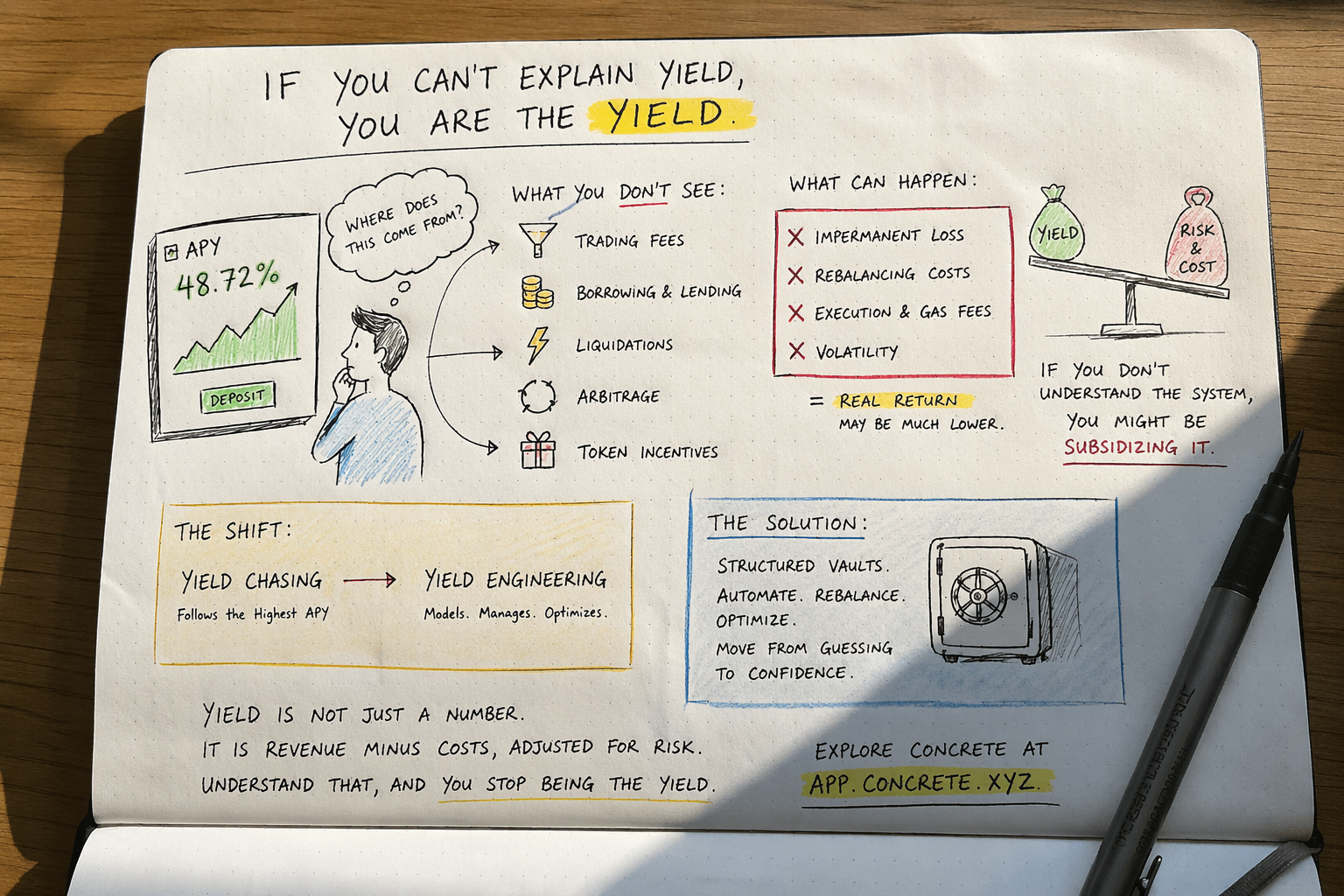
If You Can’t Explain Yield, You Are the Yield
--
DeFi made yield look simple.
Too simple.
You open a dashboard, see a number, and it feels obvious what to do.
APYs are updating. Returns look like they’re compounding. Everything feels… smooth.
Deposit → earn → repeat.
But most people stop there.
They don’t ask the one question that actually matters:
Where is that yield coming from?
Because in markets, there’s a harsh reality:
If you don’t understand the source of your return, you’re probably the one providing it.
1. The Illusion
Right now, yield in DeFi is presented like it’s plug-and-play.
You deposit your assets.
You see a high APY.
You assume it works in your favor.
That’s it.
No deep breakdown. No real explanation. Just a number that looks attractive enough to click.
And yeah — at first, it feels like easy money.
But that simplicity is mostly on the surface.
Underneath, it’s way more complex than it looks.
2. The Gap Between Displayed and Real Yield
That APY you see?
It’s usually not what you actually earn.
It’s closer to a gross number, not your real outcome.
Once you go deeper, you start noticing things that eat into that return:
- Impermanent loss
- Rebalancing costs
- Execution friction
- Slippage
- Volatility
Individually, they don’t look scary.
Combined? They change everything.
A strategy showing 40% APY can end up way lower once all of this kicks in.
Sometimes it even flips negative.
The dashboard shows stability.
Reality doesn’t always.
3. Where Yield Actually Comes From
Yield doesn’t just appear.
It comes from somewhere — always.
In DeFi, that usually means:
- Trading fees
- Lending activity
- Arbitrage
- Liquidations
- Incentives / emissions
But here’s the important part:
Not all yield is the same.
Some is backed by real activity.
Some is just temporary incentives keeping the system attractive.
If you can’t tell the difference, you’re not really evaluating yield.
You’re just reacting to numbers.
4. Hidden Value Transfer
This is where it gets real.
If you don’t understand how the system works, there’s a good chance you’re the one making it work for someone else.
That might look like:
- Providing liquidity without understanding the risk
- Earning incentives while absorbing downside
- Joining a strategy without thinking through outcomes
Nothing feels wrong at first.
You still see green numbers.
You still see yield.
But under the hood, value is moving.
And not always toward you.
That’s the idea behind this:
If you can’t explain yield, you are the yield.
5. Why Outcomes Differ
Not everyone gets the same result in DeFi.
Even using the same protocol.
Why?
Because people approach it differently.
- Some chase the highest APY
- Some try to understand cost and risk
- Some actually model what could happen before they deploy
Same system.
Different mindset.
Different outcome.
The difference isn’t luck.
It’s understanding.
6. The Shift Toward Engineered Yield
DeFi is changing.
Slowly, but clearly.
It’s moving from:
yield chasing → yield engineering
Which basically means:
- Thinking before deploying capital
- Managing risk instead of ignoring it
- Optimizing over time
- Focusing on what you keep, not what’s displayed
At that point, the question changes.
It’s no longer:
“What’s the highest APY?”
It becomes:
“What’s the most efficient way to deploy capital?”
7. Concrete Vaults as Structured Infrastructure
This is where structure starts to matter.
Instead of jumping between opportunities manually, systems like Concrete Vaults are built to handle that complexity.
They help by:
- Automating allocation
- Managing strategies
- Rebalancing positions
- Reducing execution mistakes
So instead of guessing, you’re working with a more structured setup.
Less reactive. More intentional.
👉 Explore Concrete at app.concrete.xyzhttps://app.concrete.xyz/earn
8. The Core Insight
At the end of the day, yield isn’t just a number.
It’s:
- Revenue
- Minus cost
- Adjusted for risk
Once you understand that, everything changes.
You stop chasing APY.
You start asking better questions.
You become more deliberate with your capital.
Because in DeFi, like in any market: