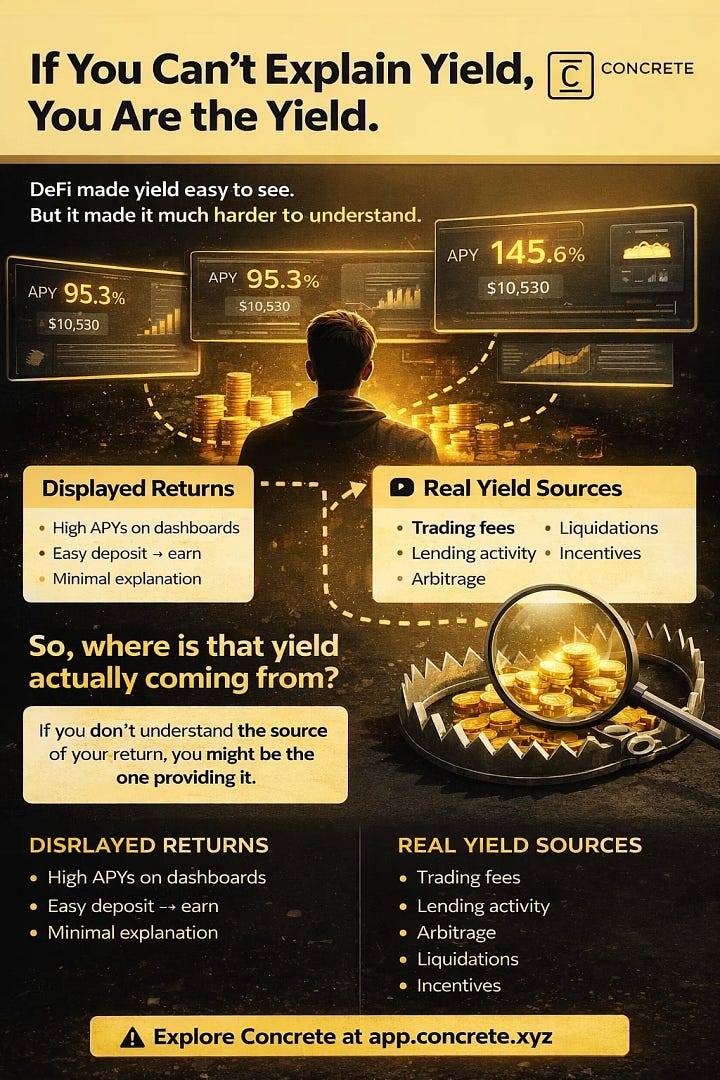
If You Can’t Explain Yield, You Are the Yield
--
The Yield Illusion: From Chasing APY to Engineering Returns
In the fast-paced world of Decentralized Finance (DeFi), yield is the primary magnet. However, the gap between the flashy numbers on a dashboard and the actual profit in your wallet is often wider than it appears. To succeed in the next era of on-chain finance, we must look past the interface and understand the machinery beneath.
The Illusion of Simplicity
Walk into almost any DeFi protocol today and you are met with a seductive sight: triple-digit APYs pulsing on a dashboard. The user flow is engineered to be frictionless — just a simple “Deposit” button stands between you and high-velocity returns.
In this “one-click” culture, the complexity of the underlying return is often stripped away. You see a number, but you rarely see the mechanics. This simplicity is the “Yield Illusion” — the belief that the number on the screen is a guaranteed, static outcome.
Breaking Down the Gap: Why the Number Lies
The reality is that yield is rarely a flat rate; it is a moving target. Several factors often compress a high advertised APY into a much smaller real return:
- Gross vs. Net Return: Dashboards show gross yield, but they often ignore gas fees, protocol performance fees, and slippage.
- Impermanent Loss (IL): In liquidity pools, if the price of your assets diverges significantly, the loss in value can easily outpace the fees you earned.
- Execution Friction: Frequent rebalancing or moving capital between pools incurs costs that eat into your principal.
- Volatility Impact: High yield in a crashing asset still results in a net loss of purchasing power.
Where Does Yield Actually Come From?
To separate the sustainable from the speculative, you must identify the source. Not all yield is created equal:
- Productive Yield: Derived from actual utility, such as trading fees from volume, interest from lending activity, or profits from liquidations and arbitrage.
- Incentive Yield: Often called “emissions,” these are tokens distributed by a protocol to bootstrap liquidity. While lucrative, this is often temporary and can lead to dilution.
The Golden Rule: If you can’t identify where the money is coming from, you are the one paying for it.
The Hidden Value Transfer
In DeFi, if you don’t understand the system, you may be the one subsidizing it. Uninformed liquidity providers often act as “exit liquidity” or “risk sponges.”
By providing liquidity without modeling outcomes, you might be earning a 20% incentive while unknowingly absorbing a 30% downside risk. In these scenarios, the sophisticated player isn’t just earning yield — they are extracting value from those who haven’t accounted for the risks they are taking.
Why Outcomes Differ: Luck vs. Strategy
Two users can deposit into the exact same protocol and walk away with vastly different results.
- The Chaser: Optimizes for the highest displayed APY, ignoring structure and exit costs.
- The Engineer: Analyzes the cost of capital, models risk, and focuses on the net-net return.
Institutions don’t “chase” yield; they model it before a single dollar is deployed. The difference in their success isn’t luck — it’s understanding the architecture of the trade.
The Shift Toward Engineered Yield
We are currently moving away from the era of “yield chasing” and toward yield engineering. This evolution focuses on:
- Precision Modeling: Predicting outcomes based on various market conditions.
- Active Risk Management: Protecting the downside rather than just boosting the upside.
- Net Optimization: Factoring in every basis point of cost to ensure the final result is positive.
How Concrete Vaults Bridge the Gap
This level of engineering is difficult for the individual user to maintain manually. This is where Concrete Vaults come in. Concrete provides the infrastructure to move from “guessing” to “structured exposure” by:
- Automating Allocation: Moving capital to where it is most efficient.
- Managing Complex Strategies: Handling the “under-the-hood” mechanics that individuals often miss.
- Reducing Manual Errors: Eliminating the execution friction that kills performance.
By using automated vault infrastructure, users can finally access institutional-grade strategies without needing a team of quantitative analysts.
The Core Insight
Yield is not just a number on a screen. True yield is a calculation:
Revenue — Cost — Risk = Real Yield
Understanding this formula changes your entire approach to DeFi. It transforms you from a spectator into a participant who understands the value they provide — and the value they deserve to keep.
Ready to move beyond the illusion? Explore the future of structured yield at app.concrete.xyz.