If You Can’t Explain Yield, You Are the Yield.
--
In the early days of DeFi, yield was a mystery. Today, it’s an obsession.
Open any decentralized exchange or lending protocol, and you are greeted by the same sight: flashing green numbers, real-time APY updates, and “one-click” deposit buttons. DeFi has succeeded in making yield visible, but in doing so, it has made it much harder to understand.
Most users treat APY like a high-interest savings account. But in a market governed by code and liquidity, there is no such thing as “free” money.
If you want to survive the next cycle, you need to ask the most uncomfortable question in finance: Where is this money actually coming from?
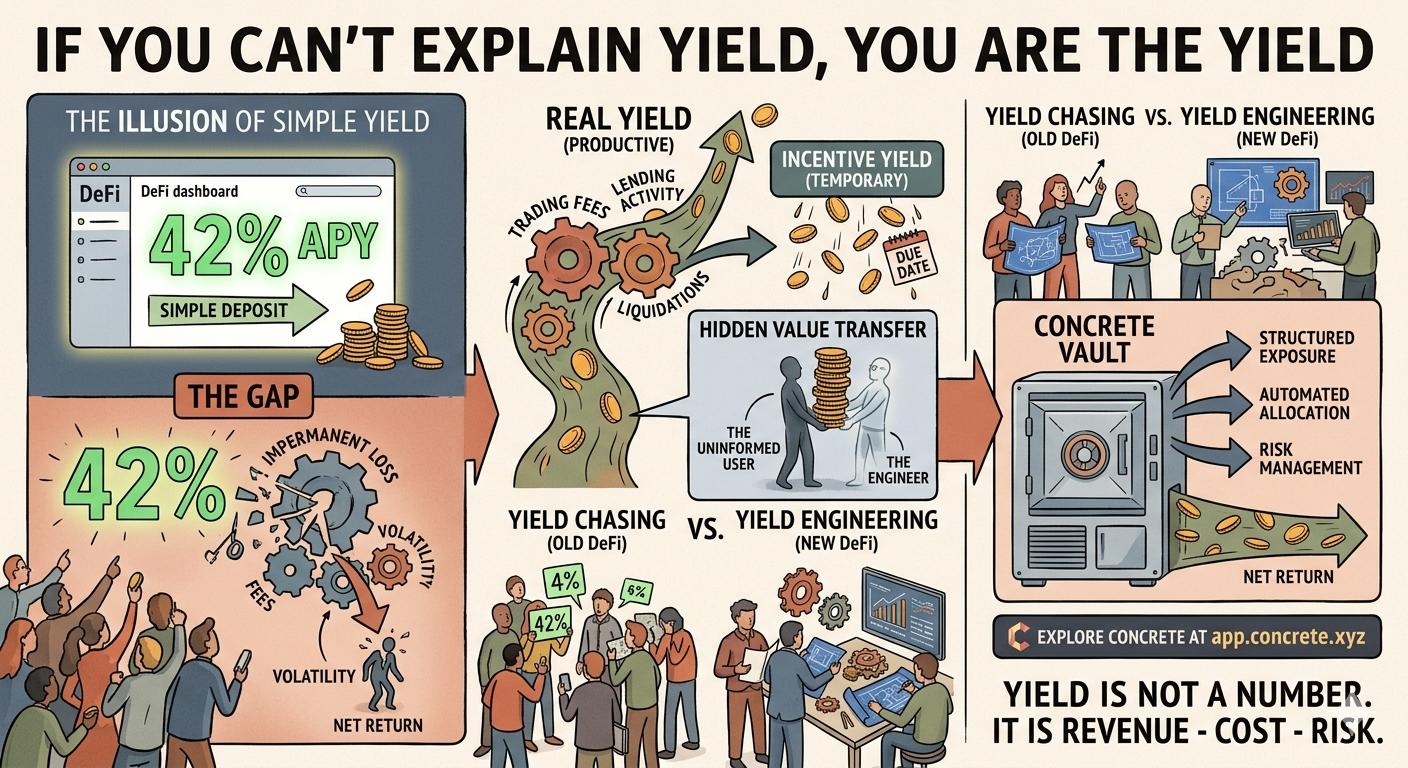
1. The Illusion of the Dashboard
The modern DeFi dashboard is a masterpiece of simplification. It hides the gears and wires of financial engineering behind a sleek interface.
- The Promise: High APY, simple flows, and auto-compounding magic.
- The Reality: Underneath that “20% APY” lies a complex web of liquidations, arbitrage, and token inflation.
When the interface is too simple, it lulls you into a false sense of security. You see the result, but you don’t see the process. And in markets, the process is where the risk lives.
2. The Gap: Why “Display Yield” is a Lie
There is a massive difference between the number on your screen and the money in your wallet. To find your Real Yield, you have to subtract the “invisible” costs that dashboards conveniently ignore:
- Impermanent Loss: The cost of being a liquidity provider in a volatile market.
- Execution Friction: Slippage and gas fees that eat your principal before you even start earning.
- Gross vs. Net: A 50% APY in a token that is devaluing by 10% a week is actually a net loss.
The Insight: A high APY is often just a premium paid to you for taking on a risk you haven’t modeled yet.
3. The Anatomy of Real Yield
Sustainable yield isn’t “printed.” It is earned. To know if your yield is real, you must map it to one of these four sources:
- Utilization Fees: People paying to borrow your capital (Lending).
- Service Fees: People paying you to facilitate their trades (LPs).
- Efficiency Gains: Capturing value by fixing price gaps (Arbitrage & Liquidations).
- Incentives (The “Red Flag”): Protocols paying you in their own token to stay. This is “temporary” yield — it’s a marketing budget, not a business model.
4. The Hidden Value Transfer
This is the core tension of DeFi. If you don’t understand how the system works, you are likely the one subsidizing it.
- Are you providing liquidity without understanding delta risk? You are subsidizing arbitrageurs.
- Are you farming high-emission tokens without a hedge? You are subsidizing the protocol’s exit liquidity.
When you participate in a system without modeling the outcomes, you aren’t an investor. You are a backstop for someone more sophisticated than you.
5. From Yield Chasing to Yield Engineering
The “Wild West” era of DeFi is ending. The future belongs to Yield Engineering.
The difference is simple:
- Yield Chasers look for the highest number.
- Yield Engineers look for the best risk-adjusted structure.
This shift requires moving away from manual “guessing” and toward Concrete Vault Infrastructure. Tools like Concrete Vaults are designed to close the gap by:
- Automating Strategy: No more manual rebalancing.
- Risk Modeling: Ensuring the strategy accounts for volatility before you deploy.
- Net-Positive Focus: Optimizing for what you keep, not just what you see.
The Bottom Line
Yield is not a gift. It is Revenue minus Cost, adjusted for Risk.
When you stop looking at DeFi as a “magic money tree” and start looking at it as a series of engineered financial flows, your results will change.
Don’t be the yield. Own the system.