If You Can’t Explain Yield, You Are the Yield.
--
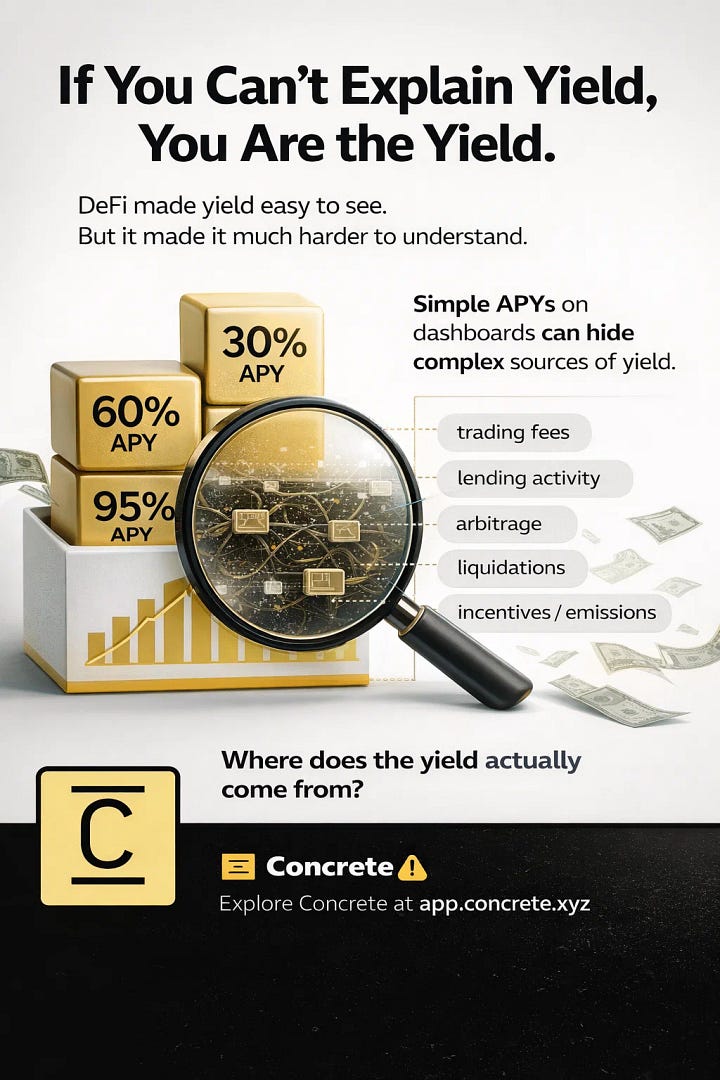
DeFi made yield easy to see. But it made it much harder to understand.
Walk through any decentralized finance protocol today and you’ll find yourself staring at a dashboard of dreams: neon greens, flashing numbers, and APYs that update in real-time. To the casual observer, it looks like a money machine. You deposit, you wait, and the numbers go up.
But there is a fundamental law in markets that many learn only after it’s too late: Yield is never “free.” It is a payment for something — risk, liquidity, or complexity. If you don’t know which one you are providing, you might be providing the most expensive thing of all: yourself.
1. The Great Illusion: The Dashboard vs. Reality
The modern DeFi user experience is a masterclass in simplification. It’s designed to be “One-Click”:
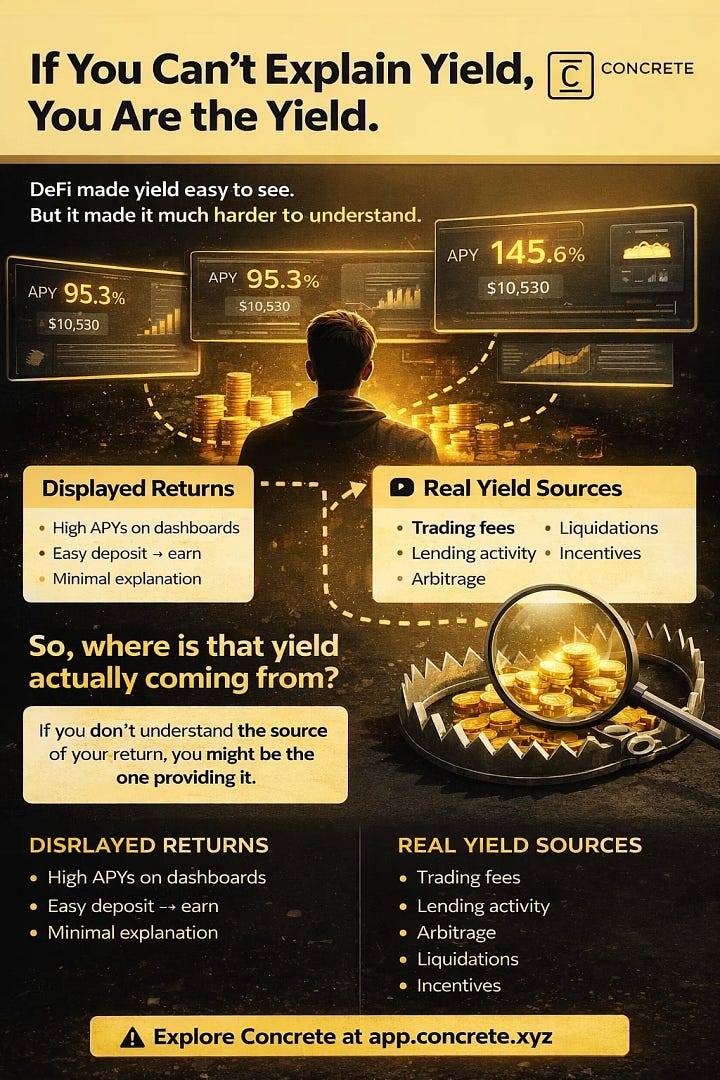
- High APYs displayed in bold.
- Simple Deposit → Earn flows.
- Minimal context on where the value originates.
On the surface, it’s beautiful. Underneath, it’s a chaotic engine of volatility and shifting incentives. The illusion is that the number on your screen is a guaranteed outcome, when in reality, it is merely a projection based on current conditions that could change in a heartbeat.
2. The Gap: Why “Displayed Yield” Isn’t “Real Yield”
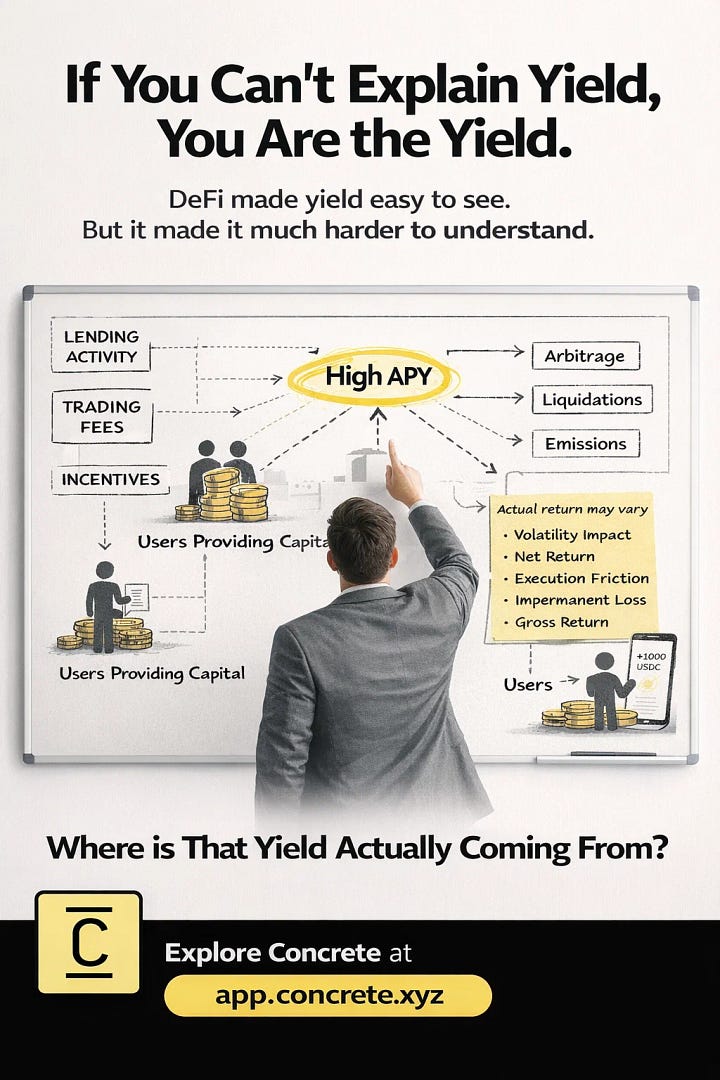
The gap between the number on the dashboard and the money in your wallet at the end of the month is often wider than users realize. To find the Real Yield, you have to subtract the invisible costs:
- Impermanent Loss (IL): The “invisible” cost that occurs when the price ratio of your deposited assets shifts significantly compared to when you first provided liquidity.
- Rebalancing Costs: The “tolls” — consisting of gas fees and slippage — that you pay every time you move your assets to keep them within an efficient profit range.
- Execution Friction: A hidden tax extracted by bots and MEV (Maximal Extractable Value) during the moments you enter or exit a position.
- Volatility Impact: The harsh reality where a 50% APY means nothing if the underlying asset’s value drops by 60% against the dollar.
When you account for these, a “triple-digit” return can quickly compress into a single digit — or even a net loss.
3. The Source: Where Does the Money Actually Come From?
To survive in DeFi, you must be able to categorize the source of your return. Broadly speaking, yield comes from two places:
Sustainable Sources (Revenue-Based):
- Trading Fees: You are paid for facilitating commerce.
- Lending Activity: You are paid interest by borrowers.
- Liquidations: You are paid for helping maintain the protocol’s health.
Temporary Sources (Incentive-Based):
- Emissions: The protocol is printing its own token to “buy” your liquidity.
- Arbitrage: You are providing a bridge that others pay to cross.
The takeaway: If the yield is coming purely from emissions, you aren’t “investing”; you are participating in a marketing campaign.
4. Hidden Value Transfer: Are You the Subsidy?
In every trade, there is a winner and a counterparty. If you are providing liquidity without a strategy, you are often the subsidy for a more sophisticated actor.
- If you don’t understand the range of your liquidity, you are subsidizing the arbitrageur’s profit.
- If you are chasing incentives without modeling the downside, you are providing “exit liquidity” for early stakers.
In DeFi, if you don’t understand the system, you aren’t a participant — you are a resource.
5. Why Outcomes Differ: Luck vs. Engineering
Two users can deposit into the exact same pool and walk away with vastly different results.
- The Yield Chaser: Looks for the highest number, deposits blindly, and hopes for the best.
- The Yield Engineer: Analyzes the structure, models the risk, and accounts for cost of capital.
Institutions don’t “chase” APY; they model outcomes. They understand that the difference between success and failure in DeFi isn’t the entry point — it’s the management of the position over time.
6. The Shift Toward Engineered Yield
We are moving away from the era of “Yield Chasing” and into the era of Yield Engineering. This means moving away from “hoping the number stays green” and moving toward:
- Systemic Risk Management: Protecting the principal first.
- Optimizing Net Returns: Focusing on what you keep, not what the dashboard says.
- Dynamic Allocation: Moving assets based on mathematical models, not FOMO.
7. Solving the Complexity with Concrete Vaults
This is where the manual burden of DeFi becomes too much for the average person to handle. Concrete Vaults are designed to bridge this gap, moving users from “guessing” to “structured exposure.”
Concrete Vaults help solve the “yield identity” problem by:
- Automating Allocation: Moving assets to where they are most productive.
- Managing Strategies: Executing complex rebalancing that would be too costly or difficult for a manual user.
- Reducing Manual Errors: Eliminating the “fat-finger” risks and execution friction that eat into returns.
By using a structured vault, you aren’t just a liquidity provider; you are a participant in an engineered strategy.
8. The Core Insight
At the end of the day, Yield is not just a number. It is a simple equation:
Revenue — Cost — Risk = Yield
Understanding this equation changes your entire approach to DeFi. It moves you from a passive victim of market volatility to an active participant in a new financial system.
Stop being the yield. Start engineering it.
🚨 Ready to move beyond the dashboard?
Explore Concrete at app.concrete.xyz