ICT Trading Method Explained: The Complete Guide to Michael Huddleston’s Inner Circle Trader Strategy
 Scarlett8 min read·1 hour ago
--
If you’ve spent any time in trading communities recently, you’ve almost certainly come across the term ICT — short for Inner Circle Trader. Developed by Michael J. Huddleston, ICT is one of the most comprehensive and widely studied trading methodologies in the modern retail trading world, attracting over 1.8 million YouTube subscribers and a global community of dedicated students.
But what exactly is ICT trading, and why has it become so influential? In this complete guide, we’ll break down everything you need to know about the ICT trading method — from its foundational philosophy to its most powerful setups — so you can decide whether it’s the right approach for your trading journey.
Who Is Michael J. Huddleston (ICT)?
Michael J. Huddleston, better known online as ICT (Inner Circle Trader), is an American trader and educator who has spent over 30 years in the financial markets. He is primarily focused on indices trading — including the NASDAQ, S&P 500, and Dow Jones — as well as forex markets.
Huddleston built his reputation by sharing his private teachings freely on YouTube, where he claims the material reveals how institutional market participants truly move price. His stated mission is to give retail traders access to the same framework used by banks, hedge funds, and algorithmic systems.
Key fact: ICT is not a paid indicator or software system. It is a framework — a way of thinking about and reading markets.
The Core Philosophy: Smart Money Concepts (SMC)
At the heart of the ICT methodology is a single, powerful idea:
Markets are not random. Price is delivered algorithmically by large institutions — and retail traders are the liquidity these institutions need.
This philosophy is commonly called Smart Money Concepts (SMC). Rather than using lagging indicators like RSI or MACD, ICT teaches traders to read the “footprints” left behind by institutional activity. Once you understand where institutions are placing orders — and why price moves to specific levels before reversing — you can align your trades with the “smart money” instead of being on the losing side of their moves.
Key ICT Concepts Explained
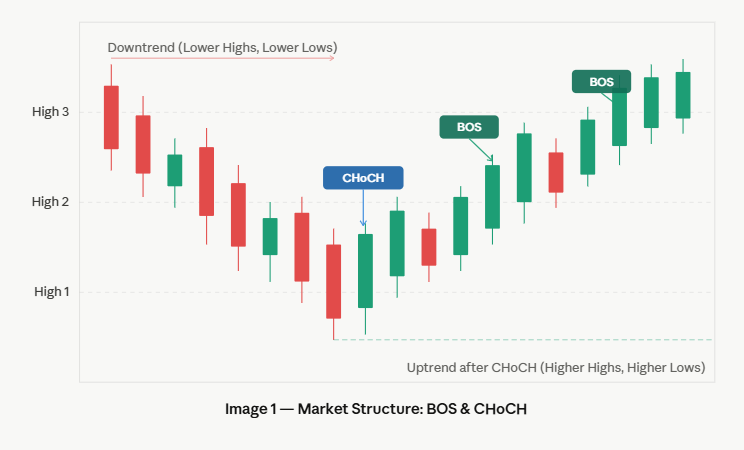
1. Market Structure (BOS & CHoCH)
Market structure is the foundation of ICT analysis. Before any trade is considered, ICT traders first identify the directional bias of the market on higher timeframes.
Break of Structure (BOS): When price breaks above a previous high (in an uptrend) or below a previous low (in a downtrend), this confirms trend continuation.
Change of Character (CHoCH): A shift in market behavior — such as when a downtrending market begins making higher highs — signals a potential reversal.
Why it matters: Understanding market structure prevents you from trading counter-trend at the wrong time. ICT always emphasizes: trade in the direction of the higher timeframe narrative.
2. Liquidity Pools & Liquidity Sweeps
One of the most revolutionary concepts in ICT is liquidity. Huddleston teaches that institutional players need large amounts of liquidity to fill their orders. Where does that liquidity exist? Where retail traders park their stop-loss orders.
Common liquidity pools include:
- Equal highs and equal lows (where many retail traders place stops)
- Previous day/week highs and lows
- Trendlines (retail traders cluster stops below/above these)
Institutions “sweep” these levels — pushing price into liquidity zones to trigger stop orders and fill their own large positions — before reversing in the opposite direction. Recognizing these liquidity grabs is one of the most profitable skills an ICT trader develops.
3. Order Blocks (OB)
An Order Block is a specific price zone where a large institutional order was placed. These zones act as future support or resistance and are often revisited by price, providing high-probability entry opportunities.
Bullish Order Block: The last bearish (down) candle before a significant bullish move. When price returns to this zone, it may bounce higher.
Bearish Order Block: The last bullish (up) candle before a significant bearish move. When price returns to this zone, it may reverse lower.
Order blocks are arguably the most widely used ICT concept. They work across all timeframes and all liquid markets — forex, indices, and crypto.
4. Fair Value Gaps (FVG)
A Fair Value Gap is a three-candle pattern where a rapid price movement creates an imbalance between supply and demand — essentially a “gap” in price delivery. These gaps appear when price moves so aggressively that not enough orders are filled at intermediate price levels.
ICT teaches that markets are drawn back to fill these imbalances. When price returns to an FVG, it often provides an entry opportunity in the direction of the original move.
Bullish FVG: Gap created during a sharp upward move — often acts as support on a retest.
Bearish FVG: Gap created during a sharp downward move — often acts as resistance on a retest.
5. Premium & Discount Zones
ICT divides the trading range between any two significant swing points into three zones using a Fibonacci-style framework:
Premium Zone (above 50%): Price is expensive. In an uptrend, institutions buy in the discount zone and distribute (sell) in the premium zone.
Equilibrium (50% level): The midpoint — a neutral zone.
Discount Zone (below 50%): Price is cheap. This is where ICT traders look for buy entries when the higher timeframe trend is bullish.
This concept prevents traders from “buying the top” or “selling the bottom.”
6. Kill Zones — Optimal Trading Times
Not all hours of the trading day are equal. ICT identifies specific windows — called Kill Zones — during which institutional activity is at its highest and the highest-probability setups occur.
Kill ZoneTime (EST)Best ForLondon Open2:00 AM — 5:00 AMForex pairs (GBP, EUR)New York Open7:00 AM — 9:00 AMIndices (NQ, ES) + ForexNew York AM8:30 AM — 11:00 AMHighest volatility windowLondon Close10:00 AM — 12:00 PMReversal setups
Trading outside Kill Zones during choppy, low-volume sessions is one of the most common mistakes ICT students make.
7. Optimal Trade Entry (OTE)
The Optimal Trade Entry is ICT’s precision entry technique. After a liquidity sweep and a shift in market structure, ICT traders use a specific Fibonacci retracement tool to find the ideal entry zone — typically between the 61.8% and 79% retracement of the previous swing.
This technique maximizes the risk-to-reward ratio by entering as close as possible to the “smart money” entry point rather than chasing price.
8. Power of 3 — The AMD Model
One of ICT’s most elegant concepts is the Power of 3, also called the AMD model:
Accumulation: Smart money builds its position quietly, often in a range.
Manipulation: Price sweeps a liquidity level (a “fakeout”) to trigger retail stops and fill institutional orders.
Distribution: Price moves in the true intended direction, with institutions taking profit.
This pattern appears on every timeframe — from a single 15-minute session to weekly market structure — making it one of the most versatile tools in the ICT toolkit.
9. ICT Silver Bullet
The ICT Silver Bullet is a specific intraday trading model that targets three 1-hour windows each day:
- 3:00 AM — 4:00 AM EST
- 10:00 AM — 11:00 AM EST
- 2:00 PM — 3:00 PM EST
During these windows, ICT traders look for a Fair Value Gap to form after a liquidity sweep, then enter in the direction of the higher timeframe bias. It is one of the most popular ICT models because of its simplicity and repeatability.
How to Apply ICT: A Step-by-Step Framework
Here is a simplified version of how ICT traders approach a trade:
Step 1 — Define the Higher Timeframe Bias Start on the daily or 4-hour chart. Identify whether price is in an uptrend or downtrend. This defines your directional bias for the session.
Step 2 — Identify Key Liquidity Levels Mark equal highs/lows, previous day highs/lows, and any obvious areas where retail stop-losses would cluster.
Step 3 — Wait for a Liquidity Sweep Price moves into a liquidity pool, triggering stops. This is the “manipulation” phase of the AMD model.
Step 4 — Look for a Market Structure Shift (CHoCH) After the sweep, watch for a Change of Character on a lower timeframe (1-minute to 15-minute chart) to confirm the reversal.
Step 5 — Enter at an Order Block or FVG in the Premium/Discount Zone Look for a confluence of an Order Block or Fair Value Gap within the discount zone (for buys) or premium zone (for sells).
Step 6 — Set Stop and Target Place your stop-loss beyond the liquidity sweep. Target the next significant liquidity level or opposing premium/discount extreme.
What Markets Does ICT Work On?
ICT concepts are most effective in highly liquid markets:
- Forex: EUR/USD, GBP/USD, USD/JPY
- Indices: NASDAQ (NQ), S&P 500 (ES), Dow Jones (YM)
- Crypto: Bitcoin and Ethereum (with wider stop adjustments)
ICT is primarily an intraday and swing trading methodology, though the concepts scale to all timeframes.
Pros and Cons of the ICT Method
Pros
- Provides a logical, institutional explanation for price movements
- Works across multiple asset classes and timeframes
- Extensive free educational content available on YouTube
- High risk-to-reward setups when executed correctly
Cons
- Steep learning curve — typically 6 to 12 months before consistent application
- Highly subjective — two traders can read the same chart differently
- Risk of information overload given the volume of concepts
- Requires significant backtesting to build proficiency
Is ICT Trading Legitimate?
The ICT methodology has generated genuine debate in the trading community. Critics point out that many core ICT concepts — such as order blocks (similar to supply and demand zones) and market structure analysis — are rooted in classical technical analysis, repackaged under new terminology.
However, the framework’s popularity is undeniable. Thousands of traders worldwide report using ICT concepts profitably, particularly for intraday forex and index trading. The key is to approach it with realistic expectations: ICT is not a holy grail. It is a framework that requires disciplined study, rigorous backtesting, and consistent practice.
As Huddleston himself has stated, all the core concepts are available for free on his YouTube channel. There is no need to purchase expensive third-party courses to learn the basics.
Final Thoughts
The ICT trading method by Michael Huddleston is one of the most detailed and structured retail trading frameworks available today. If you are willing to invest the time — ideally 6 to 12 months of serious study and backtesting — ICT provides a genuine edge by helping you understand why price moves where it does, rather than simply reacting to lagging signals.
Start with the basics: market structure, liquidity, and the AMD model. Build from there. Use ICT’s free YouTube content before spending money on any course. And above all, focus on one concept at a time before moving to the next.
The markets reward patience and understanding — and the ICT methodology, at its best, is a powerful tool for developing both.