Most teams measure AI output — but the real ROI comes from iteration speed, validation cost, and decision quality
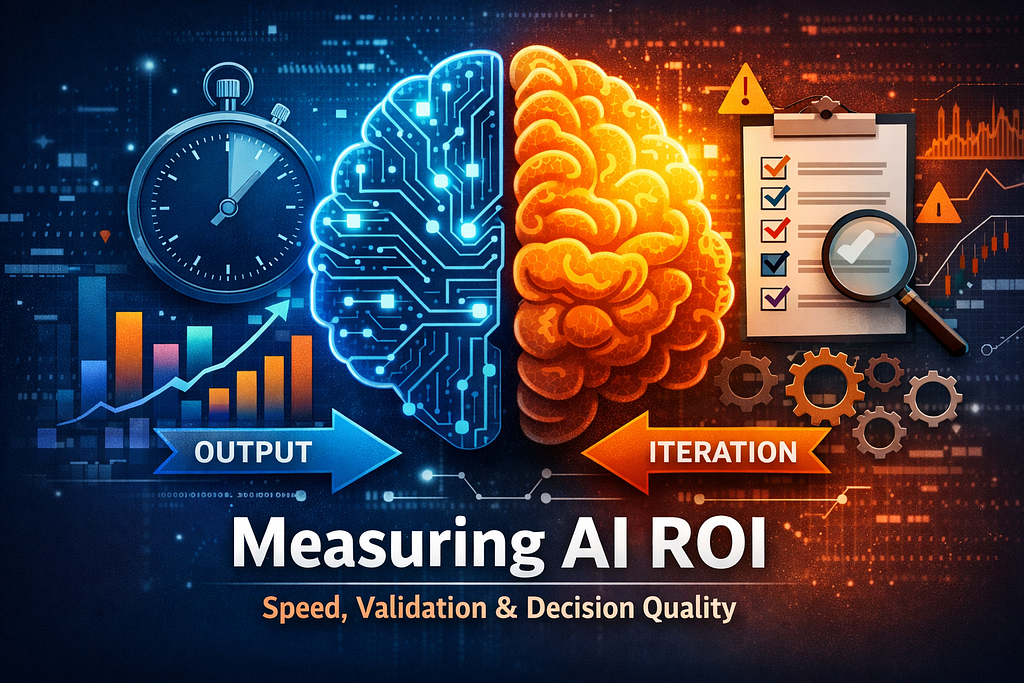
Over the past few weeks, I realized something uncomfortable: some of my “AI productivity gains” weren’t real — they just looked like it.
As AI tools rapidly move from experimentation to daily workflow, this gap between perceived and actual productivity is becoming harder to ignore.
Yes, I was producing more output, but I was also spending more time reviewing, correcting, and second-guessing it. In some cases, the net time savings were close to zero.
That observation led me to a more useful question: are we measuring AI productivity correctly — or just measuring output?
AI is not a productivity tool — it’s an iteration engine.
Most AI adoption strategies today are built around the wrong metric.
Most teams are not failing to adopt AI — they’re failing to apply it in the right parts of the workflow.
This perspective is especially relevant for knowledge workers, consultants, and teams integrating AI into daily workflows. While these observations are based on my experience, similar patterns are increasingly visible across comparable environments.
1. The Highest ROI: Reducing Time-to-First-Draft
The strongest and most reliable gains came from one place: starting.
Drafting a structured memo or article used to take 60–90 minutes to reach a usable first version; with AI-assisted outlining and drafting, that dropped to 20–30 minutes. In my experience, these gains become more consistent once you get comfortable prompting and iterating.
This is not a marginal improvement — it fundamentally changes how quickly work can begin, acting less as a content generator and more as a friction remover. In knowledge work, reducing that initial friction compounds across the entire workflow.
2. The Measurement Problem: Output vs. Iteration Speed
Most discussions about AI focus on output — more content, faster responses, higher volume. But output is a misleading metric; the real value shows up in iteration speed, or how quickly you can move from idea → draft → refinement.
AI doesn’t just make work faster — it makes iteration cheaper.
If AI reduces time-to-first-draft by 60% but increases validation effort by 30%, the net ROI depends entirely on how often outputs require revision.
This distinction matters because iteration, not initial output, is what ultimately drives quality in most knowledge work.
3. The “Speed vs. Accuracy” Tradeoff
Across multiple tasks in my workflow, a clear pattern emerged.
High ROI (speed-driven tasks):
- First drafts and outlining
- Summarization and synthesis
- Idea exploration
Low ROI (accuracy-driven tasks):
- Precision analysis
- Final outputs
- High-stakes or client-facing work
The key variable is not the task itself, but the cost of being wrong.
4. Where AI Quietly Destroys Value
AI’s limitations become clear in precision-heavy work — particularly when used without sufficient context, constraints, or validation.
In one instance, while refining a validation-heavy function and its associated test cases, AI generated clean logic and standard scenarios but missed a region-specific business rule — something that could have caused a production issue if not caught.
This highlights a structural issue: AI is optimized for fluency, not correctness.
AI can create the illusion of productivity if the time spent validating and correcting output offsets the initial speed gains.
In many cases, teams optimize for visible output rather than actual efficiency — and AI doesn’t reduce work, it just moves it to a less visible stage.
The biggest risk with AI adoption is not underuse — it’s overestimating where it works.
5. AI as a Multiplier, Not a Replacement
The most effective workflows were not fully automated; instead, they followed a consistent pattern: AI generates options, humans apply context and judgment, and rapid iteration improves outcomes.
Fully automated workflows often fail not because AI is incapable, but because context is incomplete.
In many knowledge work contexts, the highest ROI comes from augmentation rather than full automation — even though there are specific, well-defined tasks where AI can operate more autonomously.
The highest ROI comes from augmentation, not automation.
6. Case Study: Research, Coding, and Test Design
One of the clearest gains showed up in research-heavy tasks — but similar patterns emerged in coding and test design.
For research and writing, synthesizing multiple inputs into a coherent narrative would previously take 3–4 hours. With AI, initial summaries are generated quickly, structure is established early, and alternative framings can be explored in minutes, reducing the initial phase to ~1–1.5 hours.
A comparable pattern appears in coding workflows.
When working on small utilities or structured logic, AI is highly effective at generating boilerplate code, suggesting function structures, and even providing step-by-step implementation guidance. Tasks that used to take 45–60 minutes of setup can often be reduced to 10–15 minutes.
In many cases, AI can produce near-complete implementations and even generate accompanying test cases.
However, these outputs are based on generalized assumptions.
They operate with limited context.
AI does not fully understand:
- system-specific constraints
- data inconsistencies
- implicit business rules
As a result, even well-structured outputs can miss domain-specific nuances or complex edge conditions unless explicitly guided.
The same applies to test case generation.
AI is particularly useful for quickly generating baseline test scenarios and identifying common edge cases, but it often requires additional prompting and human input to cover deeper, context-specific scenarios.
AI can produce syntactically correct code — but only humans ensure it is contextually correct.
In practice, this shifts effort from writing to reviewing, validating, and adapting outputs.
Across research, coding, and testing, the pattern is consistent: AI significantly reduces initial effort, but final quality still depends on human judgment.
7. The Hidden ROI: Cognitive Bandwidth
Beyond time savings, AI changes how cognitive effort is allocated.
It allows for externalizing incomplete thoughts, iterating on phrasing quickly, and exploring multiple directions in parallel. As a result, effort shifts away from managing information toward higher-value activities like decision-making, prioritization, and problem framing.
In many cases, this is the most significant — and least measured — benefit.
8. How to Measure AI ROI (Practically)
In practice, this comes down to tracking:
- Time to first draft
- Total time to final output
- Number of iterations required
- Error correction time
AI creates value only if total time — including rework — actually decreases.
AI ROI ≈ Time saved — Rework cost (adjusted for output quality)
In simple terms, AI creates value only when the time saved outweighs the cost of correcting it.
Most organizations overestimate AI ROI because they measure the speed of output, not the total cost of correctness.
In reality, AI impact should be evaluated at the workflow level — not the task level — where iteration speed, validation effort, and decision quality all matter.
9. A Simple Rule I Now Follow
- If the task requires speed, use AI aggressively
- If it requires correctness, slow down and verify
- If it requires judgment, AI supports, not decides
Most inefficiencies come from applying AI in the wrong category.
Where This Might Not Apply
These patterns may differ in highly structured environments — such as well-defined engineering workflows with strong tooling, guardrails, and context-rich inputs — where AI systems can achieve higher accuracy with less oversight.
Final Thought
The biggest mistake organizations are making is treating AI as a tool for increasing output, rather than a system for accelerating iteration.
Those are not the same thing.
The companies seeing real returns from AI are not the ones using it the most — they’re the ones using it in the right places.
The real ROI of generative AI is not in producing more — it’s in functioning as an iteration engine, enabling faster learning, faster iteration, and ultimately better decisions.
For leaders, this means AI adoption should be evaluated not by output volume, but by how it changes iteration cycles and decision speed.
Personally, the biggest shift has been this: I no longer optimize for perfect first outputs — I optimize for speed of iteration, with AI as a constant collaborator.
If you’re working on integrating AI into real-world workflows, the key is not using it everywhere — but using it where it compounds.
I Tracked My AI Usage for Weeks — Here’s Where It Actually Pays Off was originally published in DataDrivenInvestor on Medium, where people are continuing the conversation by highlighting and responding to this story.