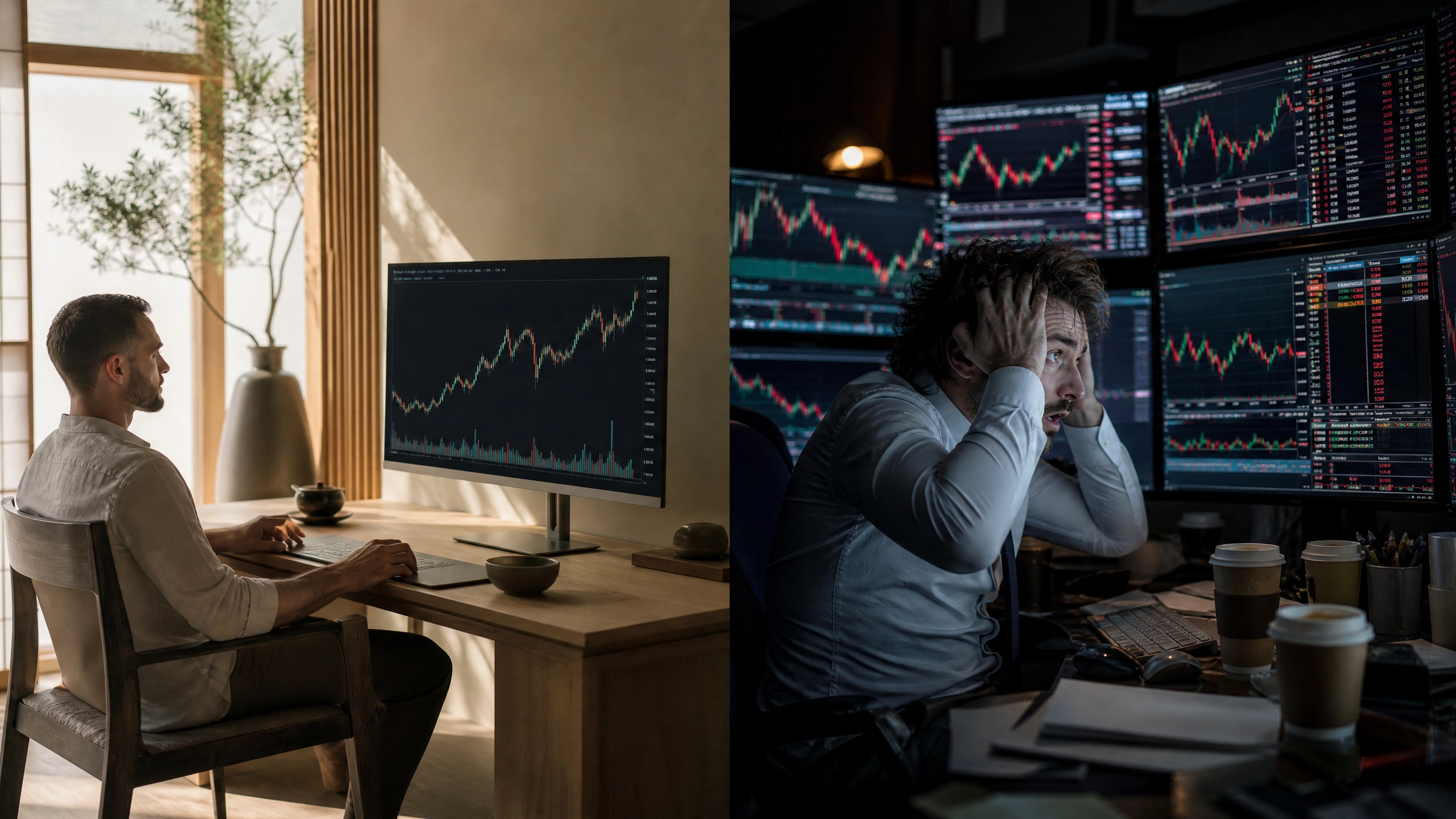
I Tested Patience vs Aggression for 30 Days — One Clearly Won
I traded two different ways for 30 days. The results weren’t even close.
 FXM Brand (Stephen M.)13 min read·1 hour ago
--
Every trader eventually faces this question: should I wait for the perfect setup, or should I stay active and capture every opportunity I can?
The debate has two sides. The patient trader argues that quality beats quantity — that waiting for the best setups protects capital and maximizes edge. The aggressive trader argues that markets reward action — that capturing every move compounds faster and keeps you sharp.
I’d had this debate with myself for months. I’d read arguments on both sides. I’d watched traders I respected land on opposite ends of the spectrum. And I’d noticed that my own instincts shifted depending on my recent results — I went patient after losses and aggressive after wins, which meant my execution style was being dictated by emotion, not evidence.
That bothered me. So I decided to settle it with data.
I would trade for thirty days — fifteen days of pure patience, fifteen days of controlled aggression — using the same strategy both times. I would track everything: trades taken, wins, losses, R multiples, stress levels, sleep quality, and decision quality. Whatever the data said, I would believe it.
Here’s what happened.
Why This Debate Matters More Than You Think
Most traders don’t realize how much their execution style determines their results — independent of their actual strategy.
You can have a statistically positive system and destroy it with aggressive execution. You can take a mediocre strategy and squeeze surprising profit out of it through disciplined, patient execution. The strategy gives you the edge. The execution style determines whether you capture it or waste it.
This is why two traders can run the same system and get completely different results. One is patient. One is not. Over hundreds of trades, the gap compounds into a chasm.
The stakes of getting this right are enormous. If aggression costs you even 30% of your potential return annually, that’s not just lost money — it’s lost compounding. Over five years, the difference between patient and aggressive execution could mean the difference between a funded account and a blown one.
Asian Session Gold Trading Strategy: How to Trade XAUUSD Like a Pro Before London Opens
Learn a structured method to trade gold during the Asian session with repeatable setups and timing-based execution that…
medium.com
Defining Patience and Aggression — Precisely
Vague definitions produce vague conclusions, so I defined each approach with surgical precision before the test began.
Patience meant:
- Waiting for setups that met every criteria on my checklist, not most of them
- Requiring confirmation before entry — no anticipation trades
- Passing on setups that looked “good enough” if they weren’t genuinely strong
- Exiting at predetermined profit targets, not letting ego push for more
- Accepting that some days would produce zero trades, and that was acceptable
Aggression meant:
- Taking setups that met most criteria, even if one or two boxes weren’t fully checked
- Entering on anticipation — getting in before confirmation to improve fill price
- Trading marginal setups when the broader context seemed favorable
- Letting winners run beyond predetermined targets, aiming for extended moves
- Prioritizing activity over selectivity
The strategy itself — the setups I was looking for, the stop placement, the general risk management — was identical in both phases. The only variable was how I executed it.
This distinction matters. I wasn’t testing two different strategies. I was testing two different trading personalities using the same underlying edge.
The Setup: How I Structured the Test
Before trading a single session, I created a framework to keep the test clean.
I designated days 1–15 as the patience phase and days 16–30 as the aggression phase. This sequencing mattered — I didn’t want to alternate daily, which would make it too easy to slip between styles. Sustained exposure to each approach would reveal the true psychological and financial cost of each.
I kept a trade journal for every session, recording:
- The setup I saw and whether it qualified under the current phase’s rules
- My emotional state before, during, and after each trade
- Sleep quality the night before and after significant sessions
- A stress rating (1–10) at market close each day
- Any deviations from the rules and why they happened
This wasn’t just a profitability test. It was a full audit of what each execution style does to a trader — not just their account, but their mind.
Unlocking Wealth: Gold Trading Strategies for Profit
Master the Art of XAUUSD — Proven Gold Trading Strategies, Timing Secrets, and Profit Methods for 2025.
medium.com
Week 1–2: The Patience Phase
The first two weeks were harder than I expected — not because the trades were difficult, but because the waiting was.
Day three, I watched a setup that was maybe 80% of what I wanted. It set up cleanly, moved exactly as I would have expected, and hit a clean target. Under patience rules, I passed on it. It would have been a +2.1R winner. I noted it in my journal and kept going.
Day six, something similar happened. Day nine, again.
By day ten, I was questioning the test. Was I being too rigid? Was patience just another word for fear? I almost abandoned the protocol.
But I held to the rules, and the results were striking:
Patience Phase Results (Days 1–15):
- Trades taken: 8
- Wins: 6 (+2.1R, +2.4R, +1.9R, +2.7R, +2.2R, +2.5R)
- Losses: 2 (−1.0R, −1.0R)
- Win rate: 75%
- Net result: +11.8R
- Average win: 2.3R
- Average stress rating: 3.2/10
- Average sleep quality: 7.8/10
Eight trades in fifteen trading days. That’s roughly one trade every two days. To many traders, that would feel unacceptably slow. But those eight trades produced nearly twelve R of profit, with a win rate most professionals would envy.
The setups I took were exceptional. They had clean structure, clear invalidation points, and strong confluence. When they worked, they worked decisively. When they failed, they hit my stop and stopped — no ambiguity, no hope trades.
Week 3–4: The Aggression Phase
Switching into the aggressive phase felt like pressing a gear I’d been suppressing. Suddenly I had permission to trade everything that looked viable. The first week, I felt energized.
I was in trades constantly. I was managing positions, adjusting targets, capturing moves I would have sat out during the patience phase. I felt more like a trader. More engaged. More present.
But something else was happening beneath the surface, and I only saw it clearly in my journal entries from those days.
Day 18: “Took three trades today. First one worked. Second and third both stopped out. Not sure the last one ever really qualified. Felt like I needed to make back the loss.”
Day 22: “Moved my stop on trade four. It came back and hit target but I’m not proud of it. The aggression is leaking into my management.”
Day 26: “Exhausted. Took six trades this week. Two winners, four losers. Stress rating: 7. Sleep: 5/10. Starting to dread the session.”
Aggression Phase Results (Days 16–30):
- Trades taken: 18
- Wins: 9 (+1.8R, +2.0R, +1.6R, +2.3R, +1.9R, +2.1R, +1.7R, +2.4R, +1.5R)
- Losses: 9 (−1.0R each)
- Win rate: 50%
- Net result: +6.3R
- Average win: 1.9R
- Average stress rating: 6.7/10
- Average sleep quality: 5.4/10
More than twice the trades. Less than half the net profit per trade. A win rate that dropped by 25 percentage points. And the hidden costs — stress, sleep disruption, emotional erosion — don’t appear in the R calculations at all.
I Built a Rule-Based Trading System — Then Broke One Rule. It Was My Best Trade of the Year.
I was a slave to my rules. Then I learned when to break them.
medium.com
The Five Reasons Patience Won
1. Setup Quality Filters for Edge
When you wait for perfect setups, you’re only trading in conditions where your edge is strongest. The win rate difference in this test (75% vs 50%) reflects exactly that. Marginal setups have lower probability. Trading them dilutes your actual edge.
Think of it this way: a strategy with a 60% win rate on A+ setups might only have a 45% win rate on B setups, and 35% on C setups. Aggressive traders blend all three together and wonder why their results don’t match their backtests.
2. Entry Timing Changes Everything
Patient traders wait for confirmation. This means the trade has already started to prove itself before they enter. Aggressive traders enter on anticipation — they’re predicting movement rather than responding to it.
Anticipation entries that fail result in full stop losses. Confirmation entries that fail often result in smaller losses because the market has already moved in your favor before reversing. The risk profile of each approach is fundamentally different.
3. Transaction Costs Compound Against You
This one is subtle but significant. The aggression phase generated 18 trades. Each trade carried spreads and commissions. Even at modest costs, 18 trades generates more than twice the overhead of 8 trades — without proportional increase in profit.
Over a year, an aggressive trader might take 3–4x the trades of a patient trader. The additional cost is a silent fee, draining the account every session.
4. Decision Fatigue Degrades Quality
The human brain has a finite capacity for high-quality decisions each day. Every trade decision — enter or pass, hold or exit, move the stop or leave it — costs cognitive resources.
During the aggressive phase, I was making more trading decisions than in the patience phase. By afternoon sessions, I could feel my judgment degrading. I was less rigorous. I was lazier about checklist compliance. I took shortcuts. The later trades were consistently worse than the earlier ones.
Patience conserves cognitive resources. When you trade less, you think better on every trade you do take.
5. Psychological State Feeds Back Into Results
This is the mechanism most traders ignore. When you’re trading aggressively and hitting losses, your emotional state deteriorates. That deterioration makes you more likely to revenge trade, more likely to move stops, more likely to overtrade further. A bad day can cascade into a catastrophic one.
Patient trading interrupts this feedback loop. Because you trade less and take only high-conviction setups, individual losses feel less threatening. Your baseline emotional state stays higher, which keeps decision quality high.
The Hidden Costs of Aggression: What Doesn’t Show in the Numbers
The R comparison understates the true cost of aggression.
What doesn’t show up in the table:
Compounding mistakes. During the aggressive phase, I caught myself moving stops three times. I took profits early twice. I entered a trade because I was bored, not because it qualified. These behavioral errors — invisible in a simple win/loss log — cost real money and real edge.
Lifestyle erosion. A stress rating of 6.7 vs 3.2 is not just a number. That’s the difference between enjoying trading and dreading it. That’s the difference between a sustainable career and eventual burnout.
Relationship with your own system. By the end of the aggressive phase, I had less confidence in my strategy than when I started — not because the strategy failed, but because I had corrupted it with poor execution. Aggression made me doubt my edge. Patience had me trusting it completely.
Recovery time. After difficult aggressive days, I needed more preparation time the following session to reset mentally. That’s hidden overhead — unpaid work just to return to baseline.
Complex Trading Strategies Are Killing Your Trades — I Tried a Simple Day Trading Framework .
I tested a simple day trading framework for 30 days. The results shocked me. Read my honest experience and see if this…
medium.com
When Could Aggression Be Justified?
I want to be honest: there are scenarios where aggressive trading might outperform patience. Intellectual honesty requires acknowledging them.
During sustained, high-clarity trends: When the market offers a clear directional bias and is delivering consistent follow-through, taking more setups can compound gains quickly. In these conditions, marginal setups perform closer to A+ setups because the trend does part of the work.
For traders with very high base win rates: If your system produces 80%+ win rates on A+ setups, the drop on B setups may still be profitable. The math shifts when your edge is unusually strong.
In certain volatility regimes: High-volatility, range-expanding markets can reward aggressive entries because moves are larger and faster. Patient entries may arrive too late.
The problem? These conditions are exceptions, not the rule. And identifying them in real time — before the aggressive entries have already cost you — is far harder than it sounds. By the time a trend is obvious enough to justify aggression, the patient trader has already captured most of the move.
Building Patience: Practical Techniques That Actually Work
Patience isn’t a personality trait you either have or don’t. It’s a skill, and it’s trainable. Here’s what moved the needle for me:
Write your criteria in concrete, observable terms. Vague criteria create vague patience. “The trend should look clean” is worthless. “Price must be above the 50 EMA, with the last swing high exceeding the previous by at least 10 pips” is usable. The more specific your criteria, the less room there is for rationalization.
Use a physical checklist before every entry. Print it. Check every box before placing the order. The physical act of checking slows you down and breaks the impulse-to-execution pipeline.
Set a maximum trade quota for the day. I trade a maximum of two trades per day during patience mode. That cap forces selectivity. When you know trade three isn’t coming, you stop looking for it.
Pre-select the setups you’ll look for each session. Before the market opens, identify one or two specific setups you’ll take today if they appear. This prevents opportunistic impulses during the session.
Review every setup you passed. At day’s end, go back and evaluate every setup you saw but didn’t take. Most of the time, you’ll confirm that passing was right. Occasionally, you’ll see that you missed something legitimate — and you adjust your criteria accordingly.
Build a “cooling-off” rule. After any loss, you must wait at least two hours before taking another trade. This interrupts revenge trading before it starts.
What the Equity Curve Tells You That the Numbers Don’t
One of the clearest signals of patience vs. aggression wasn’t in the totals — it was in the shape of the equity curves.
The patience equity curve was smooth and ascending. It had two drawdowns (the two losses), both shallow, both quickly recovered. It felt like reading a line that knew where it was going.
The aggression equity curve looked like a heartbeat monitor. It spiked up and dipped down repeatedly. The total moved in the right direction, but the path was jagged, uncertain, stressful. The equity didn’t feel owned — it felt borrowed.
Traders who don’t track their equity curve are flying blind. How you make money matters as much as how much you make. A smooth curve suggests sustainable edge. A jagged curve suggests noise — and eventually, noise averages to zero.
I Took Only One Trade Per Day for 10 Days — Here’s What Happened
Extreme discipline produced extreme results. I didn’t expect this.
medium.com
Your Own 30-Day Test: A Blueprint
Don’t take my results as final. Markets differ, strategies differ, traders differ. Run your own test. Here’s how to do it cleanly:
Week 1–2: Extreme patience. Define your A+ setup in writing. Create a checklist. Only enter when every box is checked. Track every setup you see, whether you trade it or not.
Week 3–4: Controlled aggression. Lower your threshold. Take B setups. Try anticipation entries. Let winners run further than usual. Keep the same level of tracking.
At the end of four weeks, compare not just the numbers but the experience. Your stress level. Your sleep. Your confidence in your own system. Your excitement or dread at the start of each session.
The data will tell you what style fits your system. Your journal will tell you what style fits your life. Both matter.
The Verdict
After thirty days of structured testing, the conclusion was unambiguous.
Patience generated 87% more profit, a 25 percentage-point higher win rate, and dramatically better quality of life — on fewer than half the trades.
Aggression generated excitement, activity, and roughly 87 cents for every dollar that patience produced — at twice the stress and half the sleep quality.
The uncomfortable truth is that trading less is often trading better. The market doesn’t reward effort. It doesn’t care how many hours you watched the chart. It doesn’t give credit for activity. It rewards execution quality — and patience is what makes quality possible.
Aggression feels like trading. Patience is trading.
If you want to settle this debate for your own system, run the test. But if the data matters to you before you start, mine is clear: patience won, by every metric that matters, and it wasn’t close.
Ready to trade with patience? The Goldmine Elite System includes comprehensive patience-building frameworks — criteria, checklists, and psychological protocols that make disciplined execution natural. Discover the complete system at FxM Brand Store