I Tested Binance’s New Agentic Wallet Against OKX — Here’s What I Found
 Chia-Yu (Kelsey) Lin7 min read·Just now
--
In March 2026, OKX launched its Agentic Wallet. I ran a full hands-on test. Then on April 24, Binance launched its own version. I started testing the same day, using identical strategies to compare both products. Total investment: $3.00 USDT. Total returned: $3.012 USDT.
The timing was perfect. I still had fresh first-hand data from the OKX test, so I immediately ran Binance through the same playbook to see where the gaps really are.
Bottom line upfront: Binance scores higher on user-friendliness — simpler onboarding, more protective security defaults, market orders in 4 seconds. But when it comes to automated trading, Binance’s smart money signals on both BSC and Solana were completely stale — every signal had already timed out, making auto-buy impossible. Combined with the lack of automatic stop-loss execution, these are Binance Agentic Wallet’s two most significant weaknesses compared to OKX.
Part 1: Background — What Is an Agentic Wallet?
Before diving into the tests, two concepts are essential to understand.
1.1 Onchain vs. Offchain — The Most Important Distinction
Offchain (Binance’s traditional approach): Your funds sit in your Binance account, and the AI executes trades within Binance’s system. Think of it like having AI manage your savings account at a bank.
Onchain (What Agentic Wallets do): Your funds stay in your own wallet — you hold the private keys — and the AI directly interacts with blockchain protocols. Think of it like AI physically taking your cash to the financial markets and trading on your behalf.
This distinction determines each product’s fundamental capability ceiling.
1.2 Binance Has Three Different AI Products — Don’t Confuse Them
- Binance AI Pro (Mar 25): AI trading assistant inside the CEX — grid bots, trade recommendations. Your money stays in Binance.
- Binance Keyless Wallet (Mar 18): MPC-based self-custody wallet, no seed phrase required.
- Binance Agentic Wallet (Apr 24): AI Agent-specific sub-wallet — the direct competitor to OKX. This is what I tested.
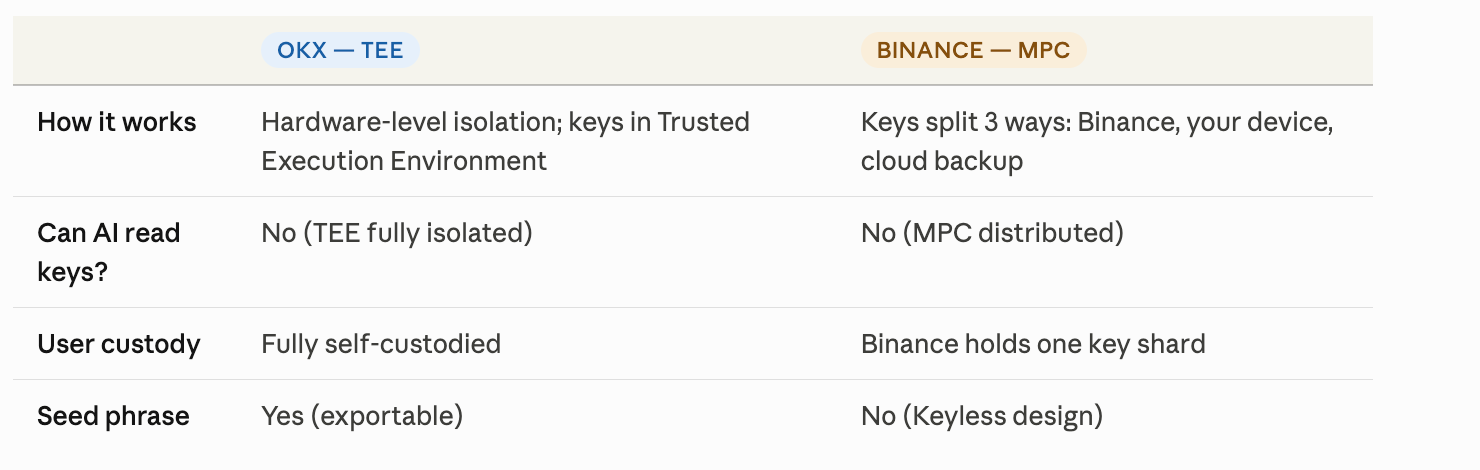
1.3 Private Key Technology: TEE vs. MPC
Part 2: OKX Agentic Wallet — Test Results
2.1 Product Overview
- Launch date: March 18, 2026
- Positioning: Self-custodial on-chain AI wallet, purpose-built for AI agents
- Supported networks: ~20 chains (Ethereum, Solana, BNB Chain, X Layer, and more)
- Key protection: TEE — AI cannot access the seed phrase
- Target users: Developers, quant traders, advanced Web3 users
- Cost: Free (requires Claude Code or similar AI tooling)
2.2 Setup
Login via email verification, receive both EVM and Solana wallet addresses. Fund with 2 USDT (Ethereum) + 0.012 SOL (for gas).
npx skills add okx/onchainos-skills
npm install -g @anthropic-ai/claude-code
2.3 Strategy
One natural language sentence set the entire automated strategy:
“Monitor Solana for smart money buying activity. Conditions: market cap under $5M, at least 2 smart money wallets buying, auto-buy 1 USDT after passing security checks, 50% trailing take-profit (sell on 10% pullback), 20% stop-loss.”
2.4 What the AI Did Automatically
- Scanned Solana for smart money signals — found 12 candidates meeting the market cap filter
- Auto-filtered out tokens where smart money had fully exited
- Ran security scans on candidates (honeypot, wash trading, liquidity risk)
- Got best available quote and confirmed routing
- Executed on-chain buy (Cyberhog, entry $0.0000573, cost $1.007 SOL)
- Monitored price every 3 minutes — peak gain reached +18.7%
- Stop-loss triggered at -21.4%, auto-sold and cancelled the cron job. Loss: ~$0.21
Key Observations
- When the AI hit a CLI parameter error mid-execution, it diagnosed and fixed itself without any human input
- Security scan flagged isWash=true (wash trading) but no honeypots or fatal risks — proceeded per strategy
- Stop-loss triggered correctly. Total loss: ~$0.21 on $1.007 invested
- End-to-end: natural language instruction to on-chain trade in under 5 minutes
Part 3: Binance Agentic Wallet — Test Results
3.1 Product Overview
- Launch date: April 24, 2026
- Positioning: AI Agent-specific sub-wallet, nested under Binance Keyless Wallet
- Supported networks: 4 chains (Ethereum, BSC, Base, Solana)
- Key technology: MPC three-party key split, no seed phrase
- Target users: Existing Binance users, especially retail
- Cost: Free (promotional period: 0 service fees, first 20 transactions gas-free)
3.2 Setup
Step 1 — Install Binance Skills:
npx skills add binance/binance-skills-hub/skills/binance-web3Step 2 — Install BAW CLI:
sudo npm install -g @binance/[email protected]Step 3 — QR Code login:
In Claude Code, type “Login to Binance Agentic Wallet.” The system automatically opens a browser window with a QR code and a 6-digit pairing code. Open the Binance App, scan the QR code, and confirm the pairing code matches. Done.
This is noticeably more intuitive than OKX’s email verification flow. Total setup time: ~45 minutes, versus OKX’s 2–3 hours.
After login, the wallet displays addresses across 4 chains — ETH, BSC, and Base all share the same EVM address, while Solana gets a separate address.
3.3 Security Settings — Binance Defaults Are More Conservative
3.4 Funding — Binance Wins by a Wide Margin
OKX’s pain point: Requires ETH to pay gas. No ETH = stuck. Cross-chain bridging is complex and confusing for non-technical users.
Binance: Withdraw directly from Binance CEX account. BSC network. Fee: $0.01. Arrived in 2 minutes.
This gap is enormous for mainstream adoption.
3.5 Available Commands — Binance Has Limit Orders, OKX Doesn’t
Key commands Binance has that OKX lacks:
limit-order buy/limit-order sell— Set target price entries/exitswallet left-quota— Check remaining daily transaction allowancewallet tx-lock— Check for pending or double-confirmation-required transactions
3.6 Market Order — 4 Seconds
“Buy 2 USDT worth of BNB on BSC at market price”
Two things stood out:
MEV protection is on by default — OKX requires you to manually add the
--mev-protectionflag. With Binance, users get protection without knowing what MEV even is.Every trade requires user confirmation — OKX executes autonomously. Binance requires you to reply “confirm” before each trade executes. This is the most fundamental design difference: OKX pursues full autonomy; Binance keeps a human in the loop.
3.7 Limit Order — Binance’s Unique Advantage
OKX has no limit order functionality. Binance does. I set one up: auto-buy 1 USDT of BNB when price drops to $600. Successfully created, status WORKING. BNB was at $613 at the time — only 2.2% from triggering.
3.8 Take-Profit / Stop-Loss — Binance’s Core Limitation
Critical finding: Binance cannot execute automatic stop-losses. The limit-order command only supports "sell when price rises to target." It does not support "sell when price falls below target." Stop-loss is alert-only — you still have to manually execute the sell.
3.9 Smart Money Signals — The Most Important Gap
This isn’t a one-off failure. After an hour, after relaxing the market cap filter, after switching chains — the result is the same. Binance’s signal system has a systemic refresh rate problem. When every signal is stale by the time the user sees it, the auto-trading feature is effectively non-functional.
3.10 Security Audit — Binance Is More Thorough
Part 4: Full Feature Comparison
Part 5: Full P&L Record
Conclusion
Overall, Binance scores higher on user-friendliness — frictionless funding, conservative security defaults, 4-second market order execution. But when it comes to the core automated trading use case, Binance’s smart money signals on both BSC and Solana were consistently stale — no active signals were available across multiple attempts. Combined with the absence of automatic stop-loss execution, these are Binance Agentic Wallet’s two most significant weaknesses compared to OKX right now.
OKX is solving “how do we let AI operate fully autonomously on-chain” — self-custodied funds, real-time signals, automatic stop-losses, and access to the entire DeFi ecosystem.
Binance is solving “how do we make AI wallets safe enough for everyone” — frictionless onboarding, protective defaults, and human checkpoints at every trade. The tradeoff is reduced autonomy and shallower on-chain depth.
These two products aren’t direct competitors — they serve different users at different stages of Web3 adoption. Whoever fixes their core weakness first wins the next wave.
This is the second article in the “Kelsie’s Web3 Lab” series. Based on hands-on testing conducted April 13, 2026 (OKX) and April 29, 2026 (Binance). Total funds used: approximately $3 USDT. All activity conducted for research purposes only. Nothing in this article constitutes investment advice.
A Traditional Chinese version of this article is also available as Link https://medium.com/@chayi.lin/ai-%E5%8A%A0%E5%AF%86%E9%8C%A2%E5%8C%85%E5%AF%A6%E6%B8%AC-okx-agentic-wallet-binance-agentic-wallet-%E5%AE%8C%E6%95%B4%E5%B0%8D%E6%AF%94%E5%A0%B1%E5%91%8A-05dd0c8d4cf1