I Paid $39/Month for PineConnector. Then I Built a $4.99 Alternative.
 Benjamin Sanchez8 min read·Just now
--
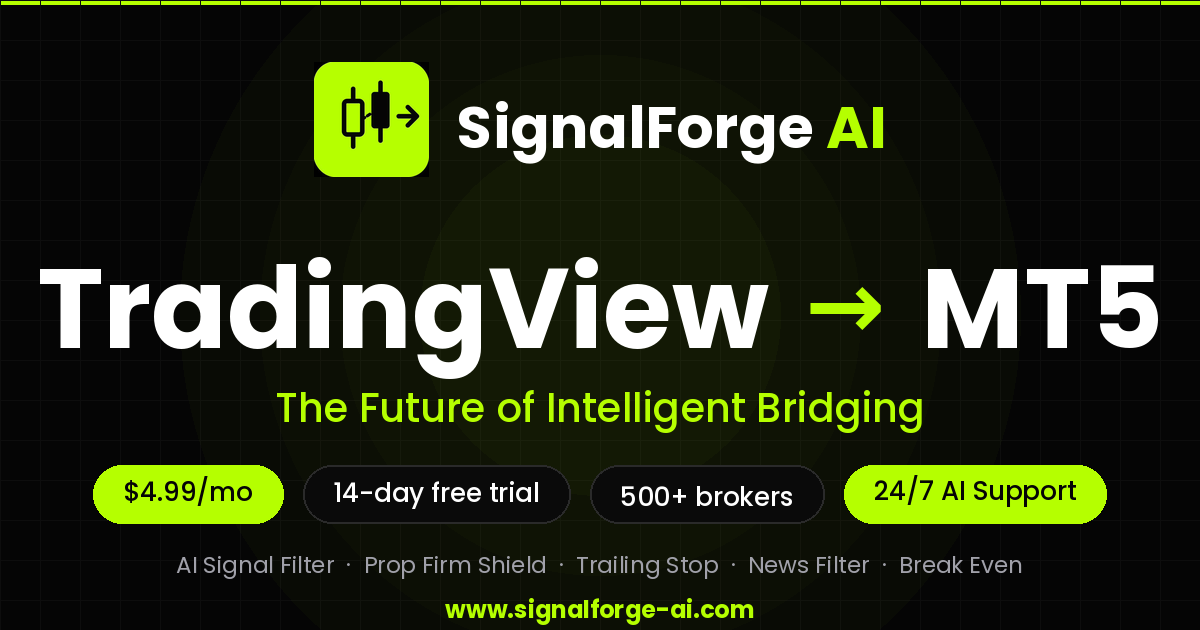
TL;DR: I was paying $39/month for PineConnector to connect my TradingView alerts to MetaTrader 5. After 6 months, I decided to rebuild the core feature myself on a $10/month Railway server. The result: SignalForge AI, which starts at $4.99/mo. This post is an honest breakdown of what I learned — not a hit piece on PineConnector.
The $468/year question
Here’s the math that started everything.
I was running a simple scalping strategy on TradingView. When it fired a signal, I needed it to execute on MetaTrader 5. For that, I paid PineConnector $39/month — their Starter plan. After one year, that’s $468. After two years, $936.
For a single feature: take a webhook and forward it to MT5.
I wasn’t angry at PineConnector. They built something that works, and being first in a niche deserves reward. But at some point the math stops making sense. $39/mo for webhook forwarding is priced like enterprise software, not a retail tool.
So I did what any engineer with too much free time would do. I rebuilt it.
What PineConnector actually costs — the real numbers
Before I get into the competitive analysis, let me be fair about PineConnector’s pricing. Here’s what the market actually looks like as of April 2026:
So to run PineConnector realistically — Starter plan plus their cloud VPS — you’re looking at $89/mo, or $1,068 per year. For webhook forwarding.
That’s the moment I stopped rationalizing it.
Why I thought PineConnector was overpriced (and why I was partially wrong)
When I first complained about the price, people pushed back with valid points:
- “You’re paying for reliability.” True. PineConnector has processed millions of signals. That level of infrastructure validation takes years.
- “You’re paying for support.” Partially true. Their docs are decent. Support response times vary.
- “You’re paying for convenience.” True. Setup is straightforward. Most traders don’t want to touch a webhook server.
But here’s what nobody said out loud: you’re also paying for the absence of alternatives.
PineConnector existed in a market with very little direct competition. TradingConnector at $14.99/mo was buggy (Trustpilot 2.8/5 as of 2026). A handful of smaller tools came and went, but none combined reliability, focus, and a sustainable price point. Most traders didn’t know a serious alternative existed.
That’s not a product problem. That’s a distribution problem. And distribution problems are fixable.
What I actually had to build
I’ll be honest: I went in expecting to build a weekend project. It took three months of evenings.
Here’s what the real cost of “webhook forwarding” turned out to be:
The easy part (what I expected)
- Flask server on Railway receiving webhooks from TradingView
- Simple JSON parser
- Connection to MetaTrader 5 via an Expert Advisor (EA)
- Basic buy/sell logic
This took about two weeks. Total infrastructure cost: $10/month on Railway.
The hard part (what I didn’t expect)
This is where PineConnector’s $39/mo starts making more sense:
1. Parser robustness. Real traders use 4–5 different webhook formats. Some send JSON, some send key=value, some copy PineConnector's syntax verbatim, some send raw text. My parser initially supported only JSON. A single customer with a different format broke everything. Now my parser handles three formats with field aliases ( ticker->symbol, volume->lot, signal->action). That's a lot of edge cases I didn't plan for.
2. MT5 connection stability. The MT5 Expert Advisor has to stay connected to your broker, handle reconnects, verify signal authenticity with a token, and execute orders with correct position sizing. Getting this rock-solid took weeks. The first version would silently fail on spread spikes. The second version would double-execute on retries. Version 3 finally handled the edge cases.
3. Prop firm compatibility. FTMO, FundedNext, The Funded Trader — each has slightly different rules about drawdown limits, news trading, and position sizing. I had to build a “Prop Firm Shield” module that stops trading before you breach limits. This is a real feature PineConnector doesn’t include at any price tier.
4. Spread and news filtering. Real traders don’t want to execute during NFP or FOMC announcements. They don’t want to enter when spread spikes 10x. These filters sound trivial but require real-time data integration.
So when someone tells you “it’s just webhook forwarding” — no, it really isn’t. The core is simple. The reliability layer is where the actual work lives.
The three decisions that made the $4.99 price possible
Here’s the competitive analysis part. I didn’t undercut PineConnector by being smarter than them. I undercut by making different tradeoffs.
Decision 1: Solo founder, no investors
PineConnector is a real company with employees, marketing budget, customer support staff, and overhead. I’m one person building at night. My cost of existing as a business is my Railway bill ($10/mo) and Stripe fees.
This isn’t a feature — it’s a structural cost advantage that lets me price at $4.99 without losing money per customer. A 10-person team literally cannot match this price without operating at a loss.
Decision 2: Narrower scope
PineConnector supports MT4 AND MT5. I support MT5 only.
Why? MT4 is deprecated. MetaQuotes (the company behind both) has been trying to kill MT4 for five years. Supporting MT4 adds code complexity, testing matrix explosion, and customer support load — for a platform that brokers are abandoning anyway.
I made the call: MT5 only. If you’re on MT4, PineConnector is your answer and that’s fine.
Decision 3: Different distribution
PineConnector gets customers through Google SEO (they’ve dominated “tradingview mt5 bridge” for years) and word of mouth in trading Discord servers.
I can’t beat them at SEO in year one. So I went different:
- YouTube tutorials in Spanish (LATAM + Spain, a market PineConnector doesn’t serve in their language)
- Direct comparison articles with honest tradeoffs
- Free MQL5 Market EAs that funnel to paid plans
- Content marketing focused on specific pain points (prop firm rules, AI filtering)
I’m trading “broad reach” for “depth in specific segments.” It’s slower. It’s also more defensible.
What I added that PineConnector doesn’t have (at any price)
This is where it stops being about price and becomes about product.
AI signal filter
I integrated DeepSeek V3 as an optional signal filter. Before executing a trade, the AI reviews the chart context, recent price action, and news — then approves or rejects the signal based on your written rules.
Example rules a user can set:
— “Skip trades during high-impact news”
— “Only take trades when 1H trend aligns with signal direction”
— “Reject counter-trend signals during Asian session”
The AI reads these rules in plain English and applies them. No coding required.
PineConnector has no AI filter at any tier. This isn’t about them being behind — it’s that their architecture was designed before LLMs became cheap enough to integrate.
Prop Firm Shield
Real-time drawdown protection. The EA tracks your current P/L against your prop firm’s daily and max drawdown limits. Before executing a new trade, it calculates if the worst-case outcome would breach the limit. If yes, it rejects the trade.
FTMO, FundedNext, Topstep, The Funded Trader — all supported out of the box.
Again, this doesn’t exist in PineConnector. Traders using PC with prop firms have to build their own limit tracking in Pine Script, which is error-prone.
Honest pricing
No “request a demo.” No “enterprise plan” pricing games. Three tiers, clearly displayed:
- Starter $4.99/mo — Bridge + trailing stop + break-even + spread filter
- Trader $14.99/mo — Adds Prop Firm Shield, news filter, Telegram notifications
- Pro $29.99/mo (coming soon) — Adds AI filter and cloud VPS
14-day free trial on all tiers. Cancel anytime. No surprises.
What I learned about pricing in trading software
A few patterns I noticed that might be useful for other solo founders:
1. Traders are price-sensitive but ROI-rational
My customers aren’t cheap. They’re running strategies that profit $500–5,000/mo. A $39/mo tool is noise if it works. But if a $4.99 tool does the same thing AND saves them $34 that they can redeploy — they do the math.
Pricing decisions in B2B SaaS aren’t about “the lowest price wins.” They’re about being priced below the mental threshold where the decision stops being a decision.
$39 requires a justification. $4.99 doesn’t. Most people spend more on coffee.
2. The 10x rule is real
Marc Andreessen wrote that new products need to be 10x better or 10x cheaper than incumbents to win. At $4.99 vs $39 I’m at 8x cheaper. Not quite 10x, but enough that the conversation with prospects changes entirely.
The first thing people say isn’t “why are you cheaper?” It’s “what’s the catch?” Which means they’re already considering switching. That’s a different sales conversation.
3. Incumbents can’t respond
PineConnector can’t drop their price to $10/mo. Their cost structure doesn’t allow it (team, overhead, existing customers paying $39). They’re locked in.
This is the classic innovator’s dilemma. The incumbent has a business model they can’t abandon. The new entrant has no installed base to protect.
This isn’t about them being slow or dumb. It’s structural.
4. Niche positioning beats horizontal competition
I don’t try to be “PineConnector but cheaper.” I try to be the best choice for specific segments:
— Spanish-speaking traders (native support)
— Prop firm challengers (Prop Firm Shield)
— AI-curious traders (DeepSeek filter)
— Budget-conscious beginners ($4.99 entry)
Each of these is a defensible sub-market. PineConnector can’t target all of them without diluting their brand.
What I’d tell myself if I were starting over
If you’re thinking about building a cheaper alternative to any SaaS — trading-related or not — here’s what I wish I’d known:
1. The “it’s just X” trap is real. Whenever you look at a SaaS and think “this is just a simple wrapper,” add 3x to your estimate. The visible product is 20% of the actual code.
2. Pricing below the threshold matters more than pricing “competitively.” $4.99 vs $39 isn’t 8x cheaper mentally. It’s “negligible vs real expense.” Different category entirely.
3. You don’t need to kill the incumbent. PineConnector will be fine. I’ll be fine. Markets are big enough for multiple approaches. I don’t need to win their customers — I need to win the customers they don’t serve well.
4. Distribution is the bottleneck, not product. Building SignalForge took 3 months. Getting the first 5 paying customers took another 3 months. The product was always easier than the marketing.
5. Be honest publicly. I write posts like this one because honesty is my differentiator. If I had to pretend PineConnector was garbage to sell my thing, I’d have nothing to stand on. They’re legitimate. I’m just a different choice.
If you’re curious
SignalForge AI is live at signalforge-ai.com. There’s a 14-day free trial on all plans. If you’re currently on PineConnector and the price tag has been bothering you, give the free trial a shot — worst case you lose 5 minutes setting it up.
If you’re not in the market for a bridge but you’re a solo founder thinking about competing against an incumbent in any SaaS space — the playbook in this post applies. Structural cost advantage + narrow scope + distinct distribution = viable entry point.
The big companies have real advantages. But “being a company” is itself an expense that solo founders don’t have to carry. Use it.
I’m Benjamin, solo founder of SignalForge AI. I write about building SaaS in public, trading automation, and what I learn along the way. Follow me here or at @SignalForge_AI on X.If you want to read the deeper technical breakdown of the architecture behind SignalForge, including the Flask backend, the DeepSeek integration, and how I handle 200+ signals per second on Railway — let me know in the comments. I’ll write that next.
Originally published at https://www.signalforge-ai.com.