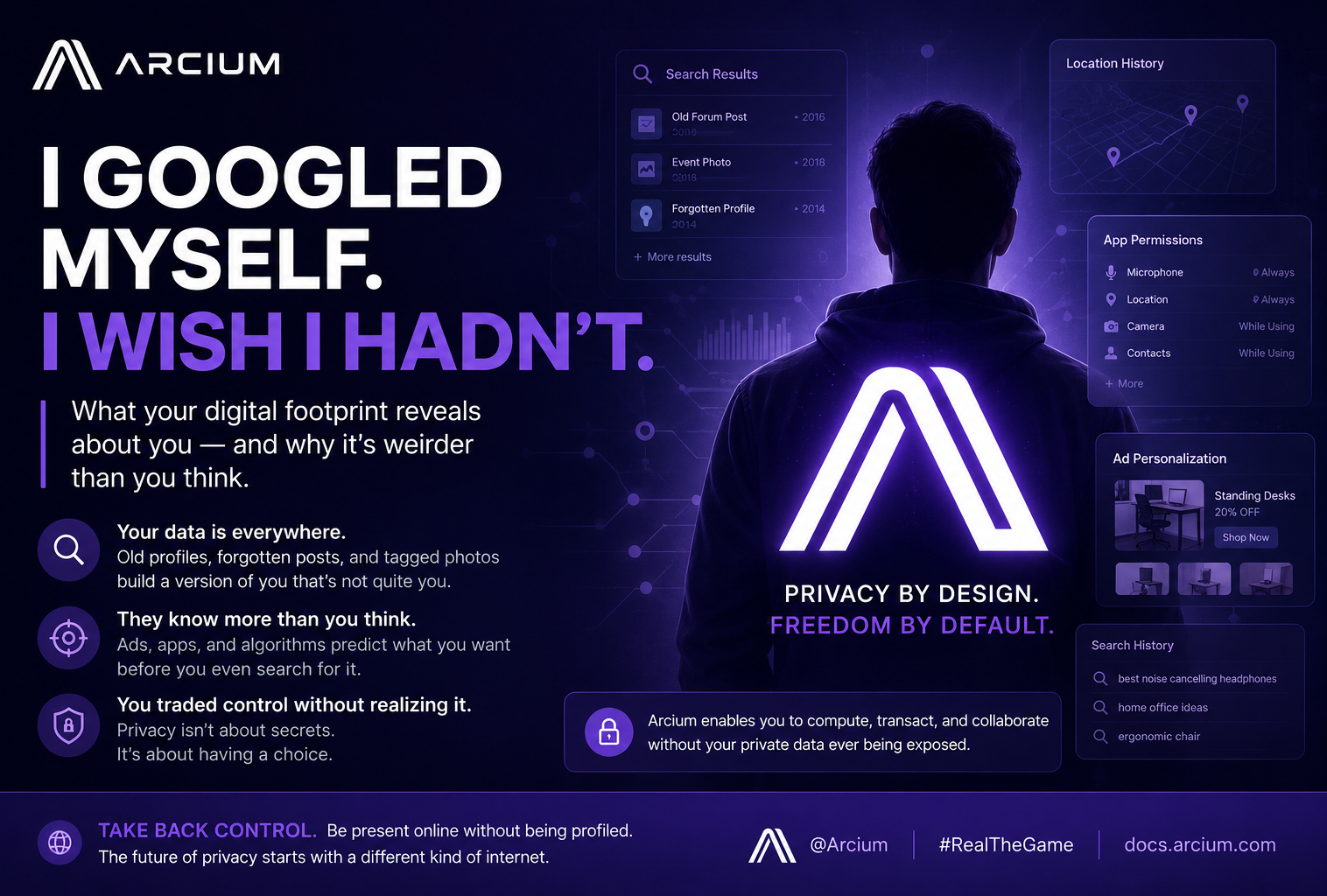
I Googled Myself. I Wish I Hadn’t.
--
What your digital footprint reveals about you — and why it’s weirder than you think.
I am not a particularly private person.
I post a few times a week. I use Google Maps without thinking twice. I click “Accept All” on cookie banners because the alternative is a maze of toggles I don’t have time for. I am, by most measures, a pretty average internet user.
So when I sat down one afternoon to actually look at what I was exposing online, I expected to feel mostly fine about it.
I did not feel mostly fine about it.
The Google Search
The first thing I did was search my own name.
There it was. An old profile from a platform I had forgotten I joined. A comment I left on a forum years ago, attached to a username I thought was anonymous. A photo from an event that someone else had uploaded and tagged. None of it was embarrassing exactly. But none of it was me — not the version of me I would choose to present.
It was like finding a scrapbook that someone else made about you. Technically accurate. Somehow completely wrong.
The Ads That Know Too Much
This is the part that had been quietly unsettling me for months before I even started this exercise.
A few weeks ago I was having a conversation with a friend about wanting to get a new desk. I did not search for desks. I did not text anyone about desks. I just talked about it out loud. Two hours later, my feed was full of desk advertisements.
Now, the rational explanation is probably simpler than that. Maybe I had searched for something adjacent. Maybe an algorithm picked up on patterns I was not aware of. Maybe it was a coincidence that felt like a pattern because my brain is wired to notice patterns.
But here is the thing: I do not actually know. And that is the part that bothers me.
I do not know what was collected. I do not know when. I do not know which app was listening or reading or inferring. I just know that something, somewhere, built a model of what I wanted before I had fully decided I wanted it.
That is not a conspiracy theory. That is just how targeted advertising works. The technology is designed to know you better than you know yourself. It is doing exactly what it was built to do.
I just never stopped to think about what that meant from the other side.
The App Audit
Out of curiosity, I went into my phone settings and checked which apps had access to my microphone and location.
There were apps on that list I had not opened in over a year. One of them I genuinely did not remember installing. Several had location access set to “Always” — not just when the app was open. Always.
I spent about twenty minutes revoking permissions. It felt like cleaning out a drawer full of things you forgot you owned. A little satisfying, mostly just strange.
What Did I Actually Find?
Nothing scandalous. No data breaches, no leaked passwords, no dramatic revelations.
What I found was something quieter and in some ways more uncomfortable: a version of me constructed from fragments. An old username here, a location ping there, a purchasing pattern, a search history, an ad interaction. Each piece is small. Together they form something that is recognizably me but not quite right. Like a portrait painted by someone who has only ever seen photographs.
That portrait exists whether I think about it or not. It is being updated constantly. And I have very little say in who gets to look at it.
Does It Matter?
This is the question I kept coming back to.
I have nothing to hide. Most people say that. Maybe it is even true. But “nothing to hide” assumes the people doing the looking are trustworthy, that the data is being interpreted accurately, and that what is collected today cannot be used against me tomorrow in a context I cannot anticipate.
Those are big assumptions.
Privacy is not really about secrets. It is about control. The ability to decide what you share, with whom, and when. Right now, for most of us, that control is largely an illusion. We traded it away in increments so small we never noticed the total.
So What Now?
I am not going to delete all my apps and move off the grid. That is not a realistic answer for most people and it is not what I am arguing for.
But I did start paying more attention. I revoked some permissions. I thought twice before accepting cookies. I became slightly more aware of the gap between the version of me that exists in databases somewhere and the version I actually experience from the inside.
And I found myself thinking about what it would look like if that gap did not have to exist. If you could interact with the internet, transact, communicate, participate — without leaving a trail that someone else owns.
That is exactly the problem @Arcium is built to solve. Not by asking you to disappear from the internet, but by making it possible to compute, transact, and collaborate without your private data ever being exposed in the first place.
I do not think most people realize the trade-off they have already made.
I did not fully realize it either, until I typed my own name into a search bar and saw what came back.
Try it.
For more about Arcium, you can follow and join their official social accounts links below:
https://x.com/Arcium
https://discord.com/invite/arcium
Follow me on X:
https://x.com/leosereinn