I Built an AI Assistant for Investors — Here’s What I Learned (Real Product Story from ASK ANT)
 Vishwa V J4 min read·Just now
--
Most trading platforms help users buy and sell.
Very few truly help users think better before investing.
That gap became clear while building ASK ANT, an AI-powered investment intelligence assistant integrated into the ANT trading ecosystem. The mission was simple:
Give retail investors access to institutional-grade research, portfolio intelligence, and simplified decision-making — inside the same platform where they trade.
This wasn’t about adding a chatbot.
It was about building an intelligent layer between raw market data and better investor decisions.
Why We Built It
Retail investors today face three major problems:
1. Too Much Information
Users are overloaded with:
- endless market news
- technical jargon
- scattered stock data
- conflicting opinions
- complex portfolio decisions
2. Research Is Fragmented
To evaluate one stock or mutual fund, users often jump between:
- broker apps
- news sites
- charting tools
- screening websites
- AMC portals
3. No Decision Support
Most platforms give data.
Few translate data into clear action-oriented intelligence.
That’s where ASK ANT came in.
What ASK ANT Was Designed to Do
ASK ANT combined multiple intelligence layers into one product:
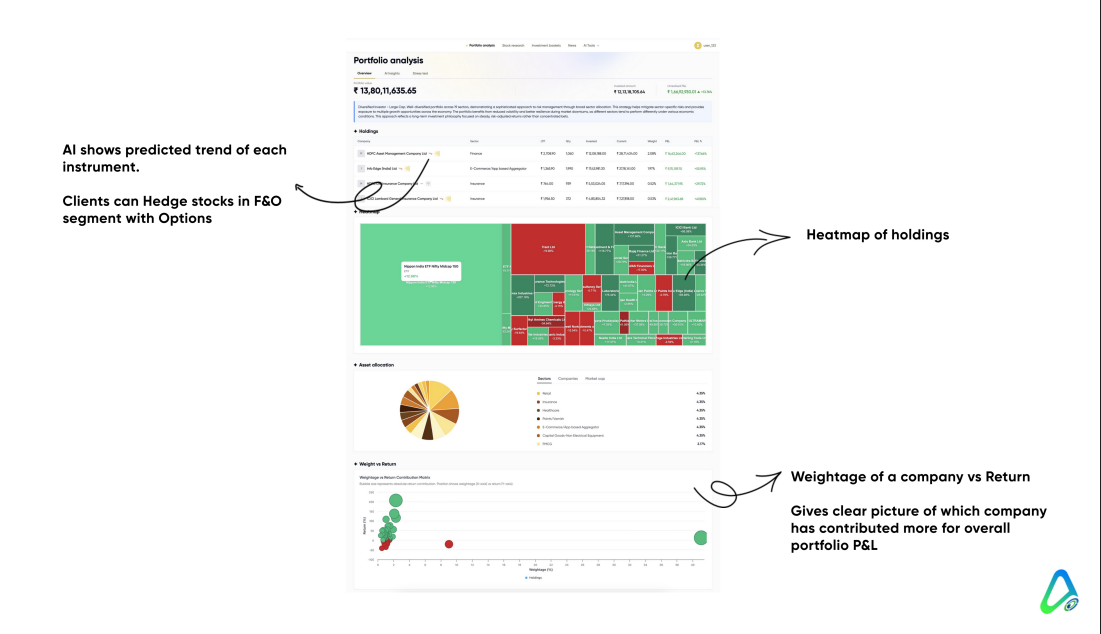
- Portfolio analytics
- Stock/company research
- Technical + fundamental screening
- Risk & stress testing
- Hedge strategy simulation
- AI news summarization
- Conversational financial queries
Later, it expanded into Mutual Fund Research, allowing users to compare schemes, AMCs, categories, peer funds, and AI-generated summaries.
What I Learned Building It
1. Users Don’t Want AI. They Want Confidence.
No user logs in saying:
“I hope I use AI today.”
They want:
- clarity
- reduced confusion
- faster decisions
- lower risk
- more confidence
AI is only useful when it solves emotional friction.
That was the biggest lesson.
2. Finance Requires Trust More Than Creativity
In entertainment apps, AI can be playful.
In finance, AI must be precise.
That meant ASK ANT had to rely on:
- structured financial datasets
- quantitative scoring engines
- statistical models
- verified market feeds
The language model was used only for simplifying outputs, not generating fake predictions.
That distinction matters.
3. Great UX Beats Smart Models
Even the best analytics fail if users don’t understand them.
So instead of overwhelming dashboards, we focused on:
- simple summaries
- clear scores
- visual heatmaps
- stress indicators
- plain-English explanations
Users loved simplicity more than complexity.
4. Portfolio Analytics Is a Huge Untapped Opportunity
Retail investors rarely know:
- concentration risk
- sector overexposure
- volatility sensitivity
- diversification weakness
- downside scenarios
ASK ANT introduced:
- Portfolio Health Score
- Stress Testing across 10+ factors
- Asset allocation insights
- Weight vs return contribution analysis
This moved users from “What stocks do I own?” to:
“How healthy is my portfolio?”
That shift is powerful.
5. Mutual Funds Needed Better Product Experience Too
Most investors research mutual funds on external sites and return later to transact.
We solved this by launching an in-app Mutual Fund intelligence layer featuring:
- scheme search
- live NAV
- AUM
- risk meter
- AMC profiles
- peer comparisons
- AI summaries
This reduced drop-off and increased ecosystem stickiness.
6. Explainability Is Non-Negotiable
Users trust recommendations only when they understand:
- why it matters
- what risk exists
- what assumptions are used
- what alternatives exist
Every future AI fintech product should focus on explainability first.
7. The Best Product Isn’t a Chatbot — It’s a Copilot
The future isn’t users chatting endlessly with AI.
The future is AI embedded inside workflows:
- smarter watchlists
- better fund discovery
- risk alerts
- contextual insights
- portfolio coaching
- research acceleration
That’s where real value lives.
If I Built Version 2 Today
I’d add:
Personalized Wealth Copilot
Understands income, goals, risk appetite, time horizon.
Portfolio Memory
Tracks user behavior and recurring mistakes.
AI Scenario Engine
“What happens if markets fall 15%?”
Smart Rebalancing Assistant
Suggests diversification moves.
Learning Layer
Improves user investing knowledge over time.
Biggest Product Management Lesson
Users don’t pay for AI.
They pay for:
- better decisions
- saved time
- lower anxiety
- confidence
- trust
AI is just the engine. Value is the destination.
Final Thought
Building ASK ANT taught me something simple:
The next generation of investing apps won’t just execute trades.
They’ll help users think smarter before every trade
And the winners won’t be the loudest AI products.
They’ll be the most trusted.