I Backtested 200+ Trades Before Putting Real Money In. Here’s What I Found.
 Rishabh Chauhan8 min read·1 hour ago
--
Demo trading felt boring. Backtesting felt pointless. I was wrong on both counts — and the market made sure I learned that the hard way.
Let me start with a confession.
When I first heard about paper trading — trading with fake money on a real platform before risking actual capital — I thought it was for people who were too scared to just start. I did a couple of demo trades, got bored, and moved on to real money.
That decision cost me everything.
I’ve already written about how I jumped into F&O without preparation and lost my entire capital. If you haven’t read that story, go read it first. But what I didn’t tell you in that article is what I did after the loss — and how a boring, unglamorous process called backtesting completely changed the way I trade.
This article is about that process. Not the sexy part of trading. The part nobody talks about because it doesn’t make for a good highlight reel.
The Mistake I Made With Demo Trading (And Then Fixed)
The first time I tried paper trading, I lasted about two trades. It felt fake. There was no adrenaline, no real stakes, no emotional weight. I told myself I’d learn better with real money on the line.
That’s one of the most dangerous things a beginner can tell themselves.
After blowing my capital in F&O, I came back to demo trading — this time with a completely different mindset. Instead of treating it like a practice round I had to get through, I treated it like a real job. I spent a couple of months on it. I didn’t move to real money until I was consistently profitable on paper and — more importantly — until I felt emotionally stable while trading.
That second part surprised me. I expected demo trading to teach me about entries and exits. I didn’t expect it to teach me about myself.
Trading with fake money still triggered real emotions. I felt overconfident after winning streaks. I felt frustrated after losses. I wanted to revenge trade. And because the stakes were low, I could observe these emotions without them destroying my account. I could catch myself in the moment and ask — why am I feeling this way, and is it affecting my decisions?
By the time I switched to real money, I wasn’t just more skilled. I was more self-aware. That made all the difference.
Platform I used: TradingView. I’d recommend it to any beginner — the paper trading feature is clean, realistic, and works across global markets. One limitation worth knowing: it doesn’t support Indian stocks for paper trading. But for learning the mechanics of trading and testing strategy, it does the job extremely well.
What Backtesting Actually Is (And Why Most Beginners Skip It)
Backtesting is simple in concept: you take your strategy and test it against historical price data to see if it would have worked in the past.
Most beginners skip it for the same reason I initially skipped demo trading — it feels slow, tedious, and disconnected from the excitement of actual trading. You’re not making money. You’re just… studying old charts.
But here’s the truth: backtesting is where you find out if your strategy is real or if it’s just a story you’re telling yourself.
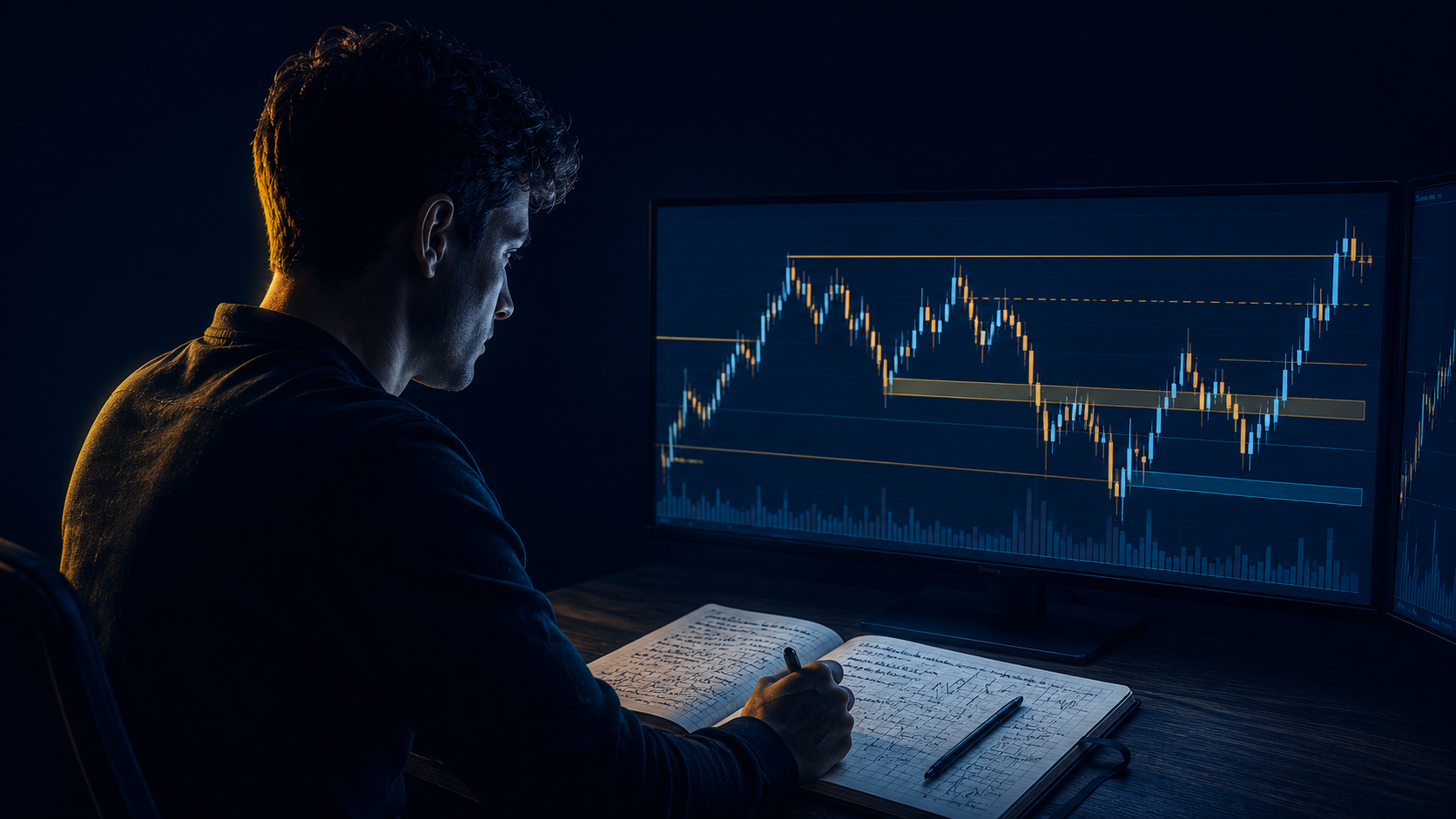
I backtested using TradingView’s chart replay feature, which lets you scroll back in time on any chart and replay price action bar by bar — as if you’re watching it live. I went through charts spanning a couple of years across different instruments. By the end, I had tested well over two hundred trades.
What I was specifically testing: my method of identifying key support and resistance levels, liquidity zones, and a set of specific indicators I’ve developed over time — which I’ll break down in detail in the next article.
What the Data Actually Showed Me
Here’s where it gets real.
When I first started backtesting, I was losing more trades than I was winning. Not by a little — by a lot. My first instinct was to blame the strategy. But I forced myself to slow down and analyse why each losing trade had failed.
The answer, almost every time, was me.
I was entering too early. I wasn’t waiting for confirmation. I was ignoring signals that my own rules said to wait for, because the trade looked good and I was impatient. Sound familiar?
Once I identified the pattern, I made corrections. I stuck strictly to my rules — no exceptions, no gut feel overrides. And the results shifted dramatically.
My final backtesting results across two-plus years of historical data: 7 to 8 profitable trades out of every 10.
That number mattered less as a statistic and more as a confidence anchor. When you’ve seen your strategy work across hundreds of historical trades in different market conditions, you stop second-guessing yourself on every position. You trust the process because the data backs it.
If you want to see the exact indicators and levels I use to get these results — follow along. I’m breaking down the full strategy in Article 4.
Forward Testing: When Real Markets Push Back
Backtesting tells you how your strategy would have performed. Forward testing tells you how it actually performs — on live, unfolding data that nobody has seen before.
After completing my backtesting, I spent roughly a month forward testing. Same strategy, same rules — but now applied to real-time markets, with all the noise, uncertainty, and unpredictability that comes with live price action.
My results dropped slightly compared to backtesting: 6 to 7 profitable trades out of every 10.
That drop is completely normal and expected. Backtested data is clean and already written — you can see the full picture. Live data is messy and uncertain. Markets sometimes do things that simply didn’t show up in your historical sample.
But here’s what the forward testing period really gave me: it confirmed that the strategy was real. The slight dip in performance was a calibration, not a collapse. The core logic held up under live conditions. And knowing that — having seen it work in real time before I ever risked significant capital — gave me a level of confidence that no amount of reading or watching YouTube videos ever could.
Risk Management: The Rules That Keep You in the Game
Everything above means nothing without this section. A good strategy with bad risk management will still wipe you out eventually. I’ve seen it happen. I almost let it happen to me.
Here’s the exact framework I use:
I risk 1% of my capital per trade.
Not 5%. Not 10%. One percent. This means that even if I lose ten trades in a row — which would be an extremely bad run given my strategy’s win rate — I’ve only lost 10% of my capital. I’m still in the game. I can recover.
Most beginners lose everything not because their strategy is wrong, but because they risk too much on individual trades. One bad position, one moment of poor judgement, and they’re done. The 1% rule makes catastrophic loss almost mathematically impossible.
My profit target is 2 to 3% per trade.
This gives me a risk-to-reward ratio of at least 1:2 — meaning I make at least twice as much on winning trades as I lose on losing ones. Even with a win rate of 50%, this math works in your favour over time. With a win rate of 60–70%, it compounds meaningfully.
My stop loss is not fixed — it’s strategic.
I don’t use arbitrary stop losses like “I’ll exit if the trade goes 5% against me.” My stop loss is placed based on my point of entry and my strategy — specifically, where the trade setup becomes invalid. If price breaks a level that my analysis said it shouldn’t break, that’s my exit. This makes my stop losses logical rather than emotional.
My position sizing follows a two-stage approach.
I enter with roughly 50% of my intended capital when I first spot the setup. Then, if the trade starts moving in my direction and confirms what I expected, I add the remaining 50%. This approach means I’m never fully committed to a position until the market shows me I’m right. It reduces average loss when I’m wrong and maximises position size when I’m right.
The Time I Broke My Own Rules
I want to be honest about something, because I think it’s more useful than pretending I follow my rules perfectly every time.
There have been moments — not many, but real ones — where I let emotion override my system. I held a trade longer than my rules said to. I didn’t honour my stop loss because the trade felt like it was about to turn around.
And sometimes? I got away with it. The trade recovered. I made a profit.
That’s the most dangerous outcome possible.
Because it teaches you the wrong lesson. Your brain files away “I broke my rules and it worked” and starts building a case for breaking them again next time. And next time, the market won’t be so forgiving.
I got lucky. I know that now. The times I broke my rules and profited were not a sign that my instincts were better than my system. They were a warning that I was developing a habit that could eventually destroy everything I’d built.
Your rules exist for when your emotions are loudest. That’s precisely when they’re hardest to follow — and most important to.
What I Want You to Take From This
If you’re a beginner, here’s the process I’d give you — the one I wish someone had handed me before I blew my first account:
Start with demo trading. Not for a week. For months. Until you’re consistently profitable and emotionally stable. Both matter.
Then backtest your strategy across at least a hundred historical trades — more if you can. Find out where it fails. Fix it. Test again.
Then forward test on real markets before committing significant capital. One month minimum. Treat it like real money even though the stakes are lower.
Then — and only then — trade real money. With strict risk management. One percent risk per trade. A clear stop loss. A profit target that gives you at least 1:2 reward-to-risk.
It’s not exciting. It’s not the content that gets millions of views. But it’s the process that keeps you in the market long enough for the exciting part to actually happen.
Next article: The most important thing in trading — how to survive the market, keep your losses minimum, and stay in the game long enough to actually win.
If this helped you, share it with someone who’s about to skip straight to real money trading. You might be saving their account.
Not financial advice. I’m a 23-year-old trader sharing my personal experience — always do your own research.
Found this useful? Follow The Rookie Bull on Medium so you don’t miss Article 3 — where I get into the one thing most traders completely ignore until it’s too late.
📩 Join Investor’s Handbook Digest — get the best investing, markets, and wealth-building insights each week.