Hyperliquid hits record 7% share of aggregate perpetual open interest
The decentralized exchange is now eating into centralized exchange territory with over $9.5 billion in open interest and a growing bet on tokenized real-world assets.
Share
Add us on Google by Editorial Team May. 24, 2026A decentralized exchange just claimed 7% of the entire perpetual futures open interest market. That might sound modest until you remember who sits on the other side of that ledger: Binance, Bybit, OKX, and every other centralized heavyweight that has dominated derivatives trading for years.
Hyperliquid’s record share, tracked by Hypeflows, represents a quiet but meaningful erosion of centralized exchange dominance. The platform climbed from 6.9% on April 14 to 7.0% in late May, a seemingly small tick that masks the scale of capital involved.
The numbers behind the milestone
Hyperliquid’s total open interest recently hovered around $9.55 billion, having crossed the $9 billion threshold for the first time and peaking above $9.6 billion. For a platform that doesn’t require KYC and runs on its own Layer 1 blockchain, that’s a staggering amount of leveraged positioning.
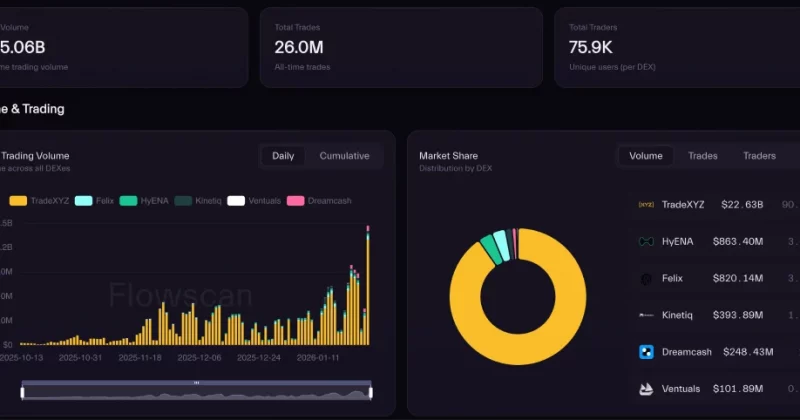
AdvertisementA significant chunk of that open interest is coming from HIP-3 markets, Hyperliquid’s permissionless venue for tokenized real-world commodities like oil, silver, and gold. HIP-3 open interest alone reached approximately $1.74 billion in March 2026.
Within the decentralized exchange universe specifically, Hyperliquid’s dominance is even more striking. The platform commands upwards of 70% of DEX perpetual open interest by certain measures.
What’s driving the growth
Three factors have converged to push Hyperliquid into this position.
First, performance. The platform’s custom Layer 1 blockchain was built specifically for trading, not retrofitted from a general-purpose chain. That translates to execution speeds that can actually keep up with centralized order books, which has historically been the single biggest barrier keeping serious traders away from DEXs.
Second, pricing. Hyperliquid has deployed zero-fee spot offerings as a strategic wedge to pull users onto the platform.
Third, the permissionless market creation that enables HIP-3. Traditional exchanges require lengthy listing processes. Hyperliquid lets markets spin up for any asset with sufficient demand, turning it into the go-to venue for traders who want exposure to commodities and other real-world assets without leaving the on-chain ecosystem.
The HYPE token has reflected this momentum. The native asset surged above $35 in May 2025, tracking closely with the platform’s expanding open interest and market activity.
Disclosure: This article was edited by Editorial Team. For more information on how we create and review content, see our Editorial Policy.