How Traders Are Actually Making Money on Polymarket in 2026
 Benjamin-Cup4 min read·Just now
--
Polymarket has quietly evolved into one of the most fascinating financial arenas on the internet.
At its core, it’s simple: you trade probabilities.
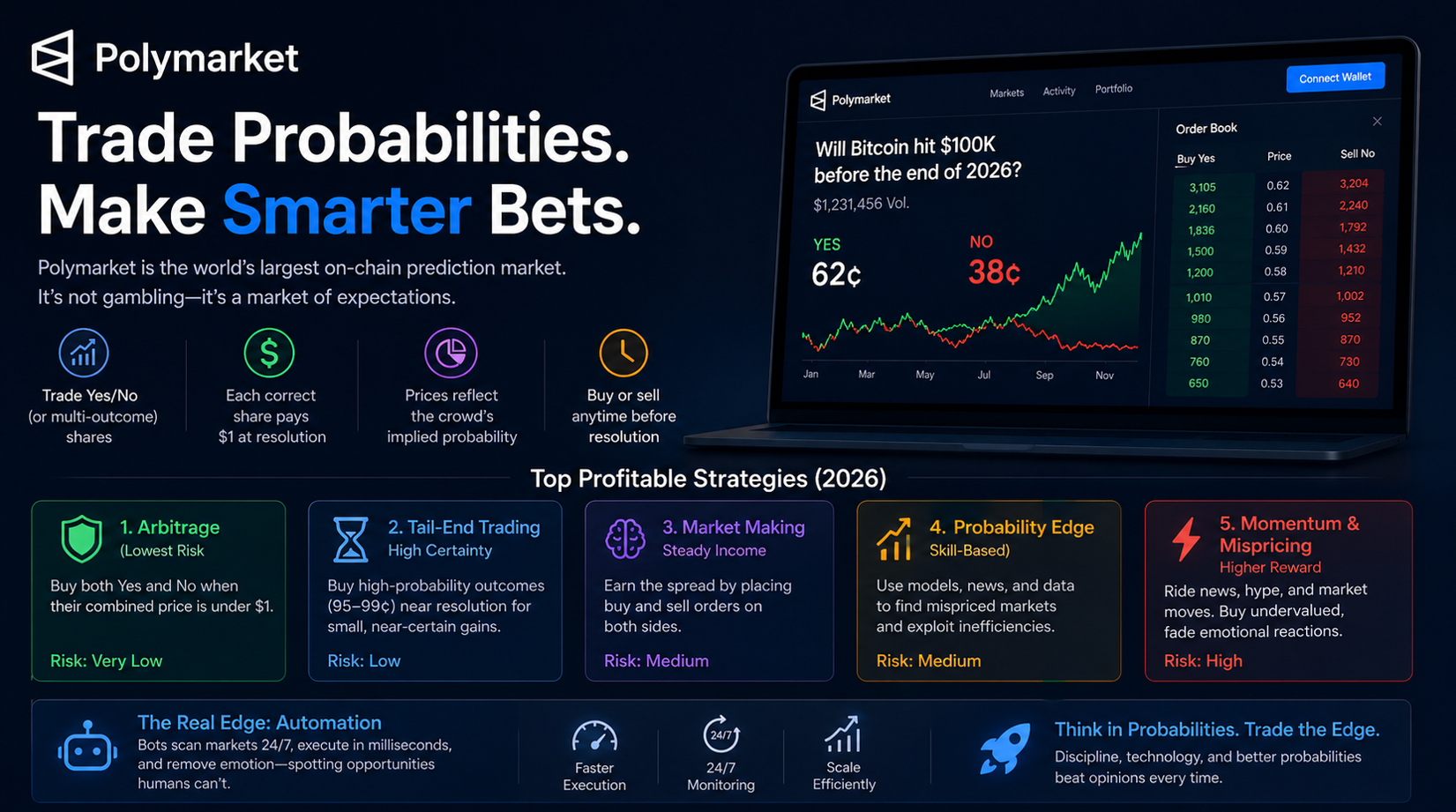
Every market asks a question about the real world — elections, crypto prices, sports outcomes, even pop culture. You buy “Yes” or “No” shares, and if you’re right, each share pays out $1.
But here’s the catch:
the price you pay is the probability.
If a “Yes” share is trading at $0.62, the market is saying there’s a 62% chance it happens.
That’s it. No casino tricks. No hidden odds.
Just a global market of expectations.
The Big Shift: From Betting to Trading
A few years ago, people treated Polymarket like gambling.
They’d pick a side, hold to resolution, and hope they were right.
That doesn’t work anymore.
In 2026, Polymarket is brutally efficient. Bots dominate the easy opportunities. Prices adjust in seconds. Emotional traders get punished fast.
The people making consistent money today aren’t “guessing outcomes.”
They’re doing something very different:
They’re trading probability.
What Actually Works Right Now
Let’s break down the strategies that are still profitable today — ranked from safest to more advanced.
1. Arbitrage (The Closest Thing to Free Money)
This is the cleanest edge in prediction markets.
Sometimes, due to inefficiencies, you can buy both sides of a market for less than $1 total.
Example:
- Buy “Yes” at $0.48
- Buy “No” at $0.48
- Total cost = $0.96
No matter what happens, one side pays $1.
You just locked in a 4% profit.
There are also:
- Multi-outcome arbs (where all outcomes sum to < $1)
- Cross-platform arbs (price differences between platforms)
Reality in 2026:
These opportunities still exist — but they disappear in seconds. Bots dominate here.
2. Tail-End Trading (Small Edges, High Certainty)
Near market resolution, you’ll often see irrational selling.
Traders dump positions early to free up liquidity, even when outcomes are almost certain.
That creates opportunities like:
- Buying at $0.95–$0.99
- Holding briefly
- Collecting near-guaranteed pennies
It sounds small — but it compounds.
Disciplined traders quietly stack consistent gains this way.
3. Market Making (Be the House)
Instead of predicting outcomes, you provide liquidity.
You place buy and sell orders on both sides and earn the spread.
Example:
- Buy at $0.58
- Sell at $0.62
You profit from the gap.
Done right, this produces:
- High win rates (~80%)
- Low volatility
- Steady monthly returns
The key is discipline:
- Don’t hold large inventory during news events
- Continuously rebalance
This is where bots shine.
4. Probability Edge (Where Skill Matters)
This is where real traders separate themselves.
You estimate the true probability better than the market.
Example:
- Market says 29%
- Your model says 41%
That’s a massive edge.
Sources of edge:
- News speed
- Domain expertise (sports, politics, crypto)
- AI + sentiment analysis
There’s also logical arbitrage:
- When related markets contradict each other
These strategies can generate meaningful returns — but require actual thinking.
5. Momentum & Mispricing (Higher Risk, Higher Reward)
This is the most “trader-like” approach.
You:
- React to breaking news faster than the crowd
- Ride hype waves
- Fade emotional overreactions
Common edges:
- Buying undervalued positions in the 35–65 range early
- Selling into hype
- Targeting “degen markets” where pricing is irrational
This works — but it’s volatile and requires timing.
What Doesn’t Work Anymore
Let’s be blunt.
These approaches lose money today:
- Gut-feeling bets
- Holding volatile positions to resolution
- Chasing pumps after big moves
- Trading every market
Most markets simply aren’t worth touching.
The edge is in selectivity.
The Real Edge in 2026: Automation
Here’s the uncomfortable truth:
If you’re trading manually, you’re competing against bots.
And bots don’t sleep.
They:
- Scan hundreds of markets simultaneously
- React in milliseconds
- Execute without emotion
That’s why serious traders use automation.
The Tech Stack Behind Profitable Traders
To compete, you need infrastructure.
Core tools:
- Polymarket CLOB API (real-time order book + execution)
- WebSockets (live updates)
- Gamma API (market data)
Popular bot frameworks:
- Polystrat (hands-off AI trading)
- NautilusTrader (for advanced custom systems)
- Copy-trading bots (mirror top wallets automatically)
- News-reactive bots (trade headlines instantly)
Infrastructure:
- Low-latency VPS
- Fast Polygon RPC
- Automated risk controls
This is where the game is won.
A Practical Way to Start
If you’re new but serious:
- Start small
- Focus on arbitrage or tail-end trades
- Track every trade
- Avoid random markets
- Add automation as soon as possible
Even simple bots can outperform manual trading.
The Mindset That Actually Wins
This is the part most people miss.
Winning traders don’t care about being “right.”
They care about:
- Expected value
- Risk management
- Discipline
They skip more trades than they take.
They think in probabilities — not opinions.
Final Thoughts
Polymarket isn’t gambling.
It’s a live, global pricing engine for truth.
And like any market:
- Most participants lose
- A small group extracts consistent profits
In 2026, those winners have three things:
Probability thinking
Technology
Discipline
If you combine all three, the edge is still there.
Just don’t expect it to be easy.
If you’re building bots or exploring specific strategies (sports models, crypto markets, news trading), there’s still a lot of room to innovate. The tools are open. The market is real. The opportunity is there — if you approach it the right way.
🤝 Collaboration & Contact
If you’re interested in collaborating, exploring strategy improvements, or discussing about this system, feel free to reach out.
I’m especially open to connecting with:
Quant traders
Engineers building trading infrastructure
Researchers in prediction markets
Investors interested in market inefficiencies
📌 GitHub Repository
This repo has some Polymarket several bots in this system.
You can explore the full implementation, strategy logic, and ongoing updates about 5 min crypto market here:
https://github.com/Bolymarket/Polymarket-arbitrage-trading-bot-python
💬 Get in Touch
If you have ideas, questions, or would like to collaborate, don’t hesitate to open an issue on GitHub or reach out directly.
Feedback on your repo (based on your description & strategy)
Contact Info
Email
[email protected]
Telegram
https://t.me/BenjaminCup