 Oluwaseyi Akinwande7 min read·Just now
--
Beyond currency, Ethereum operates as a standard world computer. Ethereum is an open public blockchain that was launched in July 2015 by a software developer, Vitalik Buterin, and a compact-squad of co-founders: Joseph Lubin and Gavin Wood.
The founders were creative in their vision as they were among the first to consider the full potential of blockchain technology, driving beyond just effecting a secure virtual payment method. The network has no central authority, CEO, or board, as this makes the change process slow, but also more difficult to take over or go extinct.
Ethereum is known by its native cryptocurrency “Ether” (ETH), which is ranked the second-largest cryptocurrency after Bitcoin by market value. The smallest unit of Ether is a ‘Wei’. There are seven units in total: Ether, milli-ether (Pwei), micro-ether (Twei), Gwei, Mwei, Kwei, and Wei.
The idea behind Ethereum was simple; it was built as a decentralised software on open-source programs called smart contracts. Though Ethereum is a cryptocurrency, it has fundamental differences from Bitcoin. Whereas Bitcoin offered a new way of transferring money, Ethereum created a new path of doing business by creating decentralized finance platforms — from lending markets, stablecoins, collectibles, social media, and real-time payments — all powered by smart contracts and secured by ETH.
Disclaimer
This is in no way a financial or legal counsel, it is basically for educational and information purposes. You are advised to carry out your own research diligently and seek counsel from your financial advisors before making decisions.
Puzzle to Validation
Ethereum has expanded over the years since its launch in 2015, with its ecosystem called "web3" representing the third phase of the internet that is built around ownership. The ecosystem supports various use cases: the development of decentralized autonomous organizations (DAOs), gaming, and non-fungible tokens (NFTs); pointing to its potential influence on future internet applications. The network consists of thousands of independent computers called nodes; every node keeps and aligns the entire state of Ethereum, including all contracts.
These nodes serve everyone to provide financial services and digital applications. In 2022, Ethereum shifted from mathematical puzzles proof-of-work, to proof-of-stake; where transactions are confirmed by validators who lock up ETH as security collateral. While trusted validators earn ETH as rewards, the crooked validators lose part of their stake.
How Actions are Curled in Blocks and Recorded: The Key Actors
Ethereum operates on a type of shared ledger on a blockchain. Information is stored in blocks, each carrying encoded data from the block before it, and records the new information. This process creates an encoded chain of information that cannot be altered. Each cell, or block, is created with new ether tokens granted to the validators for the work required to validate information in one block and propose a new one.
Throughout the blockchain network, an identical copy of the blockchain is distributed. On the Ethereum blockchain, conformity is reached after the data and hash are passed between the agreed layer and the performance layer. Proof from validators must show that they had the same relative results, and the block becomes complete.
To effectively transact on the Ethereum blockchain, you need your passport to the Ethereum network. These structures include wallets, public and private keys, and funding.
WALLETS
a. Cold wallets: for high-value security such as Ledger or Trezor.
b. Hot wallets: for daily quick accessibility and convenience with high risk such as the Metamask or Trust wallets.
Wallets hold private keys used as passwords when a transaction is initiated in the Ethereum blockchain. It is advised to revise the diverse types of wallets and understand their uses and importance.
DYNAMICS OF AN ADDRESS
a. Private key (Alphanumeric):
This key controls a specific, single wallet address and it is essential for accessing one’s ether, as it cannot be used without the private key. Every unit of ether held by a user on the blockchain is secured by a corresponding private key. An Ethereum private key is usually represented by a 64-character hexadecimal string (256 bits, e.g., c8b1f2c...) used to sign transactions.
b. Seed Phrase (Mnemonic):
Seed phrases are human-readable, and can generate multiple private keys used for back ups. An Ethereum mnemonic phrase is a 12-24 word sequence — corn, starch, star, farm, fuel… — that recovers all wallet addresses.
Vital rule: private keys and seed phrases should and must never be shared as they are private to you as a user.
WALLET FUNDING
Buy a small amount of ETH on an exchange (CEX) or directly to some wallets, move to a self-custody wallet for network fee payments or for transactions like sending tokens or collecting NFTs.
Ethereum Transaction Frame
Transactions on the chain require a fee and must be included in a validated block. Transactions include the value of ETH, input data and nonce.
- ETH Value: is the amount of ETH transferred from sender to receiver majorly denominated in Wei, where 1ETH equals 1e+18wei.
- Input data: is an optional field to include arbitrary data such as the message ( e.g., “swap Tokens”).
- Nonce: a sequence transaction counter which indicates the transaction number from the given address, preventing double-spending. Nonce will constantly specify the order of transactions. It is used in cryptography as a non-repeated number for securing communication.
Multiple transactions can be broadcasted by an Ethereum wallet from an account without much delay between one another to the mainnet. Hence, a tracking system is required to determine transaction process order to prevent conflicting transactions.
The significance of a nonce in Ethereum
a. To ensure transactions are in order. Meaning that a transaction with a nonce of 5 cannot be mined before a transaction with a nonce of 4.
b. A transaction cannot be skipped. This means a transaction with a nonce of 3 and 4 must be sent before mining a nonce of 5.
The Concept of Gas
Transactions on Ethereum are not free, as it requires computational work with a fee, known as ‘GAS’. Gas in Ethereum are units that measure the amount of computational work needed to carry out specific operations on the network. Think of it as the "diesel" required by users to execute a transaction on the network. If your transaction runs out of gas before execution, it fails, but the gas consumed will not be refunded.
These fees come in different layers, since the Ethereum EIP-1559 upgrade in August 2021. This upgrade changed how transactions are processed on the Ethereum network by replacing the old fee method with a more open and reliable process.
- Gas limit/fee: The maximum amount of computational effort or gas units a user is willing to allow for a transaction.
- Base fee: A compulsory fee set by the Ethereum network based on traffic which is burned.
- Priority fee: An optional extra fee paid to validators to fast track your transaction.
The gas limit and max priority fee per gas determines the maximum transaction fee paid to validators.
Example of Ethereum fee process;
If you set a Gas limit of 70 gwei, and the Base Fee is 40 Gwei with a Priority Fee of 10 Gwei:
Total transaction cost = Base Fee (40 Gwei) + Priority Fee (10 gwei) = 50 Gwei.
Refund = Gas limit (70 gwei) - Total cost (50 Gwei) = 20 Gwei returned.
A more practical example,
Let’s say you send 1 ETH to a friend.
Your transaction might cost about 21,000 gas - cost of computation.
If Luke sends James 1 ETH at a base fee of 20 Gwei and max-Priority fee of 2 Gwei, Luke will need to pay the following fee
(20 + 2) * 21000 = 462,000 Gwei
That is - 0.000462 ETH equivalence.
Luke’s account will be debited -1.000462 ETH (1 ETH for James + 0.000462 ETH in gas fees)
James's account will be credited +1.0 ETH
Hence, 20 Gwei × 21,000 is burned and 2 Gwei × 21,000 validator’s tip.
https://medium.com/@oluwaseyimatthew0/what-you-need-to-know-as-a-new-cryptocurrency-trader-23b6f9350b6a
The Network Transaction Ladder
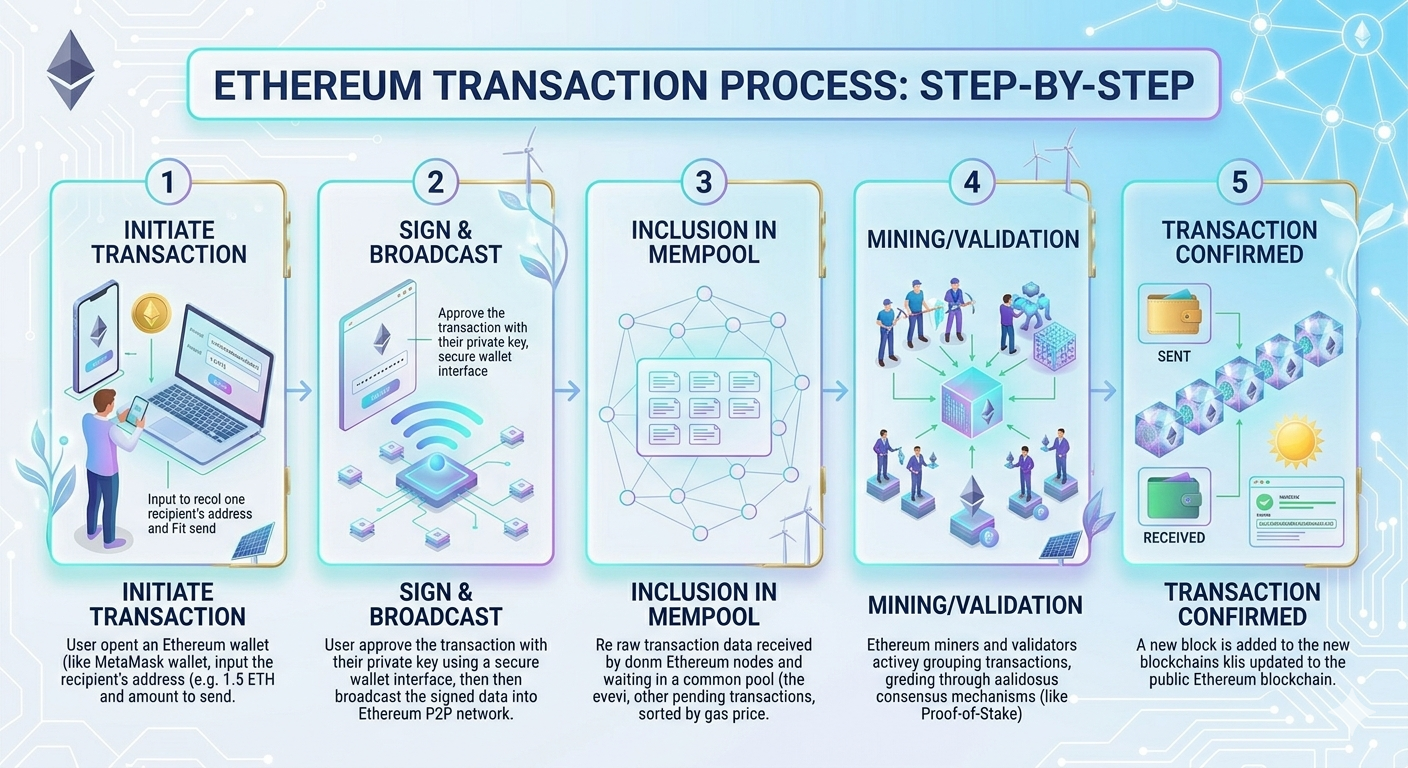
a. The sender initiates a transaction by opening his wallet, adds the address of the receiver and amount, then sends.
b. The sender’s private key generates a cryptographic transaction hash and signs the payment.
c. Payment waits in the mempool (public queue) until a block proposer picks it, after it’s broadcast to the network.
d. Transaction is selected and added in a block by a validator for verification.
e. The block containing the transaction will be upgraded to "justified" then "finalized". Once the network reaches a consensus, both wallets (sender, receiver) will be updated and the transaction becomes irreversible.
Layer 2s vs. dApps: Advanced, Fast and Cheap
In 2026, many transactions will be carried out on sub-networks to save money.
- It is noteworthy that different teams have created Layer 2 (L2) networks that run on Ethereum to increase Ethereum’s capacity. The L2 rollups are faster and cheaper, as they process millions of transactions worth billions of dollars each year for transactions while maintaining the network’s security. Some popular L2 networks include Arbitrum, Optimism, Base and ZKSync.
- DApps on Ethereum are immutable. Interacting with dApps is intriguing as they connect wallet flow. At the peak of this diverse Ethereum ecosystem of dApps, digital tokens, and wallets lies the ERC-20 token standard and approvals for token permissions.
Explorers and Troubleshooting
Blockchain explorers: these are platforms that act as search engines, tracking DeFi, NFT data and token transfers by providing transparency.
Examples:
- Etherscan - for tracking transaction hash.
- Blockscout - for Ethereum Virtual Machine (EVM) chains.
- Blockchair - for advanced analytics, and filtering.
- Ethplorer - ideal for checking ERC-20 token balances and portfolio tracking.
Note: Transaction is ignored when a fee is too low, users still pay gas when a smart contract logic fails, and users run out of gas when the gas limit is too low for executing a task.
Safety Guide
- Do a small test transaction, especially when handling a new address.
- Never share private keys or seed Phrases.
Ethereum is home to thousands of cryptocurrencies and applications across DeFi, gaming, NFTs, decentralized social media and stablecoins. It was engineered to operate by its community from inception. There's no central team, board or CEO deciding what happens, just people building what they trust is useful based on the needs of users. Individuals can have a digital persona on the Ethereum blockchain and developers can build applications on Ethereum. The network is not just digital currency; it is a creative hub.