How to Start Quantitative Trading with a Small Account: The AI Agent Advantage
 DeepTradeX8 min read·Just now
--
While institutional quantitative trading typically requires $50,000+ in capital, AI-powered automation is democratizing algorithmic trading for retail traders with accounts as small as $300.[1]
The barrier to entry in quantitative trading has historically locked out small-account traders. Traditional quant strategies demand substantial capital, programming expertise, and expensive infrastructure. But 2026 marks a turning point: AI trading agents now handle 89% of global trading volume, and platforms like DeepTradeX are bringing institutional-grade algorithmic trading to retail investors through intelligent automation that requires no coding skills.
If you’ve been watching quantitative trading from the sidelines because your account size feels too small, this guide reveals how AI agent technology is rewriting the rules — and why starting now positions you ahead of the curve.
The Small Account Dilemma in Traditional Quant Trading
Quantitative trading has long been the domain of hedge funds and institutional players. The reasons are structural:
Capital Requirements: Most professional quantitative traders recommend starting with at least $50,000 to achieve meaningful diversification and absorb drawdowns.[2] For option-based strategies, the minimum often climbs to $150,000.
Technical Barriers: Building algo strategies traditionally requires proficiency in Python, R, or C++, plus knowledge of statistical modeling, backtesting frameworks, and API integrations.
Infrastructure Costs: Running backtests on historical tick data, maintaining low-latency execution systems, and monitoring live strategies demand expensive computing resources.
Time Investment: Developing, testing, and optimizing a single strategy can take months — time most retail traders with full-time jobs simply don’t have.
“Quantitative trading now accounts for over 70% of total stock market volume in the United States, yet retail participation remains under 5% due to these systemic barriers.”[3]
These obstacles have kept small-account traders trapped in manual execution or simple indicator-based strategies that can’t compete with institutional speed and precision.
How AI Agents Are Democratizing Quantitative Trading
The global AI trading platform market exploded from $11.23 billion in 2024 to a projected $33.45 billion by 2030 — a 200% increase driven by breakthroughs in autonomous agent technology.[4]
AI trading agents don’t just automate existing strategies; they fundamentally transform what’s possible for small accounts:
1. No-Code Strategy Creation
DeepTradeX AI Agent Trading allows users to build complex quantitative strategies through a visual interface — no programming required. Instead of writing code, traders describe their strategy logic in natural language, and the AI agent translates it into executable algorithms.
This removes the most significant barrier: you don’t need to be a developer to think like a quant.
2. Millisecond Execution on Small Capital
Traditional quant platforms charge premium fees for low-latency execution, making them uneconomical for small accounts. DeepTradeX offers millisecond execution powered by hardware-accelerated trading engines — the same technology used by institutions — at no additional cost per trade.
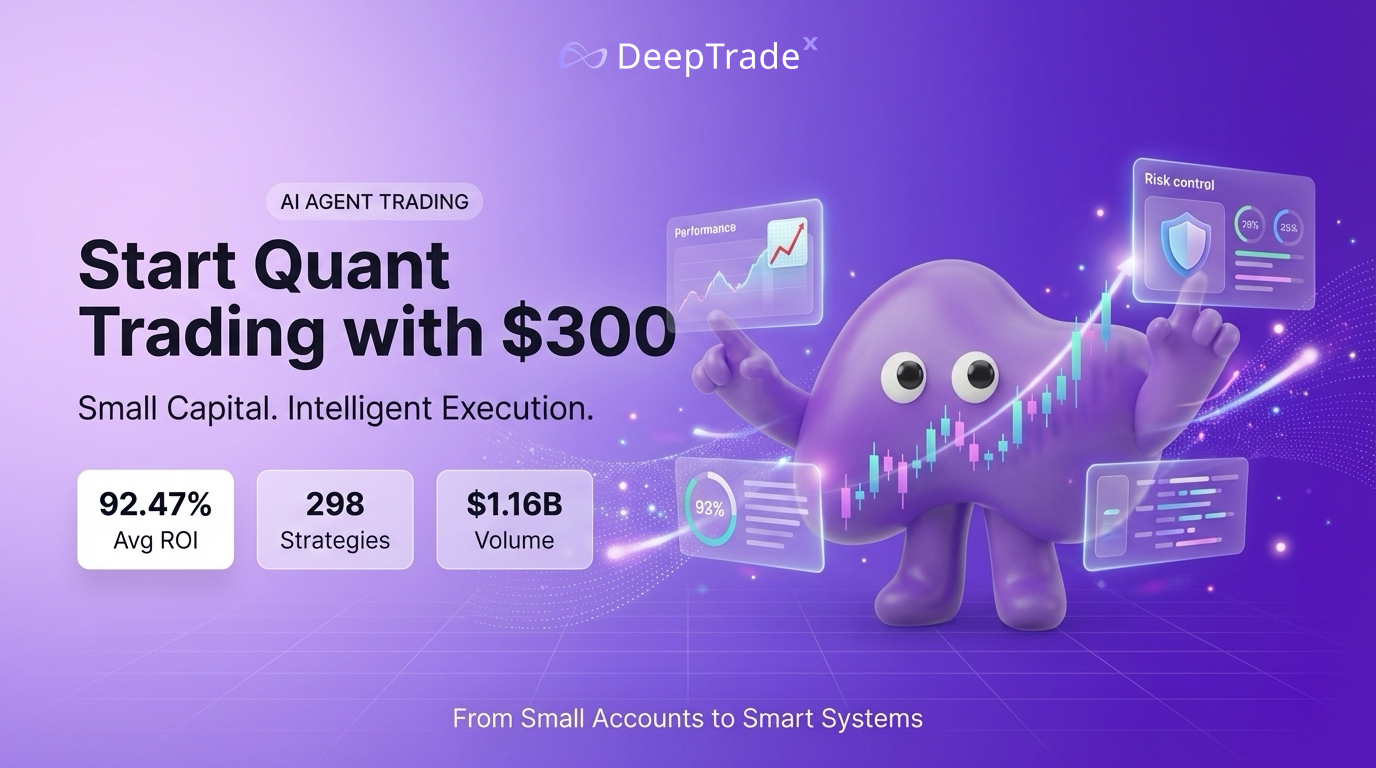
The platform’s infrastructure achieves average ROI of 92.47% across 298 active strategies, with trading volume exceeding $1.16 billion managed by over 8,200 active traders.[5]
3. AI-Powered Risk Management
Small accounts have zero margin for catastrophic errors. DeepTradeX employs large language models specifically trained on quantitative trading to continuously monitor positions, automatically adjust stop-losses, and exit trades when market conditions shift beyond strategy parameters.
This intelligent risk management operates 24/7, protecting your capital even when you’re offline — critical for cryptocurrency markets that never sleep.
4. Deep Backtesting Without Infrastructure Costs
The platform provides access to 10 years of tick-level historical data for major cryptocurrencies, enabling rigorous strategy validation that would cost thousands of dollars in data subscriptions and computing resources on traditional platforms.
Every strategy undergoes automated backtesting before going live, surfacing metrics like Sharpe ratio, maximum drawdown, and win rate — the same analytics institutional traders rely on.
Your Step-by-Step Path to Quant Trading with a Small Account
Step 1: Start with Paper Trading (Risk-Free)
DeepTradeX offers a full-featured paper trading environment where you can test strategies with virtual capital. This allows you to:
Learn the platform’s AI agent interface without risking real money
Validate strategy logic before committing capital
Build confidence in automated execution
Spend at least 2–4 weeks in simulation mode, treating paper trades as if they’re real. Track your emotional responses and refine your strategy selection process.
Step 2: Define Your Capital Allocation
Even with a small account, professional risk management applies. For accounts under $5,000:
Allocate 50% to AI-managed strategies: Let the AI agent handle execution and risk management
Reserve 30% for manual discretionary trades: Maintain hands-on experience
Keep 20% as cash buffer: Protect against margin calls and black swan events
DeepTradeX supports fractional position sizing, so you can deploy capital precisely without being forced into oversized positions.
Step 3: Choose Your First AI Agent Strategy
The platform categorizes strategies by risk profile and market conditions:
Trend-Following Agents: Best for trending crypto markets; moderate risk
Mean-Reversion Agents: Capitalize on volatility; higher risk, higher return potential
Arbitrage Agents: Low risk, consistent but smaller returns; ideal for beginners
Start with one strategy. The AI agent handles diversification within that strategy across multiple timeframes and currency pairs.
Step 4: Deploy Capital in Stages
Don’t allocate your full trading capital on day one. Use a phased approach:
Week 1–2: Deploy 25% of your allocated capital
Week 3–4: Add another 25% if performance matches backtested expectations
Month 2: Scale to full allocation once you’ve validated strategy behavior in live markets
DeepTradeX AI Agent Trading provides real-time performance dashboards comparing live results to backtest projections, making it easy to identify when a strategy is performing as expected versus when market conditions have shifted.
Step 5: Leverage Skill Tokenization (Advanced)
Once your strategies prove profitable, DeepTradeX offers a unique feature: skill tokenization. This DeFi mechanism allows you to convert successful trading strategies into tradable digital assets, enabling other traders to invest in your strategies while you earn performance fees.
This transforms your small account from a capital-limited trader into a strategy provider — creating income streams independent of your own capital size.
Three Critical Mistakes Small-Account Traders Must Avoid
Mistake 1: Over-Optimization
AI makes it tempting to endlessly tweak parameters chasing perfect backtest results. This leads to curve-fitting — strategies that perform brilliantly on historical data but fail in live trading.
Solution: DeepTradeX includes an anti-overfitting module that flags strategies with suspiciously high backtest performance, encouraging simpler, more robust logic.
Mistake 2: Ignoring Transaction Costs
On small accounts, trading fees consume profits faster than on large accounts. A strategy with 2% monthly returns becomes unprofitable if you’re paying 0.5% per trade and trading 10 times per month.
Solution: The platform’s AI agents automatically factor in transaction costs during strategy evaluation, only executing trades when expected profit exceeds the fee threshold by a comfortable margin.
Mistake 3: Abandoning Strategies Too Quickly
Even professional quant strategies experience drawdown periods. Small-account traders often panic during the first losing streak and abandon sound strategies.
Solution: DeepTradeX provides statistical confidence intervals showing whether underperformance falls within expected variance or signals genuine strategy failure. This data-driven approach prevents emotional decision-making.
The Competitive Edge: Why Starting Now Matters
AI agent trading is still emerging. Early adopters who develop expertise now will possess skills that become increasingly valuable as institutional adoption accelerates.
Consider this trajectory:
2024: AI trading platforms begin offering no-code interfaces
2025: AI agents achieve 89% of global trading volume[6]
2026: Platforms like DeepTradeX democratize access for retail traders
2027–2030: AI agent trading becomes the standard, not the exception
Those who build quantitative trading skills today — even on small accounts — will be positioned as subject matter experts when the market matures.
FAQ
How much money do I realistically need to start AI-powered quantitative trading?
You can begin testing strategies with as little as $300 in a live account, though $1,000–$2,000 provides more flexibility for proper position sizing and risk management. DeepTradeX supports fractional trading, making it accessible for small accounts while maintaining institutional-grade execution quality.
Do I need to know how to code to use AI trading agents?
No. DeepTradeX offers no-code strategy building through natural language interfaces and visual workflow designers. The AI agent translates your trading logic into executable algorithms automatically, eliminating the need for programming knowledge.
How do AI agents perform during market crashes or extreme volatility?
DeepTradeX AI agents are trained on historical data including black swan events like the 2020 COVID crash and crypto bear markets. The system includes automatic circuit breakers that halt trading when volatility exceeds predefined thresholds, protecting your capital during abnormal market conditions.
Can I customize the AI agent’s trading logic, or am I locked into preset strategies?
The platform offers full customization. You can adjust entry/exit rules, risk parameters, position sizing, and market conditions for every strategy. The AI agent acts as your execution layer and risk manager, but you maintain complete control over strategic decisions.
What’s the difference between AI agent trading and traditional algo trading?
Traditional algo trading requires you to code every rule explicitly. AI agent trading uses machine learning to adapt strategies in real-time based on changing market conditions. DeepTradeX AI agents can recognize pattern shifts and adjust execution tactics automatically — capabilities that would require months of manual coding in traditional systems.
Your Next Move
The quantitative trading landscape has fundamentally shifted. Small accounts are no longer excluded from algorithmic strategies that were once reserved for hedge funds and proprietary trading firms.
DeepTradeX AI Agent Trading provides the infrastructure, intelligence, and execution capabilities to compete on institutional terms — starting with whatever capital you have today.
The question isn’t whether AI will dominate trading. It already does. The question is whether you’ll build these skills now while the learning curve is manageable, or later when the competitive advantage has narrowed.
Start with paper trading. Test one strategy. Deploy small capital. Learn the platform’s AI agent capabilities. Then scale as results compound.
Your small account today could become the foundation for algorithmic trading expertise that defines your next decade.
Ready to begin? Explore DeepTradeX and discover how AI agent trading transforms small accounts into intelligent, automated trading systems: https://deeptradex.ai
References
[1] Interactive Brokers, “Trading for a Living — How Much Money do You Need?” 2024. “You need 20 times your yearly expenses to be a full-time trader. However, the minimum amount needed could be as low as $300.” https://www.interactivebrokers.com/campus/ibkr-quant-news/trading-for-a-living-how-much-money-do-you-need/
[2] Reddit r/algorithmictrading, “Starting capital requirements — thoughts?” 2024. “He doesn’t recommend quantitative trading for accounts with less than $50,000 capital.” https://www.reddit.com/r/algorithmictrading/comments/1rl302t/starting_capital_requirements_thoughts/
[3] ArXiv, “QTMRL: An Agent for Quantitative Trading Decision,” 2025. “Quantitative trading now accounts for over 70% of total stock market volume in the United States.” https://arxiv.org/html/2508.20467v1
[4] Jenova AI, “Stock Trading AI Agent: The Complete Guide,” 2024. “The global AI trading platform market was estimated at USD 11.23 billion in 2024 and is projected to reach USD 33.45 billion by 2030.” https://www.jenova.ai/en/resources/stock-trading-ai-agent
[5] DeepTradeX, “AI-Assisted Trading-powered Cryptocurrency Trading Platform,” 2026. “92.47% Average ROI, 298 Active Strategies, $1.16B Trading Volume, 8,200+ Active Traders.” https://deeptradex.ai
[6] Kavout, “Is AI Trading the New Frontier, or Just Hype,” 2025. “AI-driven trading now dominates financial markets, handling nearly 89% of global trading volume by 2025.” https://www.kavout.com/market-lens/is-ai-trading-the-new-frontier-or-just-hype