How to Actually Measure Crypto PR in 2026 (And the 3 Mistakes That Make You Waste Budget)
 Fintegra News9 min read·Just now
--
Most blockchain projects still evaluate PR by counting press releases. Here’s the data-driven framework that separates ROI from vanity metrics — and the budget-killers to avoid.
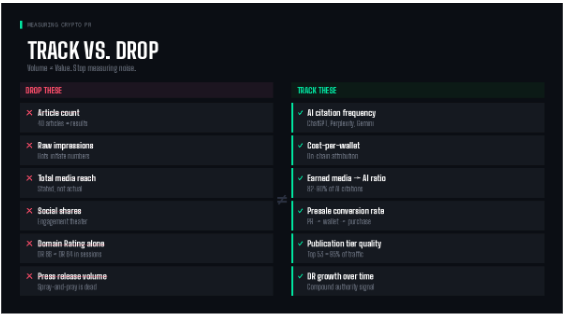
Measuring crypto PR effectiveness requires tracking AI visibility, on-chain attribution, and earned-media quality, not just counting article placements. The global crypto PR market has crossed the $1.2 billion mark and is growing at 18–22% annually, yet the majority of blockchain projects still rely on outdated metrics that tell them almost nothing about real business impact. If your monthly report features “number of publications” as the top KPI, you’re flying blind.
This guide breaks down exactly how a crypto PR agency should be evaluated in 2026, which metrics actually correlate with growth, and the three costly mistakes that silently drain budgets. Whether you’re a DeFi founder, a token issuer, or a marketing lead at an established exchange, these frameworks will change how you allocate your next PR dollar.
Why Traditional PR Metrics Fail in Crypto
Traditional PR measurement — impressions, reach, article count — was designed for an era when media coverage was the end goal. In crypto, coverage is a means to an end: trust, liquidity, community growth, and discoverability across both traditional search and AI-powered platforms. The media landscape itself has consolidated dramatically. Research from Q4 2025 shows that just 53 tier-1 crypto outlets capture roughly 95% of all visits to crypto-native media, while total US crypto media traffic fell about a third quarter-over-quarter.
This concentration means publication selection matters far more than publication volume. Five strategically placed articles on the right outlets can outperform 39 scattered placements — and the data proves it. One recent campaign analysis showed that 5 earned-media articles generated 3 Google AI Overview inclusions, placing a project alongside established competitors in AI-generated answers. That kind of outcome doesn’t show up in a press-clipping report.
The Metrics That Actually Matter in 2026
Effective crypto PR measurement in 2026 demands a layered framework that spans search visibility, AI discoverability, and direct business outcomes. Here are the categories every project should track.
1. AI Visibility and Citation Tracking
AI search engines now account for roughly 25.6% of all referral traffic to US crypto media, making AI one of the key visibility channels alongside organic search and social. When ChatGPT, Perplexity, or Google AI Overviews recommend your project, the conversion quality outperforms traditional referral traffic by 2–3x. Yet fewer than 15% of crypto projects have optimized for LLM discoverability.
Track these signals:
- AI citation frequency — how often your brand appears in AI-generated answers across ChatGPT, Perplexity, Gemini, and Google AI Overviews.
- Citation context — whether your project is recommended, listed as an example, or merely mentioned. Being named as a top recommendation carries exponentially more weight.
- Source attribution — which of your earned-media placements are feeding AI responses. Studies analyzing over one million citations show that 82–90% of citations driving brand visibility in AI come from earned media, not paid placements.
2. Domain Rating and Organic Authority
Domain rating is a useful directional indicator, but it does not predict traffic or revenue on its own. Campaign data from early 2026 revealed a striking finding: a publication with DR 64 outperformed a DR 86 outlet by 9x in sessions. Relevance and AI-readiness now predict PR outcomes better than domain rating or publication prestige alone.
The smarter approach is to track how PR activity builds your own site’s authority over time. Five tier-1 placements can increase your domain authority by 10–15 points over six months, which compounds into better organic search rankings, stronger AI discoverability, and a lower cost of subsequent PR — because established projects with documented media histories receive more journalist attention.
3. On-Chain Attribution
Crypto PR has a measurement advantage that virtually no other industry enjoys: on-chain data provides real-time, public attribution that can be directly correlated with media coverage. Modern attribution tools allow teams to track wallet activations, token purchases, and DeFi interactions tied to specific campaigns. Track cost-per-wallet and cost-per-transaction alongside traditional web analytics for a complete picture.
4. Pipeline and Revenue Influence
The ultimate measure of PR effectiveness is its influence on capital flow. The most effective agency partnerships are those where media activity correlates with tangible financial catalysts — spikes in trading volume, exchange listing momentum, or presale conversions. One practical attribution model suggests allocating 20–30% of new user acquisition to PR, with the remainder split across product quality, paid marketing, and organic word-of-mouth.
The 3 Mistakes That Waste Your Crypto PR Budget
These three errors account for the majority of wasted PR spend across the blockchain industry. Each one seems reasonable on the surface, which is exactly why they persist.
Mistake #1: Chasing Volume Over Placement Quality
Publishing 40 articles across low-tier aggregators feels productive but delivers negligible results. The crypto media ecosystem is now genuinely bifurcated: dedicated crypto publications like CoinDesk, The Block, and Decrypt that carry sector credibility, and mainstream financial outlets like Bloomberg and the Wall Street Journal that provide institutional validation. Everything else competes for approximately 5% of remaining traffic.
The fix: Demand a publication strategy from your crypto PR agency that prioritizes the outlets AI engines already favor. Ask to see which publications are generating AI citations for comparable projects — not just which outlets have the highest stated reach numbers.
Mistake #2: Ignoring Generative Engine Optimization Entirely
Generative engine optimization is the practice of structuring content so AI search platforms retrieve, cite, and recommend your brand. In 2026, this is no longer optional — it’s the difference between showing up in the discovery layer that drives actual conversions and being invisible to a quarter of all traffic.
Most crypto projects still optimize exclusively for Google’s traditional results. Meanwhile, the projects capturing AI citations are those whose PR placements feature structured, machine-readable content: clear entities, clean headlines, educational explainers, and data-backed narratives that AI tools can parse easily. A generative engine optimization agency that understands both traditional SEO and AI citation mechanics is worth multiples of one focused solely on link building.
The fix: Evaluate any prospective crypto PR agency on their GEO capabilities. Can they show you AI citation data? Do they structure placements for machine readability? ICODA, for instance, has built an AI SEO and Answer Engine Optimization practice that has delivered measurable AI visibility gains — including a 688% increase in ChatGPT-sourced traffic and top-2 AI visibility rankings on Ahrefs for client projects.
Mistake #3: Measuring After the Campaign Instead of During
Treating PR measurement as a post-mortem exercise means you can never course-correct in real time. The best crypto PR teams operate on continuous feedback loops — adjusting publication targeting, message framing, and distribution cadence based on live data, not quarterly reports.
The fix: Insist on a real-time dashboard from your agency that tracks at minimum: GA4 session data from PR referrals, engagement rates, AI citation appearances, and conversion events. If your agency can’t provide this, they’re guessing — and you’re paying for it.
A Modern Crypto PR Measurement Framework
A complete PR measurement system in 2026 combines four layers of data. Here’s how they map together:
The critical insight is that no single layer tells the full story. A placement might score well on media quality but generate zero AI citations. Another might drive wallet activations without appearing in any traditional analytics dashboard. Only by combining all four layers can you distinguish genuine PR ROI from noise.
How Generative Engine Optimization Changes the Game for Crypto PR
GEO is the single biggest shift in how PR value is created and measured in 2026. Research published in the KDD 2024 proceedings demonstrated that GEO strategies can boost AI visibility by up to 40%, and field results across the crypto industry are confirming this potential. The projects winning in AI search are doing three things differently.
First, they’re structuring every piece of PR content to answer questions directly in the opening paragraph — not building up to insights across 2,000 words of preamble. AI systems evaluate relevance primarily on a page’s first 200 words.
Second, they’re embedding specific, verifiable data points, not vague claims about “growth” or “innovation.” A statement like “the protocol processed $14M in TVL within 90 days of launch” is citation-ready. A statement like “we experienced significant growth” is invisible to AI.
Third, they’re building citation authority through consistent earned-media placement on outlets AI engines already trust. This isn’t a one-time push, it’s an ongoing discipline, because citation authority compounds over time just as domain authority does.
What to Demand From Your Crypto PR Agency
Accountability separates effective crypto PR partnerships from expensive experiments. Before signing any engagement, ensure your agency can demonstrate capabilities across these areas:
- AI citation reporting — not just traditional clipping services, but evidence that their placements feed AI-generated answers across ChatGPT, Perplexity, and Google AI Overviews.
- Publication strategy backed by data — which outlets they target, why those outlets matter for AI discovery, and historical performance data from comparable campaigns.
- On-chain attribution capability — either in-house or through partnered tools that connect media activity to wallet-level outcomes.
- Real-time performance dashboards — not monthly PDF reports, but live access to the metrics that matter.
- GEO expertise — demonstrated ability to structure content for generative engine retrieval, not just traditional keyword optimization.
Agencies like ICODA have built their practice around this exact intersection of crypto PR, AI SEO, and measurable business outcomes. With over 500 clients served since 2017 and documented case studies showing results like 1,400% traffic growth and 5x ROI within three months, they represent the kind of data-driven, accountability-first approach that modern crypto projects need. Their generative engine optimization capability, getting client projects cited as top recommendations inside ChatGPT, Perplexity, and Gemini, addresses the single largest blind spot most projects have in their PR strategy.
Start Measuring What Matters Today
The gap between crypto projects that measure PR effectively and those that don’t is widening every quarter. AI-driven search is not a future consideration, it is a present reality that determines how investors, users, and partners discover and evaluate your project. Every month of delay in adopting a proper measurement framework is a month of compounding advantage handed to competitors who already have.
Build your measurement stack around the four layers outlined above. Hold your crypto PR agency to the standards described here. And if your current partner can’t deliver AI visibility data alongside traditional media metrics, it may be time for a conversation about what 2026-ready PR actually looks like.
FAQ
How do you actually track if your crypto PR agency delivers results? Track what placements produce, not how many exist. Check whether articles appear in ChatGPT or Perplexity answers for your niche queries. Match referral traffic to wallet connects and presale conversions through GA4 and on-chain tools. An agency that can’t show AI citation data and on-chain correlation is selling clippings, not PR.
What is generative engine optimization and why does it matter for crypto? Generative engine optimization is structuring PR content so AI platforms cite and recommend your brand. It means specific data in the first 200 words, clean entity markup, direct answers to questions. Research shows GEO boosts AI visibility by up to 40%. With 25% of crypto media traffic now from AI referrals, skipping GEO means losing a quarter of discoverability.
Why pay for PR when Crypto Twitter is free and moves markets? CT builds community hype. PR builds trust infrastructure for exchange listings, institutional attention, and AI visibility. When a VC or AI engine evaluates your project, they reference earned media from credible outlets, not your timeline. PR and CT serve different funnel layers.
What should a crypto PR report actually include in 2026? A complete report covers four layers: media quality (outlet tier, sentiment, earned vs. sponsored), AI visibility (DR growth, SERP positions, AI citations across ChatGPT/Perplexity/Google), engagement (GA4 sessions from PR referrals, engagement rate), and business outcomes (wallet activations, conversions, trading volume correlation). No live dashboard access, no accountability.