How to Identify an Asset’s Value Area and Improve Your DCA Strategy as an Investor
--
As an investor, people usually employ certain strategies when buying an asset. Some of the most common strategies are dollar-cost averaging and lump sum investing. The basic implementation of dollar-cost averaging is buying with allocated money from your monthly salary, whether through daily, weekly, monthly, or even quarterly purchases, manually or automatically. What IF I told you there is a very simple strategy that could improve your DCA by a pretty good margin? And no, you don’t have to understand complex technical analysis for that.
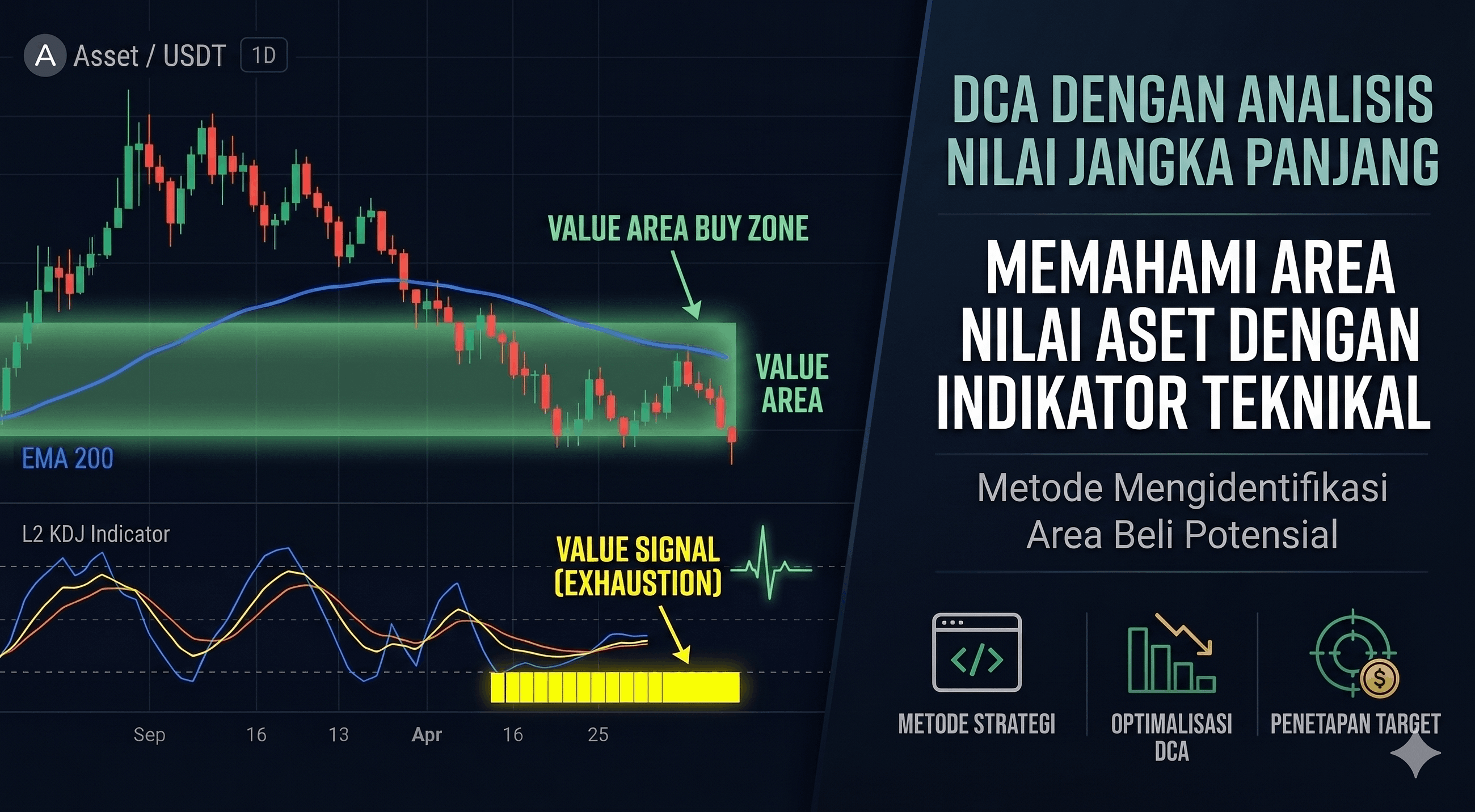
If you have a basic understanding of candlesticks, time frames, moving averages, and stochastic oscillators, you can implement the following strategy I created to help improve your DCA. First, open TradingView, then go to the chart and search for or pick the asset of your choice. Then, set the time frame to 4H, 1D, or 1W. You can also star those time frames as favorites. Go to the indicator menu, select Exponential Moving Average (EMA), and set it to EMA 200. Then select “L2 KDJ with whale pump detector” by blackcat1402. Your chart will look as follows, please ignore the color difference:
The chart above is the BTC chart on the weekly time frame. As you can see, on the weekly time frame, EMA 200 consistently marks the bear market value area. We can say EMA 200 on the weekly chart gives a very good value area if you plan to hold for the long term, as it consistently marks the breakdown toward the bear market bottom. Nevertheless, the price can still go down by quite a wide margin, from 11% to 42% below the 1W EMA 200 before reaching the bear market bottom. If you are a long-term investor, that is not necessarily a problem, as being able to identify the value area is already an advantage compared to 90% of others who FOMO buy based on news.
On lower time frames such as Daily, 4H, or below, EMA 200 can still be useful. But the lower you go, the less useful it becomes for identifying value areas, as price can stay under the EMA for days or even months while continuing to make lower lows. 1D can still be considered a good value area if your asset of choice is fundamentally strong in the first place. If you go into intraday time frames, I do not recommend using EMA 200 alone to identify value areas for a big buy unless you know what you’re doing. There are cases where intraday time frames like 4H work well, for example when the market is in the heart of a bull run.
Now we move to the KDJ indicator. This indicator can give even more precise timing for identifying local bottoms, major bottoms, and macro bottoms, depending on the time frame and market condition. As shown in the image above, the KDJ indicator displays three momentum oscillator lines, but that’s not what we will discuss, as it is not necessary for our strategy purposes. You can disable it, ignore it, or use it as additional confluence. During some bearish runs, the KDJ printed yellow candles that marked market value areas, or what I like to call buy zones. Please understand that a yellow candle print does not mean auto-buy, as you can still analyze the setup further and potentially get a better price. The logic behind these yellow candles is that the KDJ oscillator has reached an extreme oversold condition with volatility through the roof, and at some point, it reaches exhaustion. To understand this concept more simply, imagine it like a heartbeat. It can only stay elevated for so long during exercise before a person needs to take a break.
If you have good emotional control and management paired with contrarian thinking, you can capitalize on this moment by buying the dip. At this point, I’ve already given you a really good framework for identifying when to buy the dip. I won’t spoil everything, so from here, use your creativity and study how to improve the strategy further.
For example:
- Study the KDJ candle size
- Analyze the drawdown percentage from the first candle print
- Lower the time frame and reduce position sizing
- Or experiment with other ideas you can think of
We all, as market participants, can have our own unique way of interpreting the same chart, and that is the art of technical analysis.