How to Build a Polymarket Trading Bot in 2026 (After the New Rules Edition)
 xniiinx4 min read·Just now
--
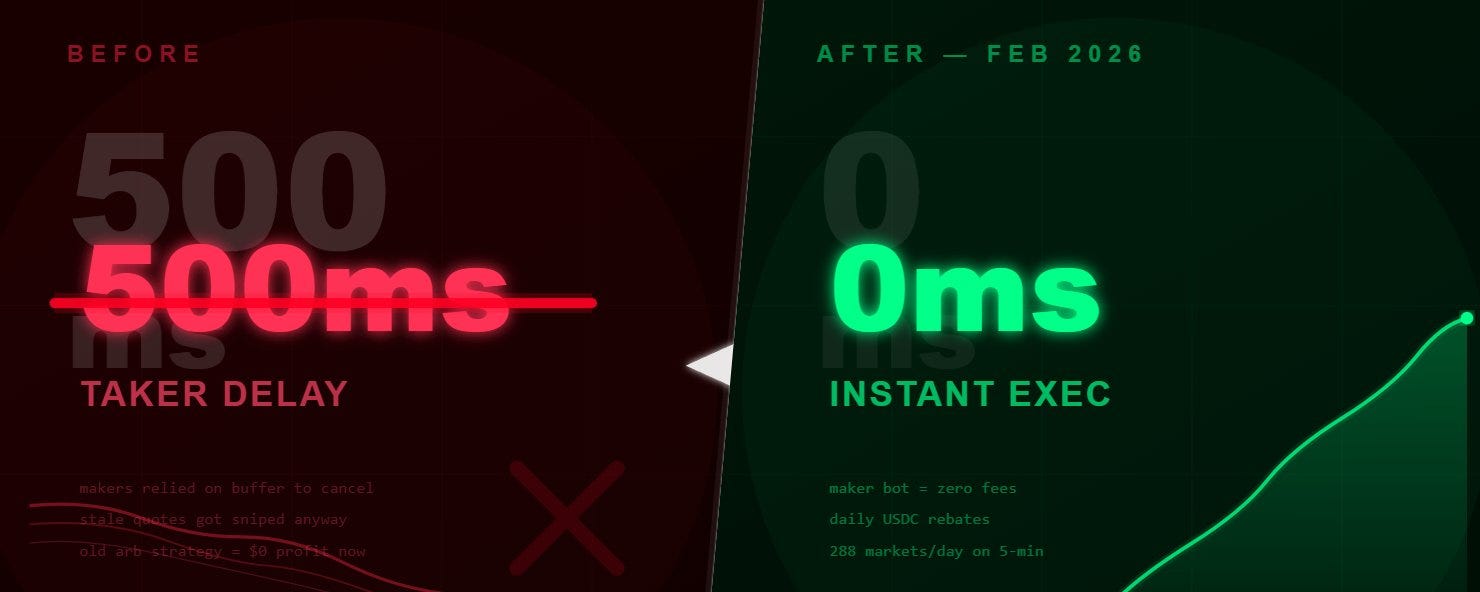
The 500ms taker delay is gone, dynamic fees are here, and taker arbitrage is dead. Here’s exactly how to build a profitable maker bot under the new regime.
### The Rules Have Changed — And So Must Your Bot
Polymarket’s trading landscape shifted dramatically in early 2026. If you’re still running a bot based on 2025 logic, it’s likely losing money — or about to.
On **February 18, 2026**, Polymarket removed the 500ms taker delay. Taker orders now execute **instantly**. This eliminated the safety net that previously let market makers cancel stale quotes.
Shortly after, in January 2026, **dynamic taker fees** were introduced on crypto markets (especially 5-minute and 15-minute ones). The old arbitrage plays between Polymarket and centralized exchanges like Binance? Mostly dead.
**New reality:**
- Takers face significant fees and adverse selection.
- Makers pay **zero fees** and earn daily USDC rebates (funded by those taker fees).
At 50% probability, takers now need more than **~1.56% edge** just to break even. The winning bots in 2026 aren’t the fastest takers — they’re the best **liquidity providers**.
### Understanding the New Fee Structure
For affected crypto markets, the taker fee is calculated as:
```python
fee = C × 0.25 × (p × (1 — p))²
```
Where:
- `p` = probability (between 0 and 1)
- Maximum fee hits ~1.56% when `p = 0.5`
- Fees drop close to zero near 0% or 100% probability
**Key takeaway:** Market making (posting on both sides) is now massively advantaged. Top bots reportedly profit from rebates alone, even with tight spreads.
### Core Architecture for a 2026 Polymarket Bot
Forget old-school REST polling — it’s too slow. Here’s what actually works now:
1. **WebSocket-First Design**
Real-time orderbook streams are mandatory. Latency kills opportunities in this environment.
2. **Fee-Aware Order Signing**
Every signed order **must** include the `feeRateBps` field. Omit it (or get it wrong) and the order gets rejected on fee-enabled markets.
3. **Ultra-Fast Cancel/Replace Loop**
Target **under 100–200ms** end-to-end. Without the old 500ms buffer, stale quotes get picked off instantly (adverse selection).
### Step-by-Step Setup
#### 1. Prepare Your Wallet
Use the same private key (EOA) you log into Polymarket with:
```bash
export POLYMARKET_PRIVATE_KEY=”0xYourPrivateKeyHere”
```
#### 2. One-Time Approvals
Approve the Polymarket exchange contracts for **USDC** and **conditional tokens**. Do this once per wallet before trading.
#### 3. Install the Right Libraries
**Python (quick start):**
```bash
pip install py-clob-client
```
**For speed (recommended for production):**
- `polyfill-rs` — Zero-allocation hot paths with SIMD JSON parsing (claimed 21% faster).
- Official `polymarket-client-sdk` (Rust).
- `polymarket-hft` — Full HFT framework with CLOB + WebSocket support.
Choose based on your latency requirements and language preference.
#### 4. Always Query Current Fee Rates
Never hardcode them. Fetch dynamically:
```
GET /fee-rate?tokenID={token_id}
```
#### 5. Sign Orders Correctly (Include feeRateBps)
Example order payload structure:
```json
{
“salt”: “…”,
“maker”: “0x…”,
“signer”: “0x…”,
“taker”: “0x…”,
“tokenId”: “…”,
“makerAmount”: “50000000”,
“takerAmount”: “100000000”,
“feeRateBps”: “150”
}
```
Modern SDKs handle fee fetching and signing automatically — use them.
#### 6. Implement Market Making
Post **limit orders on both YES and NO** sides to provide liquidity. This earns spreads + rebates.
#### 7. Build the Cancel/Replace Engine
Monitor external feeds (e.g., Binance WebSocket for price signals). When the fair price moves:
- Cancel stale orders
- Post updated quotes
The entire loop must stay under 200ms (ideally <100ms) to stay competitive.
### Example Strategy: 5-Minute BTC Markets
These markets run **288 times per day** — fresh opportunities constantly.
**Edge play:**
- Use Binance WebSocket for real-time BTC price.
- In the final ~10 seconds before resolution, post maker orders on the **likely winning side** at 90–95¢.
- If filled: Pocket $0.05–$0.10 per share on resolution.
- Benefits: Zero taker fees + rebates.
The key differentiator? Posting faster and more reliably than competing makers.
### Common Mistakes That Will Cost You Money
- Relying on REST API instead of WebSocket
- Forgetting or mismatching `feeRateBps` in signatures
- Running from high-latency setups (home WiFi, distant VPS)
- Market making at ~50% probability without accounting for adverse selection risk
- Hardcoding fees instead of querying them live
- Not properly merging YES/NO positions (this locks up capital unnecessarily)
- Still trying old 2025-style taker arbitrage
### How to Use AI Effectively
Don’t ask an AI to “build me a full Polymarket bot” — you’ll get outdated 2025 code.
Instead, give it **precise constraints**:
> “Write a maker bot for 5-minute BTC markets using Binance WS. Post maker orders on both sides, include dynamic feeRateBps, and implement a cancel/replace loop targeting under 100ms latency.”
Always **backtest** against the real fee curve before going live.
### Final Thoughts
In 2026, Polymarket rewards **liquidity providers**, not snipers. The fastest, most reliable makers win — through rebates, tight spreads, and smart positioning near resolution.
Bots now dominate the top traders. If you’re serious, invest in low-latency infrastructure, Rust-level performance where it counts, and rock-solid fee handling.
Good luck — and trade responsibly.
— -
**Resources & Further Reading**
- Telegram bots for inspiration: [Risk-Free 5min Bot](https://t.me/poly5mbot)
- Example GitHub: [polymarket-ai-agent-rust](https://github.com/xniiinx/polykalshi-ai-agent-rust)