How Oil Prices Affect the Price of Bitcoin
 Toobit3 min read·Just now
--
For years, Bitcoin maximalists have clung to a simple narrative: the digital currency is “digital gold,” a non correlated safe haven that marches to the beat of its own decentralized drum.
That theory is now under serious pressure.
If you have been watching the charts in April 2026, you have witnessed something strange. Bitcoin’s next big move is no longer just about ETF inflows or the halving cycle. It hinges on something far more traditional: the price of a barrel of crude oil.
Right now, that relationship has turned into a total coin flip.
The New Macro Puppet Master
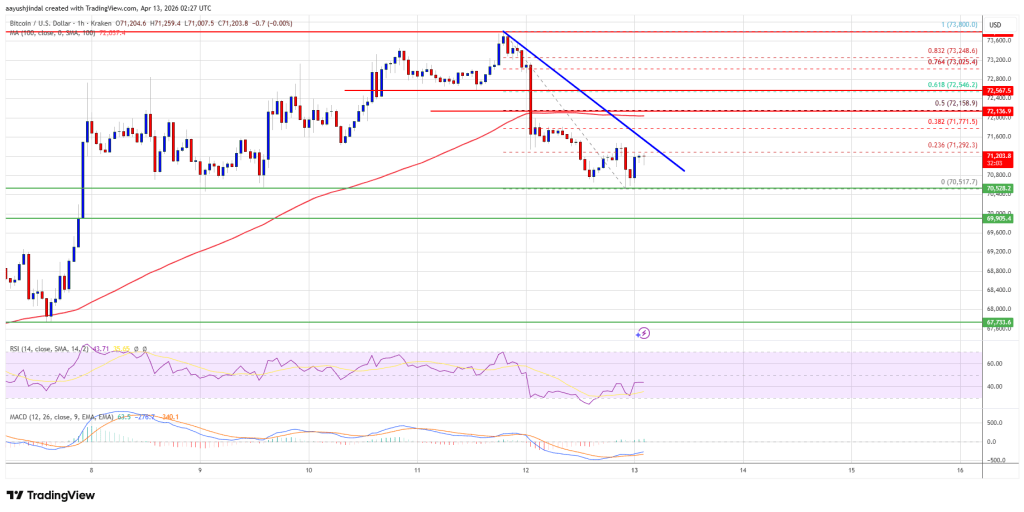
The connection is suddenly impossible to ignore. When the United States and Iran agreed to a temporary ceasefire in early April, oil prices collapsed roughly 15% to below $100 a barrel. Almost immediately, Bitcoin rebounded from its weekly lows near $67,000 to over $70,900.
This was not a coincidence.
Bitcoin is behaving less like a rebel asset and more like a high beta play on global liquidity. And the single largest driver of liquidity expectations right now is energy inflation.
A sustained 15% to 16% decline in crude oil prices could materially bring forward the window for Federal Reserve rate cuts. Lower oil means lower inflation. Lower inflation means the Fed has room to ease monetary policy. Easier policy is a structural tailwind for non yielding assets like Bitcoin.
The $80,000 Trigger
The mechanics of this trade are brutal and efficient.
Bitcoin is currently hovering near the $72,000 to $73,000 zone. According to derivatives heatmaps, there is roughly $6 billion in leveraged short positions clustered between $72,200 and $73,500. These are traders betting that the price will fall.
If oil stays low and the macroeconomic mood improves, spot buyers could force the price through that cluster of short liquidity. The resulting cascade of forced liquidations would act like a rocket booster.
Adam Saville Brown, head of commercial at Tesseract Group, explained that this scenario would likely catapult Bitcoin through the supply gap toward $80,000 in a violent short squeeze.
The Bear Case Hides in the Strait of Hormuz
However, this is where the “coin flip” analogy becomes terrifyingly accurate.
The ceasefire that sparked the oil drop appears to be already unraveling. Media reports suggest renewed hostilities around the Strait of Hormuz, a chokepoint through which a significant portion of the world’s oil flows.
If the peace talks collapse, oil could rip back above $100 a barrel. Some analysts warn it could hit $120 if the strait remains closed. In that scenario, the Fed cannot cut rates. Inflation fears return. Risk aversion dominates.
Bitcoin would likely tumble back toward the $67,000 support level or lower, erasing the ceasefire gains as quickly as they appeared.
A Binary Outcome for a Binary Asset
We are now looking at a defined two week window of extreme volatility. Participants holding risk exposure are working against a known deadline. Either the geopolitical tensions de escalate, oil drops, and Bitcoin squeezes higher, or the hostilities resume, oil surges, and the Fed remains locked in a hawkish holding pattern.
The institutional money seems to be picking a side. On Wednesday, spot Bitcoin ETFs recorded a massive $358 million in net inflows. BlackRock’s IBIT and the newly launched Morgan Stanley Bitcoin Trust saw significant demand. Whales holding more than 10,000 BTC are accumulating again.
But retail sentiment remains cautious. They have seen this movie before. Bitcoin has climbed above $70,000 several times in recent weeks, only to see the rallies fizzle out.
The Bottom Line
Bitcoin is no longer trading in a vacuum. It is now tethered to the geopolitical landscape of the Middle East and the commodity pricing power of crude oil.
Until the conflict finds a lasting resolution or the Fed signals a definitive path forward, the relationship will remain toxic and volatile. The digital asset once hailed as an escape from traditional finance is now waiting nervously on the outcome of peace talks in Islamabad and the flow of tankers through the Strait of Hormuz.
For traders, the strategy is simple. Watch the oil chart. If crude trends down, prepare for a rush to $80,000. If it spikes back above $100, prepare for a long, cold spring.
It is a total coin flip. But at least now you know what the coin represents.