
How much money do you need to start day trading
 Osman Sheikh5 min read·1 hour ago
--
Start with only $100
I say the less you have, the better. What does that mean? If you have, let’s say, $1000 and you want to start trading, in the first month, you will lose all that money, yes, all that. No matter what vehicle you trade, stocks, futures, or options, or whatever, you will lose it until you follow a clear risk management formula.
Let me tell you, the options are the most dangerous ones, very risky. You can lose all the money in about 1 week or even in one day. So don’t trade options if you are a beginner.
So, your best bet is to start trading in stocks or in futures. I choose stocks over the futures market, as it is easier.
Deposit only $500
Now deposit $500, or even less in your trading account. If you lose it, then you have another $500 as backup. But if you lose that also, then you are done. If you want to last longer, start with $100. It will take 10 liquidations to lose that $1000. So, start small and learn all the concepts in the market.
Concepts like:
1. Volume
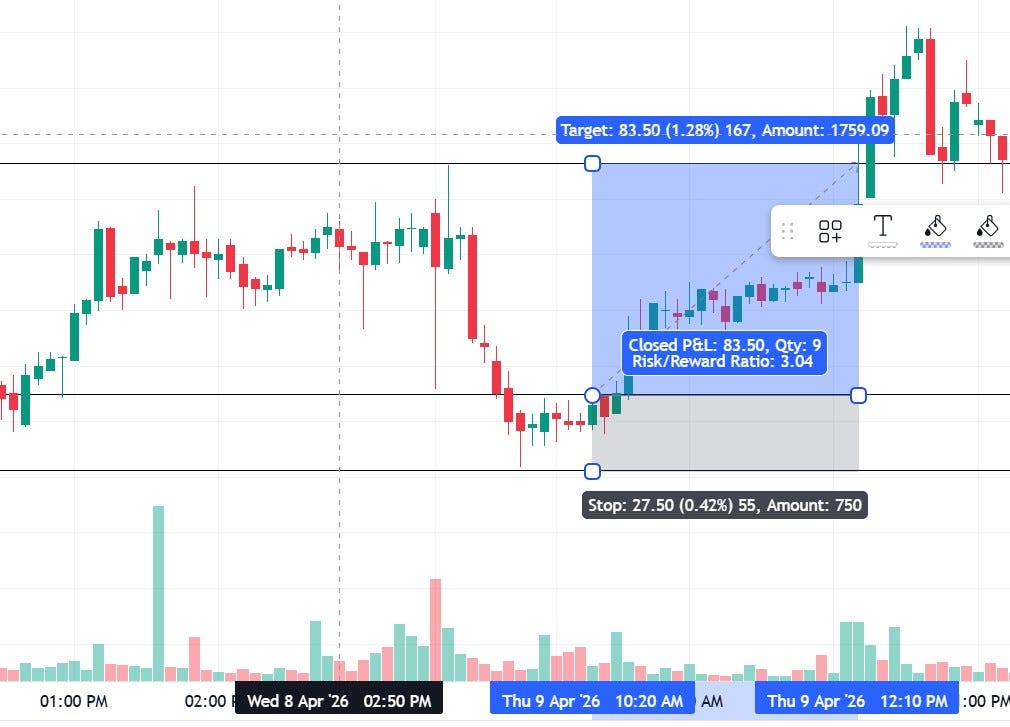
This is a 30 min candle of a stock that I had traded earlier with live market updates, and at the end I got only 1:1, while my TP was 1:5. Have a look:
How to Start Day Trading for Beginners
Will it hit TP or go back hit my SL?
medium.com
How volume affects the breakouts and the fakeouts. If the volume is low and the price is moving fast and breaks a support zone, then know it’s a fakeout and the market will reverse soon. If the breakout candle has volume, then know that it is a real breakout and the market will continue the momentum.
You can also say it as a liquidity concept. Without liquidity, markets do not move, and the volume reveals the liquidity behind that move. Here the market will come to the support zone where the breakout has happened and then move up.
2. Timeframes
Most beginners are confused about what timeframes they are going to use. I say use them all. Daily, 30 min, and 5 min. All the time frames must be aligned in one place. Get your bias like what to do in this market, buy or sell, by analyzing the daily timeframes then see the 30 min and make a decision and then use 5 min for a sharper entry.
3. Chart Patterns
This one can not be learned in a month; it will take months or years to understand. What the market is behaving like and what the reason is. What are the FVG, the order block, support and resistance, fakeouts, and breakouts, demand and supply zones, and all the other things?
Know that every idea is good when the trend is with you. If it’s not, then you will see all your SLs are getting hit, no matter how accurate your entry is or how proven your strategy is. All will fail. The trend is your friend, and never go against it.
Keep your emotions in check, kill the urge to trade, and do not let fear or greed take over. Be a disciplined trader. Read the book Trading in the Zone by Mark Douglas. You can thank me later.
Yes, there are more, like MACD, RSI, VWAP, EMA, Japanese Candlestick patterns, and a lot more. But I use only the volume, and it is much easier, and all those indicators are a bit lagging. It gives you a signal after the move has happened.
So, I don’t use them. They are good for swing trading on the weekly charts to identify the bullish or bearish divergence. But in day trading, they lag. So, use only volume and chart patterns to buy and sell the market as a day trader.
How much to Risk
First, you have to make it as simple as possible so that when you trade, you do not become emotional. You do not let the fear or greed take over your emotional state and make a loss, and please do not ever go for revenge.
I mean when you place a trade and your stop loss gets hit, what is the natural tendency? You force the trade, like, give me my money back.
By doing so, you lose more. I have seen people lose about 10% or 20% of the capital in a single day, which is devastating. You can not recover that money in a single day. I was also the same until I understood the risk management concept. Now I don’t lose that much. Max 6% in a week.
So, keep your capital safe and risk about 2%. I mean if you have $1000 in your account, you can only risk $20. That’s it. If you lost that $20 in a single day, close the computer and go outside. You are not allowed to trade the whole day. That is the best risk management I have learned.
And if your total loss goes over 6% in a week, I mean, if you have lost $60 in a week, do not trade the whole week. I repeat, do not trade the whole week, as your emotional state is not aligned with the market condition. You will lose more.
Get back, regroup, heal your wounds, and attack the next week.
Start with only $100
If you can not lose the $500, then start with only $100. You will be on the safer side. Yes, $100 is not enough, but it’s enough to help you understand the market on a daily basis. And when you are confident that you can make money, add more.
For me, the confidence is to close one month in green. That’s it. If you can close 3 months in the green, respectively, then know that you are almost there. You have become a disciplined trader. And the profitability will follow.
NB: Stock market investing is very risky. Invest at your own risk.