How Knowledge Graph Management Could Be Incorporated in the DAC Model
 Victor Yermak6 min read·Just now
--
A graph-native way to operate the Autonomous Corporate Layer.
If you’ve followed the DAC.cloud thesis or read Victor Yermak’s DAOs Discuss. DACs Execute., you already understand the structural shift underway: governance is no longer the bottleneck — execution is. Decentralized Autonomous Corporations (DACs) replace community-wide voting with deterministic delegation: a Cell (the DAC kernel) allocates capital, Deals package responsibilities, and Agents — human or AI — execute against KPIs within a capped budget. Connect enough of them and you get a Fractal — an on-chain corporation that scales the way real companies scale: by adding teams, launching products, and spinning up subsidiaries.
So far, so good. But here’s the question that doesn’t get asked enough:
Once a DAC has dozens of Deals, hundreds of Agents, sub-DACs investing into other sub-DACs, and an ever-growing web of KPIs, allocations, and dependencies — how do you actually understand what’s happening inside it?
Spreadsheets break. Relational databases force you to define the shape of every question before you ask it. Block explorers show you transactions, not relationships. What you need is the same thing every modern enterprise eventually figures out: a knowledge graph.
Why a Graph Is the Native Data Model for a DAC
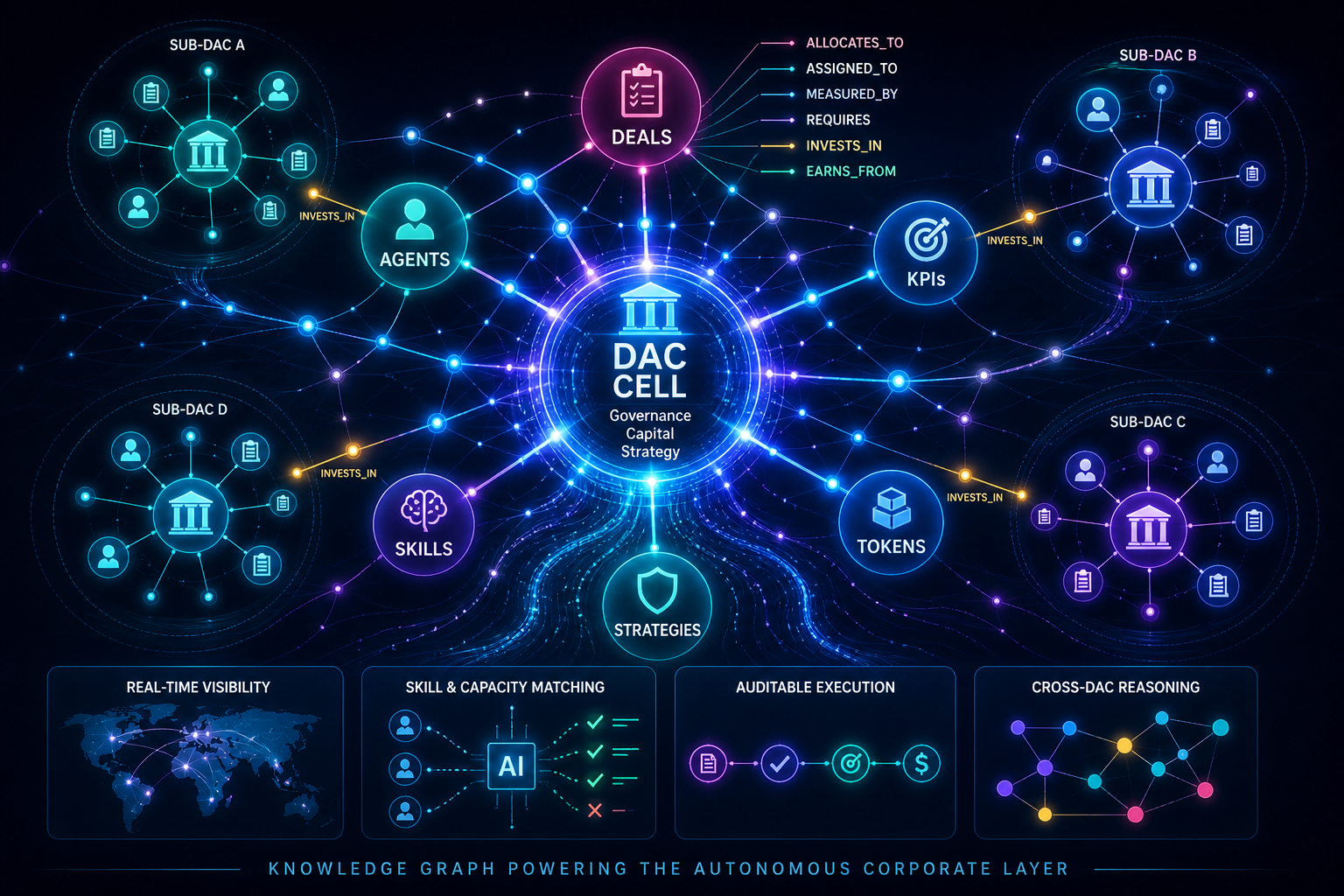
A DAC is not flat. It is a fractal hub-and-spoke network of capital, contracts, and contributors. The hub-and-spoke language is not a metaphor here — it is literally the data model. A Cell connects to Deals. Deals connect to Agents. Agents have Skills. Deals have KPIs. One DAC invests in another via a Deal acting as a Lego-like smart-contract lock. That is a graph.
Memgraph’s knowledge graph guide puts the principle plainly: a knowledge graph is a structured representation of information where entities and their relationships are organized to enable reasoning and insights. The knowledge is encoded in the structure of the graph, not buried in queries written by whoever happened to know how the system was wired.
Compare that to the alternative. In a relational world, “which Agents are over-allocated across sibling Deals in two different sub-DACs?” is a multi-table join nightmare that someone has to design in advance. In a graph world, it’s a path traversal. The semantics live in the model — Agent —ASSIGNED_TO→ Deal —GOVERNED_BY→ DAC reads like a sentence.
This matters because a DAC is a system designed to be queried by agents themselves, not just by analysts.
A Knowledge Graph Schema for a DAC
Mapping the DAC primitives onto a Labeled Property Graph (LPG) — Memgraph’s native model — gives you something like this:
Nodes (entities):
DAC— the Cell. Properties: token, treasury balance, strategy hash.Deal— the project container. Properties: budget cap, status (proposed/approved/executed), deadline.Agent— human or AI. Properties: wallet, type, reputation score.Skill— capability primitive. Properties: name, scarcity score.KPI— measurable outcome. Properties: target, actual, deadline.Token— the asset being governed.Strategy— approved policy guardrails.
Relationships (the verbs of the corporation):
(DAC)-[:ALLOCATES_TO]->(Deal)with propertyamount(Deal)-[:ASSIGNED_TO]->(Agent)with propertyrole(Agent)-[:HAS]->(Skill)(Deal)-[:REQUIRES]->(Skill)(Deal)-[:MEASURED_BY]->(KPI)(DAC)-[:INVESTS_IN]->(DAC)via(Deal)(Agent)-[:EARNS_FROM]->(Deal)with propertyreward_curve(Strategy)-[:GOVERNS]->(DAC)
What you end up with is the DAC’s organizational chart, capital flow, incentive structure, and execution status — all in a single, traversable structure. The Fractal becomes literally explorable.
The Value Add — What This Unlocks
1. Real-time visibility into the Fractal
Today, a question like “if Sub-DAC B fails its Q3 KPI, which other Deals across the Fractal are exposed?” requires a forensic analyst. With a knowledge graph, it’s a two-hop traversal from the at-risk KPI through MEASURED_BY ← Deal ← INVESTS_IN ← DAC. Risk topology becomes a graph query, not a quarterly report.
2. Skill-and-capacity matching at the protocol layer
Memgraph’s documentation uses a project-management example almost identical to the DAC use case: matching people to tasks via skills. The same pattern transfers directly. A Deal needing Risk Modeling and Solidity can be programmatically routed to Agents whose HAS edges cover the requirement set — and the model can flag missing skills across the entire corporation, surfacing structural gaps before they become missed deadlines.
MATCH (d:Deal)-[:REQUIRES]->(s:Skill)
OPTIONAL MATCH (a:Agent)-[:HAS]->(s)
WITH d, s, collect(a) AS qualified
WHERE size(qualified) = 0
RETURN d.name AS UnstaffableDeal, collect(s.name) AS MissingSkills
That single query — lifted almost verbatim from the Memgraph guide — is a hiring report, a training plan, and a strategic alert all at once.
3. Audit trails that are queryable, not just append-only
Every Deal approval, KPI evaluation, and reward distribution becomes an edge with a timestamp. The graph is the corporate memory — and unlike a chain of receipts, it is structured for the questions auditors and DAO members actually ask: “Show me every Deal Agent X executed in the last 90 days, the KPIs hit, and the rewards flowing through to their wallet.”
4. Cross-DAC reasoning
Because one DAC can invest in another via a Deal, the Fractal naturally produces deep paths — exactly the workload Memgraph’s in-memory engine and deep path traversal algorithms are built for. PageRank over the INVESTS_IN graph reveals systemically important DACs. Community detection clusters Agents who repeatedly co-execute Deals. Centrality scores expose key-person risk before it bites.
5. The agentic layer: GraphRAG-powered Agents
This is where it gets most interesting — and where the DAC thesis and the knowledge graph thesis converge.
Yermak’s article makes the point that “the next wave of on-chain activity will be agent-driven” — autonomous systems running marketing, managing positions, completing bounties. These agents need rails. But they also need context. An AI Agent assigned to a yield-vault Deal needs to know: what’s our risk strategy? What did the last Agent in this Deal do? Which sister Deals are running? What KPIs am I measured against?
That is the textbook GraphRAG problem. Memgraph’s pattern is: embed the question, find a pivot node via vector search, then expand relevance by traversing two or three hops out. Applied to a DAC: the pivot is the Deal node, the expansion pulls in the parent DAC’s strategy, sibling Deals, the agent’s own track record, and live KPIs — all served to the LLM as grounded, semantically structured context.
The result: Agents that don’t just execute their narrow Deal — they execute it aware of the corporation they sit inside. That is the difference between an automation and an organization.
6. Strategy simulation and “what-if” governance
Before a new Deal is approved, the proposed edges can be added to the graph in a sandbox: if we allocate $200K here, which Agents become bottlenecked? Which skills get over-subscribed? Does any single Agent’s reward exposure exceed our concentration limit? Governance shifts from gut-feel proposals to graph-validated ones.
Why This Matters Now
DACs solve the execution problem of DAOs. Knowledge graphs solve the comprehension problem of any sufficiently complex DAC.
You can run a small Cell with three Deals on a spreadsheet. You cannot run a Fractal of fifty interconnected DACs that way — and every successful DAC eventually becomes a Fractal, by design. The knowledge graph is not a nice-to-have analytics layer bolted on top. It is the substrate that lets the corporation see itself, lets human stewards reason about it, and lets AI Agents operate inside it with full situational awareness.
The DAC gives capital its rails. The knowledge graph gives the rails a map.
Closing Thought
If you’re building on the autonomous corporate layer, the question is not whether you’ll need a knowledge graph — it’s whether you’ll bolt one on after the complexity has already calcified, or design it in from day one.
Memgraph’s LPG model, deep path traversal, and GraphRAG tooling map onto the DAC primitives almost one-to-one. The integration isn’t speculative — it’s a weekend’s worth of schema design followed by a meaningful unlock in observability, agent intelligence, and governance precision.
DAOs discuss. DACs execute. Knowledge graphs understand.
Build accordingly.
Sources & further reading:
- DAC.cloud — The Autonomous Corporate Layer: https://dac-cloud-website.vercel.app/
- Victor Yermak, “DAOs Discuss. DACs Execute.”: https://medium.com/@victor.yermak/daos-discuss-dacs-execute-7729238109a5
- Memgraph — Model a Knowledge Graph: https://memgraph.com/docs/data-modeling/modeling-guides/model-a-knowledge-graph
#DAC #KnowledgeGraph #Memgraph #Web3 #GraphRAG #OnchainAgents #AutonomousOrganizations #DeFi #Governance