How Gas Fees Can Silently Drain Your Crypto Balance
 charlie evans11 min read·Just now
--
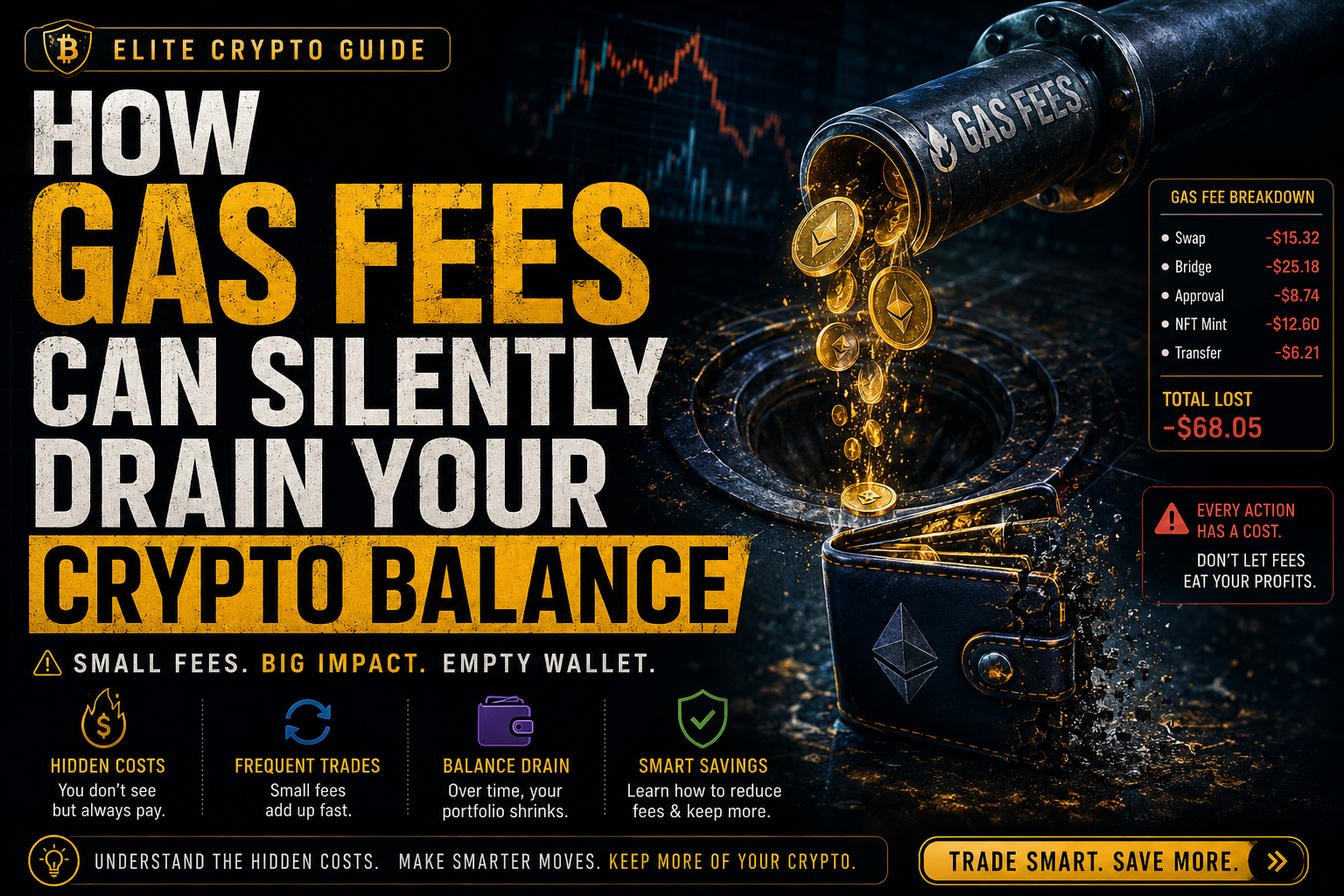
You send $50 worth of ETH to a friend. The transaction goes through. But when you check your wallet, you’ve lost $68 — not $50.
That missing $18? Gas fees.
Most beginners don’t see it coming. Even intermediate traders underestimate how much gas fees are quietly eating into their profits every single week. And in volatile markets, that silent drain can be the difference between a winning portfolio and a losing one.
This guide breaks down exactly how gas fees work, why they spike when you least expect it, and — most importantly — how to stop letting them quietly empty your wallet.
Home
Looking for reliable crypto signals? Elite Crypto Signal delivers real-time trading alerts, market insights, and expert…
elitecryptosignal.com
What Are Gas Fees in Crypto?
Gas fees are the transaction costs you pay to use a blockchain network — specifically Ethereum and EVM-compatible chains like Polygon, BNB Chain, and Avalanche.
Think of it like this: the blockchain is a highway, and gas is the toll you pay to drive on it.
Every action you take on-chain — sending tokens, swapping on Uniswap, minting an NFT, or interacting with a smart contract — requires computation. That computation is performed by validators (formerly miners), who charge a fee in return for processing your request.
On Ethereum, gas fees are paid in Gwei, which is a fraction of ETH:
1 Gwei = 0.000000001 ETH
So when you hear “gas is at 30 Gwei,” that means each unit of computation costs 30 billionths of an ETH.
Home
Looking for reliable crypto signals? Elite Crypto Signal delivers real-time trading alerts, market insights, and expert…
elitecryptosignal.com
The Two Components of a Gas Fee
Gas fees aren’t a single flat charge. They’re calculated using:
ComponentWhat It MeansGas LimitMaximum units of gas your transaction can useGas Price (Base Fee + Priority Fee)What you’re willing to pay per unit of gas
Total Fee = Gas Used × (Base Fee + Priority/Tip Fee)
The base fee is set by the network (burned since EIP-1559). The priority fee (or “tip”) is what you add to incentivize validators to process your transaction faster.
How Gas Fees Actually Work (The Mechanics)
Let’s get specific, because understanding the mechanics is the key to not getting burned.
Before EIP-1559 (August 2021), gas was pure auction-based. You bid high, your transaction got processed. You bid low, you waited — or got ignored.
After EIP-1559, Ethereum introduced a two-part fee structure:
- Base Fee — Algorithmically determined by network congestion. This amount gets burned (removed from supply).
- Priority Fee (Tip) — A voluntary add-on to get validators to pick your transaction first.
This made fees more predictable — but not cheaper.
Here’s a simple example:
- You want to swap ETH for USDC on Uniswap
- A standard swap uses roughly 150,000 gas units
- Base fee: 30 Gwei | Priority fee: 2 Gwei
- Total cost: 150,000 × 32 Gwei = 4,800,000 Gwei = 0.0048 ETH
- At ETH = $3,500 → That’s $16.80 just to swap tokens
And that’s on a moderate traffic day. During a popular NFT mint or market crash, those numbers explode.
Why Gas Fees Can Silently Drain Your Balance
This is where most people get hurt — and they don’t even realize it until they run the numbers.
1. They’re Easy to Ignore When You’re Excited
When you’re rushing to buy a hot NFT or jump into a trade before the price moves, you’re not doing math. You click confirm. The wallet shows a gas estimate. You approve it. Done.
But those small approvals add up fast.
2. Multiple Transactions Multiply the Cost
DeFi isn’t one-click. A single yield farming position might require:
- Approving the token (1 transaction)
- Swapping to the correct token (1 transaction)
- Adding liquidity (1 transaction)
- Staking the LP token (1 transaction)
That’s 4 transactions — each with its own gas fee. If each costs $15, you’ve spent $60 before earning a single cent of yield.
3. Failed Transactions Still Cost Gas
This one shocks beginners every time.
If your transaction fails on-chain — due to slippage, insufficient gas limit, or a smart contract error — you still pay the gas. The validators did the computational work. They still get compensated. You get nothing.
4. Small Trades Get Disproportionately Hit
Gas fees are fixed per transaction, not percentage-based. So if you’re trading $100 worth of tokens and gas is $20, you’re paying a 20% overhead before the trade even moves.
Compare that to a $10,000 trade — same $20 gas, but only 0.2% overhead.
Small traders and beginners are hit hardest. And most don’t realize it until they’ve already lost significant value.
Real-World Examples of Gas Fee Damage
Example 1: The NFT Mint Disaster of 2022
During the Otherside NFT mint by Yuga Labs in May 2022, Ethereum gas fees spiked to over 6,000 Gwei — nearly 200x normal levels.
Some users paid more in gas than the NFT itself was worth. According to on-chain data analyzed by Dune Analytics, over $150 million in ETH was spent on gas during that single event — including millions in failed transactions.
People lost money without receiving anything.
Example 2: The DeFi Yield Trap
A user deposits $500 into a DeFi protocol yielding 20% APY.
- 4 setup transactions: $80 in gas
- Monthly claim transactions: $20/month
- Withdrawal transactions: $30
Break-even calculation:
- Annual yield on $500 at 20% = $100
- Annual gas costs = ~$320
- Net result: -$220 loss
The yield was real. But the gas made it mathematically impossible to profit at that position size.
Example 3: The Arbitrage Bot That Wasn’t
A trader set up a simple arbitrage bot on Ethereum mainnet to capture 0.5% price differences across DEXes. The profits per trade averaged $3–$5.
Gas cost per trade? $8–$15.
The bot ran for two weeks before the trader noticed the wallet was emptying, not filling.
When Do Gas Fees Spike the Most?
Gas fees aren’t random. They follow patterns — and knowing them lets you time your transactions better.
Peak Congestion Times
Pro tip: Gas is typically lowest between 2am–8am UTC, especially on weekdays. If you’re not time-sensitive, set a gas limit and wait.
The Hidden Cost Math: What You’re Really Paying
Let’s build a realistic picture of annual gas costs for an active DeFi user.
Scenario: Active DeFi Trader (Weekly Activity)
That’s nearly $3,000 a year — just in transaction fees. Many traders never account for this in their P&L.
How Gas Fees Impact DeFi, NFTs, and Token Swaps
DeFi Protocols
In decentralized finance, every interaction costs gas. The compounding nature of DeFi — where you need to frequently claim, reinvest, and rebalance — means gas becomes a recurring operational cost.
Compounding daily vs. monthly has a radically different gas cost profile. A daily compounder might spend $300/month in gas. A monthly compounder spends $30.
The math often favors less frequent, larger-batch interactions.
NFT Markets
Minting, listing, transferring, and accepting bids on NFTs each require separate transactions. On OpenSea, for example, the first-time listing of a new collection requires a one-time approval transaction that can cost $50–$100 alone.
NFT flippers who operate at high volume — buying and selling dozens of assets per month — can easily accumulate $500–$1,000+ in monthly gas costs.
Token Swaps on DEXes
Every swap on Uniswap, Curve, or SushiSwap burns gas. Complex routes (e.g., ETH → USDC → DAI → stETH) involve multiple hops, each adding to the fee.
Multi-hop swaps can cost 2–3x more than simple swaps. Always check the route your DEX aggregator is taking before confirming.
Layer 2 Solutions and Alternatives That Reduce Gas
The good news? The Ethereum ecosystem has evolved to address this problem — dramatically.
Layer 2 Networks
Layer 2 (L2) solutions process transactions off the main Ethereum chain and batch-submit them. The result: fees drop by 90–99%.
Ethereum Mainnet comparison: $5–$50+ per transaction
Migrating your DeFi activity to Arbitrum or Base, for example, can save the average user $1,500–$2,500 annually.
Alternative L1 Chains
If you’re not committed to Ethereum’s ecosystem, other Layer 1 blockchains offer significantly lower fees:
- Solana: Sub-cent transactions, often $0.00025
- Avalanche C-Chain: $0.10–$1
- BNB Chain: $0.10–$0.50
However, always weigh the security, decentralization, and ecosystem maturity trade-offs. Lower fees on a less secure chain carry their own risks.
Practical Strategies to Minimize Gas Fee Losses
Here’s what actually works — no theory, just tactics.
✅ 1. Use a Gas Tracker Before Every Transaction
Never transact blind. Always check current network conditions on tools like ETH Gas Station, Blocknative, or GasNow before initiating any on-chain activity.
✅ 2. Set a Max Gas Limit Manually
Most wallets (MetaMask, Rabby) allow you to set a custom gas price. If your transaction isn’t time-sensitive, set a lower max fee and let the network fill your transaction when conditions improve.
✅ 3. Batch Your Transactions
Instead of claiming yield every day, claim it weekly or monthly. Instead of making 10 small swaps, consolidate into one larger trade. Fewer transactions = fewer fees.
✅ 4. Use DEX Aggregators with Gas Optimization
Platforms like 1inch and Paraswap route your swap through the most gas-efficient path — not just the best price path. This can meaningfully reduce costs on complex trades.
✅ 3. Migrate to Layer 2 for Routine Activity
If you’re actively using DeFi, Arbitrum, Optimism, or Base should be your default environment. Save mainnet for final settlements and large-value transactions only.
✅ 5. Avoid Peak Hours
Schedule non-urgent transactions during early morning UTC hours, especially on weekends. Gas prices on Ethereum often drop 40–60% during off-peak windows.
✅ 6. Monitor Gas Alerts
Services like Blocknative Gas Estimator or Telegram gas bots send alerts when gas drops below a threshold you set. You can time your transactions without constantly watching the screen.
✅ 7. Think in Percentage Terms, Not Absolutes
Before any transaction, calculate gas as a percentage of your transaction value. If gas is more than 2–3% of your trade size, reconsider — either wait, batch it, or use a cheaper chain.
Tools to Track and Predict Gas Fees
Future of Gas Fees: Post-Merge Ethereum and Beyond
The Ethereum Merge (September 2022) transitioned ETH to Proof of Stake. Did it lower gas fees?
No. And that’s intentional.
The Merge improved energy efficiency by ~99.95% — but gas fees are driven by demand, not consensus mechanism. As long as Ethereum’s blockspace is limited and popular, fees stay high.
What Actually Will Reduce Gas Fees
EIP-4844 (Proto-Danksharding) — Implemented in the Dencun upgrade (March 2024), this introduced “blob transactions” for L2s, reducing L2 data posting costs by up to 90%. This has already made Base, Optimism, and Arbitrum dramatically cheaper.
Full Danksharding — The next evolution, expected over the next 2–3 years, aims to push L2 costs to near-zero by massively expanding available blockspace.
Account Abstraction (ERC-4337) — Allows users to pay gas in stablecoins or have third parties sponsor gas costs entirely. This will dramatically change the user experience for newcomers.
The trajectory is clear: Ethereum mainnet stays expensive, but L2s become essentially free. The winning strategy is to build your habits around L2 now, not wait for mainnet to get cheaper.
FAQ
What are gas fees in crypto?
Gas fees are transaction costs paid to validators on blockchain networks like Ethereum. They compensate the network for the computational power required to process your transaction or smart contract interaction.
Why do gas fees change so much?
Gas fees fluctuate based on network demand. When many users want to transact simultaneously — during NFT mints, token launches, or market crashes — competition for limited block space drives prices up significantly.
Can I avoid gas fees entirely?
You cannot avoid gas fees on-chain, but you can drastically reduce them by using Layer 2 networks like Arbitrum, Optimism, or Base, or by transacting during low-traffic periods.
Do I pay gas fees if my transaction fails?
Yes. Failed transactions on Ethereum still consume gas because validators still expended computational resources attempting to process them. You lose the gas fee even if the transaction produces no result.
What is a gas limit in Ethereum?
A gas limit is the maximum amount of gas units you authorize a transaction to use. If the transaction requires more gas than the limit allows, it fails — but you still pay for the gas used up to the point of failure.
What is Gwei?
Gwei is a denomination of ETH (1 Gwei = 0.000000001 ETH). Gas prices are typically quoted in Gwei, making it easier to express small fractions of ETH in whole numbers.
How do Layer 2 networks reduce gas fees?
Layer 2 networks batch thousands of transactions together and submit them as a single transaction to the Ethereum mainnet. By sharing the gas cost across many transactions, each individual user pays only a tiny fraction of what they’d pay directly on mainnet.
Is gas cheaper on weekends?
Generally, yes. Ethereum gas tends to be lower on weekends and during early morning UTC hours (2am–8am) when fewer users — especially US and European traders — are actively transacting.
Does ETH price affect gas fees?
Indirectly, yes. Gas fees are denominated in ETH. If ETH price rises significantly, the same Gwei amount costs more in USD terms. So even if network congestion stays constant, your dollar cost per transaction rises with ETH price.
What is EIP-1559 and how did it change gas fees?
EIP-1559 (August 2021) introduced a base fee + tip model, replacing the old pure-auction system. It made gas prices more predictable and burned the base fee (reducing ETH supply), but it did not significantly lower average gas costs.
Conclusion
Gas fees don’t announce themselves loudly. They work quietly — one transaction at a time — steadily eroding your balance while you focus on price charts and yield percentages.
The truth is brutal and simple: if you’re not actively managing gas fees, you’re leaving hundreds or thousands of dollars on the table every year.
Understanding how gas fees drain your balance is the first step. But knowledge without action is worthless.
Move your routine DeFi activity to Layer 2. Time your transactions smartly. Stop approving gas blindly. Run the math on every position before you open it.
The crypto market is already hard enough without paying a silent tax on every single action you take. Now you know how to stop.
Call to Action (CTA)
Ready to stop losing money to gas fees?
Bookmark this guide and share it with every crypto trader you know who’s complained about “small losses they can’t explain.”👉 Start by checking L2Fees.info today — see exactly how much you’d save by switching your activity to a Layer 2 network. The numbers will surprise you.
And if you found this guide useful, subscribe for weekly insights on DeFi strategy, crypto cost optimization, and on-chain money management.
📩 Join Investor’s Handbook Digest — get the best investing, markets, and wealth-building insights each week.