Your funds are one bad exchange away from disappearing forever. Here’s how to make sure that never happens to you.
Last year, over $2.2 billion in crypto was stolen through exchange hacks, rug pulls, and custodial failures. Not from careless whales. Not from DeFi degens who knew the risks. From everyday people — retail investors, first-time buyers, long-term holders — who simply chose the wrong platform to trust with their money.
The question “Is this crypto exchange safe?” sounds simple. The answer in 2026 is anything but.
You’re now operating in a market where centralized exchanges (CEXs) are under intense regulatory scrutiny, decentralized exchanges (DEXs) have exploded in both volume and vulnerability surface, and the line between “reputable” and “reckless” can disappear overnight. What looked like a solid platform in January can become an exit scam by May.
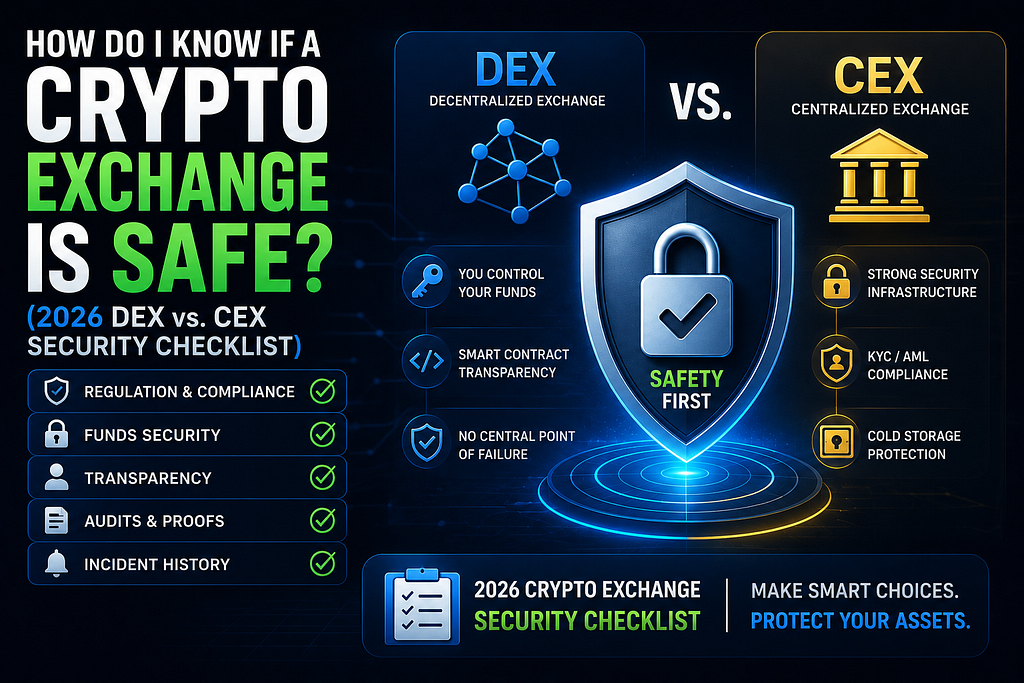
This guide gives you a definitive, actionable security checklist for evaluating any crypto exchange in 2026 — whether it’s centralized or decentralized. No vague advice. No affiliate shilling. Just a framework that protects your assets.
Let’s get into it.
Why This Question Matters More in 2026 Than Ever Before
The crypto landscape has matured, but the threats have matured with it. In the early days, exchange hacks were mostly brute-force: poor key management, unsecured hot wallets, basic phishing. Today, attacks are sophisticated social engineering campaigns, insider threats, cross-chain bridge exploits, and smart contract vulnerabilities that can drain an entire protocol in a single transaction.
At the same time, the regulatory environment has shifted dramatically. Following the collapse of several major CEXs between 2022 and 2024, new compliance frameworks have rolled out across the US, EU, and Asia. Some exchanges have embraced these changes and become demonstrably safer as a result. Others have moved operations offshore to dodge oversight — and that’s a serious red flag.
Whether you’re using a DEX like Uniswap, Curve, or a newer automated market maker, or a CEX like Coinbase, Kraken, or Binance, the risks are fundamentally different. That’s why a single checklist won’t cut it. You need two.
Part 1: The CEX Security Checklist (Centralized Exchange)
When you deposit funds on a centralized exchange, you are handing custody of your assets to a third party. You do not hold the keys. You do not hold the coins. You hold an IOU — and the value of that IOU depends entirely on the trustworthiness and competence of the exchange.
Here’s what to verify before depositing a single dollar.
1. Regulatory Licensing and Compliance Status
This is your first filter — and in 2026, it’s more important than ever.
A legitimate CEX operating in your jurisdiction should hold the relevant licensing for your region: a BitLicense in New York, FCA registration in the UK, MiCA compliance in the EU, or equivalent. If an exchange is actively operating in your country without the required license, that’s not a technicality — it’s a structural risk.
Look for:
- A clearly listed regulatory status on their website
- Verifiable registration with your country’s financial regulator
- A history of compliance, not just current status
Exchanges that operate in “gray zones” or brag about being “regulation-free” are betting your money on their ability to stay ahead of enforcement.
2. Proof of Reserves and Transparency
After FTX, this became non-negotiable. Any reputable exchange in 2026 should offer cryptographically verifiable proof of reserves — meaning they can prove that the assets users believe they hold are actually held.
What to look for:
- Merkle tree proof of reserves: A cryptographic method that lets users verify their individual balance is included in the total
- Third-party audits: Look for quarterly or monthly audits by recognized firms (Mazars, Hacken, Armanino)
- Public reserve addresses: Exchanges that publish wallet addresses and allow real-time on-chain verification
If a CEX cannot or will not prove it holds your assets, treat it as if it doesn’t.
3. Cold Storage Ratio
The safest exchanges store the vast majority of user funds in cold storage — hardware wallets or air-gapped systems that are not connected to the internet and therefore not directly hackable.
The industry benchmark: 90–95% of user assets in cold storage.
Anything below 80% is a concern. Anything with no disclosed cold storage policy is a serious red flag. Hot wallets are necessary for liquidity, but they’re the vulnerable surface. A well-run exchange minimizes exposure here aggressively.
4. Security Certifications and Audit History
Real security infrastructure gets tested by real security researchers.
Look for:
- SOC 2 Type II compliance: A rigorous audit of security, availability, and confidentiality controls
- ISO/IEC 27001 certification: The international standard for information security management
- Bug bounty programs: Active programs that pay ethical hackers to find vulnerabilities before malicious actors do
- Penetration testing history: Published results from third-party pen tests
If a major exchange has had no public security audits and no bug bounty program, that’s a gap in their posture — and it could become a gap in your portfolio.
5. Insurance and Asset Protection
What happens to your funds if the exchange is hacked? In 2026, leading exchanges carry some form of user protection fund or third-party insurance. Coinbase, for example, maintains commercial crime insurance on custodied assets. Binance maintains its SAFU fund. Not all coverage is equal, but the existence of a credible protection mechanism matters.
Ask:
- Is there a dedicated user protection fund? How large is it relative to total assets under custody?
- Is there third-party insurance through a recognized underwriter?
- What’s the claims process if funds are compromised?
An exchange that offers zero protection in case of a breach is asking you to absorb all the downside risk while they keep the upside.
6. Account Security Features
This one’s on you — but the platform has to give you the tools.
Non-negotiable account security features in 2026:
- Hardware key (FIDO2/passkey) support, not just TOTP 2FA
- Withdrawal address whitelisting with time-locks
- Anti-phishing codes embedded in official emails
- Login notifications and session management
- Mandatory 2FA before withdrawal
An exchange that only offers SMS-based two-factor authentication is not taking your security seriously. SIM-swapping attacks are trivially easy and have been used to drain accounts on exchanges that haven’t deprecated SMS 2FA.
7. Reputation, Track Record, and Incident Response
History matters. An exchange’s track record through market stress and security incidents tells you more than any marketing copy.
Research:
- Has this exchange been hacked before? If yes, how did they respond?
- Did they make users whole? How quickly?
- What does the community say on credible forums (not Telegram or Reddit shills)?
- How does the exchange communicate during outages or security events?
Silence during a crisis is a red flag. Exchanges that go dark when things get bad are not on your side.
Most traders never realize indicators only work in the right market conditions. We made a free downloadable Crypto Indicator Cheat Sheet breaking down exactly when RSI, MACD, VWAP, and Bollinger Bands actually work in live markets.
Part 2: The DEX Security Checklist (Decentralized Exchange)
Decentralized exchanges operate differently. You keep custody of your own keys and interact directly with smart contracts. There’s no company to call. No support ticket. No refund if something goes wrong.
The tradeoff for self-custody is personal responsibility — and that requires a different kind of vigilance.
1. Smart Contract Audit Status
This is the DEX equivalent of regulatory compliance. Every legitimate DEX should have its core smart contracts audited by at least one — and ideally two or more — reputable security firms.
Trusted auditors in 2026:
- Trail of Bits
- OpenZeppelin
- Certik (verify audit scope carefully)
- Halborn
- Spearbit
Check:
- When was the audit performed? (Code changes require new audits)
- What was the scope? (A UI audit is not a smart contract audit)
- Were critical issues found and resolved?
- Is the audit report publicly available?
An unaudited protocol, no matter how hyped, is an invitation to be a test case.
2. Immutability vs. Upgradeability
Smart contracts that can be upgraded by an admin key introduce centralization risk — and in the wrong hands, an upgrade can be weaponized to drain liquidity.
Ask:
- Is this protocol immutable, or can it be upgraded?
- If upgradeable, who controls the upgrade key?
- Is there a timelock on upgrades (giving users time to exit if a malicious update is proposed)?
- Is control held by a multisig? How many signers? Are their identities known or anonymous?
Immutable contracts are more trustworthy. Upgradeable contracts are only as trustworthy as the people holding the keys — and in DeFi, those people are often pseudonymous.
3. Liquidity Pool Risks and Rug Pull Vectors
Not every token on a DEX is legitimate. Liquidity pool mechanics can be exploited in multiple ways:
- Rug pulls: Developers drain liquidity from a pool they control
- Honeypots: Tokens that can be bought but not sold
- Flash loan attacks: Exploiting price oracles with borrowed capital
- Sandwich attacks: MEV bots front-running your trades
Mitigation tools:
- Use Token Sniffer, De.Fi Scanner, or GoPlus Security to screen tokens before swapping
- Check if liquidity is locked using a time-lock contract (LP tokens should not be freely withdrawable by founders)
- Verify contract ownership — renounced is safer than held by an anonymous wallet
- Check trading tax rates embedded in the token contract
If a project’s liquidity isn’t locked for a meaningful period (12+ months minimum), the founders can pull the rug whenever they want.
4. Oracle Security and Price Manipulation Risk
DEX pricing is typically determined by on-chain oracles or automated market maker (AMM) formulas. Both can be manipulated.
Price oracle attacks have been responsible for hundreds of millions in losses. When a DEX relies on a single, low-liquidity price source, a flash loan can distort that price enough to drain a lending protocol or liquidity pool.
Look for:
- Use of Chainlink or Pyth Network oracles (decentralized, manipulation-resistant)
- Time-weighted average pricing (TWAP) mechanisms
- Multiple oracle sources with divergence checks
Protocols that rely on spot price from a single low-liquidity pool for critical calculations are ticking time bombs.
5. Protocol Governance and Multisig Structure
Who controls the protocol’s treasury and critical parameters?
A healthy governance structure looks like:
- Multisig control (e.g., 5-of-9 signers required for treasury movements)
- Known or doxxed signers (at least partially)
- On-chain voting with token-weighted governance
- Timelocks on governance execution (typically 48–72 hours minimum)
Avoid protocols where a single wallet controls admin functions, where the team is entirely anonymous with no accountability, or where governance votes can be executed instantly without delay. In the wrong hands, unchecked governance is an exploit.
6. Cross-Chain Bridge Risk
If you’re using a DEX that requires bridging assets across chains, the bridge itself is a major attack surface. Cross-chain bridges have been the single largest source of DeFi losses in the past three years — the Ronin bridge hack alone cost over $600 million.
Before bridging:
- Check the bridge’s audit history
- Understand the trust model (is it trustless, or reliant on a validator set?)
- Review TVL (Total Value Locked) — large TVL is both a signal of trust and a bigger target
- Use battle-tested bridges with years of live security history over new, higher-yield alternatives
New bridges offering high incentives are the highest-risk category in DeFi. The incentives exist for a reason.
The Universal Rules That Apply to Both DEX and CEX
Regardless of platform type, these principles protect you:
Never store more on an exchange than you’re willing to lose: Even the safest CEX is a custodial risk. Even the most audited DEX can have a zero-day exploit. Keep long-term holdings in a hardware wallet you control.
Use a dedicated email address for crypto accounts: Don’t cross-contaminate your exchange credentials with your personal or work email. If that email is compromised, your exchange account should be isolated.
Verify URLs obsessively: Phishing sites that mirror legitimate exchanges are indistinguishable at a glance. Bookmark your exchange URLs. Never click links from emails, DMs, or search ads.
Treat social media alpha with extreme skepticism: Every “safe DEX” being shilled on Twitter/X has someone behind it with an incentive to get you to deposit. Do your own research. Validate every claim.
Monitor your wallet activity: Use tools like Etherscan alerts, Zapper, or DeBank to track transactions. The faster you catch unauthorized activity, the better your chance of minimizing damage. If you ever catch any, report immediately to ScamBrokerCheck to log issue on the public blockchain network.
The Bottom Line: Safe Crypto Exchange Checklist at a Glance
For CEX:
- Verified regulatory license for your jurisdiction
- Cryptographic proof of reserves with third-party audit
- 90%+ cold storage for user funds
- SOC 2 / ISO 27001 / active bug bounty program
- Insurance or user protection fund
- Hardware key 2FA + withdrawal address whitelisting
- Clean or well-recovered incident history
For DEX:
- Multiple smart contract audits from reputable firms
- Immutable code or properly timelocked upgrades with multisig
- Locked liquidity with verifiable lock contracts
- Decentralized, manipulation-resistant price oracles
- Transparent governance with timelocked execution
- Low-risk bridge infrastructure if cross-chain
Conclusion: Security Is a Process, Not a Checkbox
The crypto exchanges that exist today are not the same as the ones that will exist in six months. Teams change. Audits expire. Regulatory status shifts. Governance structures evolve. What passes this checklist today may fail it next quarter.
The investors who protect their capital long-term aren’t the ones who found one safe exchange and stopped thinking. They’re the ones who made security evaluation a habit — a recurring audit of every platform they trust with their assets.
Bookmark this checklist. Run through it whenever you’re considering a new platform. Share it with anyone who’s just getting started in crypto.
In a space built on trustlessness, the most powerful thing you can do is know exactly how much you should trust.
Found this useful? Clap if it saved you from a bad decision — or if you wish you’d had it sooner. Follow for more no-nonsense crypto security and DeFi deep-dives.
How Do I Know if a Crypto Exchange Is Safe? (2026 DEX vs. CEX Security Checklist) was originally published in Coinmonks on Medium, where people are continuing the conversation by highlighting and responding to this story.