How Do Concrete Vaults Actually Work?
 Rowley3 min read·Just now
--
Vault shares, eRate, NAV, and why leaving early is the one mistake that kills your returns.
You deposit tokens. Numbers show up in your wallet. Two of them you’ve never seen before: eRate and NAV. And the share count sitting there doesn’t look like anything you recognise.
This is what all of it means.
You didn’t store your tokens. You traded them.
When you deposit into a Concrete vault, the vault doesn’t hold your tokens on a shelf somewhere. It hands you shares in return, your proportional claim on a pool that other people are also depositing into. Think of it as buying into a fund. Everyone contributes, the pool grows (or doesn’t), and your shares tell you what slice of that pool belongs to you.
Your share count doesn’t change after you deposit. What changes is what each share is worth. That’s the eRate.
If you deposited when the eRate was 1.00 and it’s now 1.08, each share you’re holding is worth 8% more than the day you bought in. You didn’t receive new shares; the ones you have got more valuable. That’s the whole mechanic.
NAV is just the vault’s total balance sheet.
Net Asset Value: every dollar deployed across strategies, plus every dollar of yield earned, minus gas costs and fees. It’s the running total. As the vault’s strategies perform, NAV climbs. As NAV climbs, eRate rises. As eRate rises, your shares are worth more.
Nothing to claim. No harvest button to press. The value accrues to your shares automatically, every time the vault makes money.
NAV dipping briefly isn’t a crisis. A rebalancing transaction costs gas; that comes out of NAV. A strategy temporarily underperforms; NAV absorbs it. The question isn’t whether the number wobbles — it will — but what it does over months.
Now the part most people skip: time.
Concrete vaults aren’t built for people who want to flip in and out. Not because of some philosophical stance, but because of how yield actually works.
Strategies need time to generate returns. Capital sitting in a lending position on day two hasn’t accrued meaningful interest yet. A yield optimisation strategy hasn’t cycled through enough rebalances to express its logic. Entering and exiting within a week means paying the cost of deployment (gas, spread, execution) without ever reaching the window where compounding starts to matter.
There’s also a structural piece: withdrawals on Concrete are designed to prevent sudden capital flight from disrupting active strategies. If you’re in the vault, your capital isn’t at the mercy of someone else deciding to pull out at 3am. That’s deliberate.
Short-term NAV drops happen. People who exit during them lock in the dip. People who stay through them collect the recovery and everything that compounds after it.
The vault isn’t sitting still while you wait.
Concrete vaults don’t just hold capital; they route it. The Allocator, Strategy Manager, and Hook Manager work together to continuously move capital toward wherever the best risk-adjusted yield is available at any given moment. When one strategy starts underperforming, weight shifts away from it. When a better opportunity opens up, capital moves toward it.
This happens without you touching anything. No dashboard to watch. No manual rebalancing to execute.
The practical consequence: every participant benefits from rebalancing decisions proportionally, including people who made zero active choices after depositing. The system works on behalf of everyone in the pool simultaneously.
Put it together.
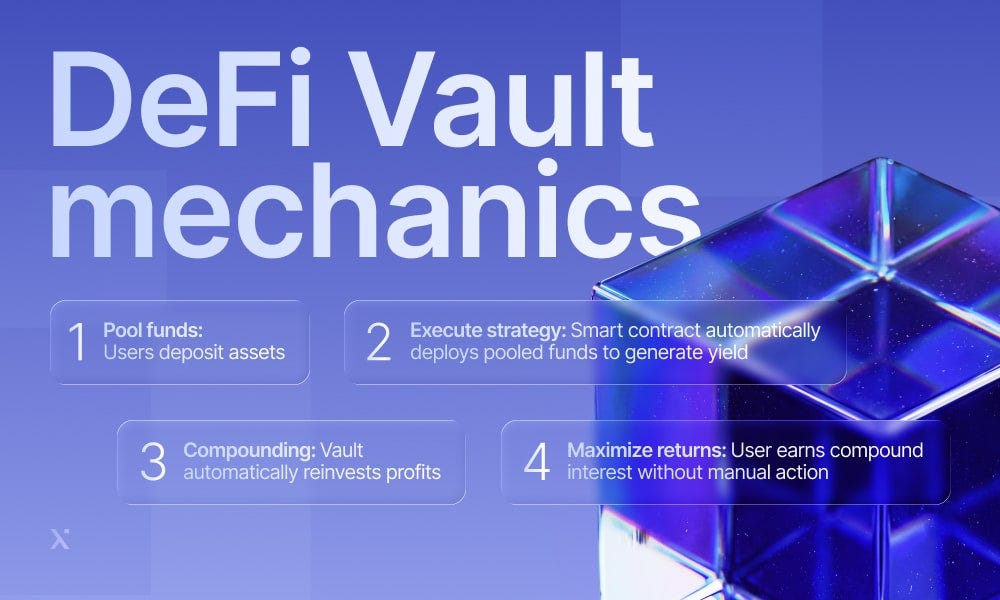
You deposit. You receive shares. The vault deploys that capital across yield strategies. Yield accrues to NAV. NAV growth raises the eRate. Your shares become worth more.
Then time compounds all of it: more rebalancing cycles, more yield accrual, more strategy rotations working in your favour. The first week is essentially a cost period. The first month starts showing signal. Over a longer horizon, the vault’s logic has had room to actually run.
That’s the whole model.
Explore Concrete at app.concrete.xyz