
How Distributed Quantum Computing and Quantum Networks Will Become the World’s First Real Quantum Supercomputers
How Multi-Node Quantum Systems Will Become the Real Quantum Supercomputers

If you imagine a future “quantum supercomputer” as one giant shiny box in a lab, you’re already a step behind.
The most powerful quantum systems we build will almost certainly look more like the internet than a single machine: a fabric of many quantum devices, connected by quantum networks, working together as one.
This is the core idea behind distributed quantum computing (DQC) and quantum networks — and why leaders in India, the US, the EU, and the Global South should care now, not ten years from now.

TL;DR for Busy Leaders
- We will not get to practical, fault-tolerant quantum computing by only making chips bigger.
- The realistic path is: many medium-sized quantum processors + high-quality quantum networks + smart software.
- Countries and enterprises that prepare their fibre, cloud, and security stacks for multi-node quantum systems will get the first real advantage.
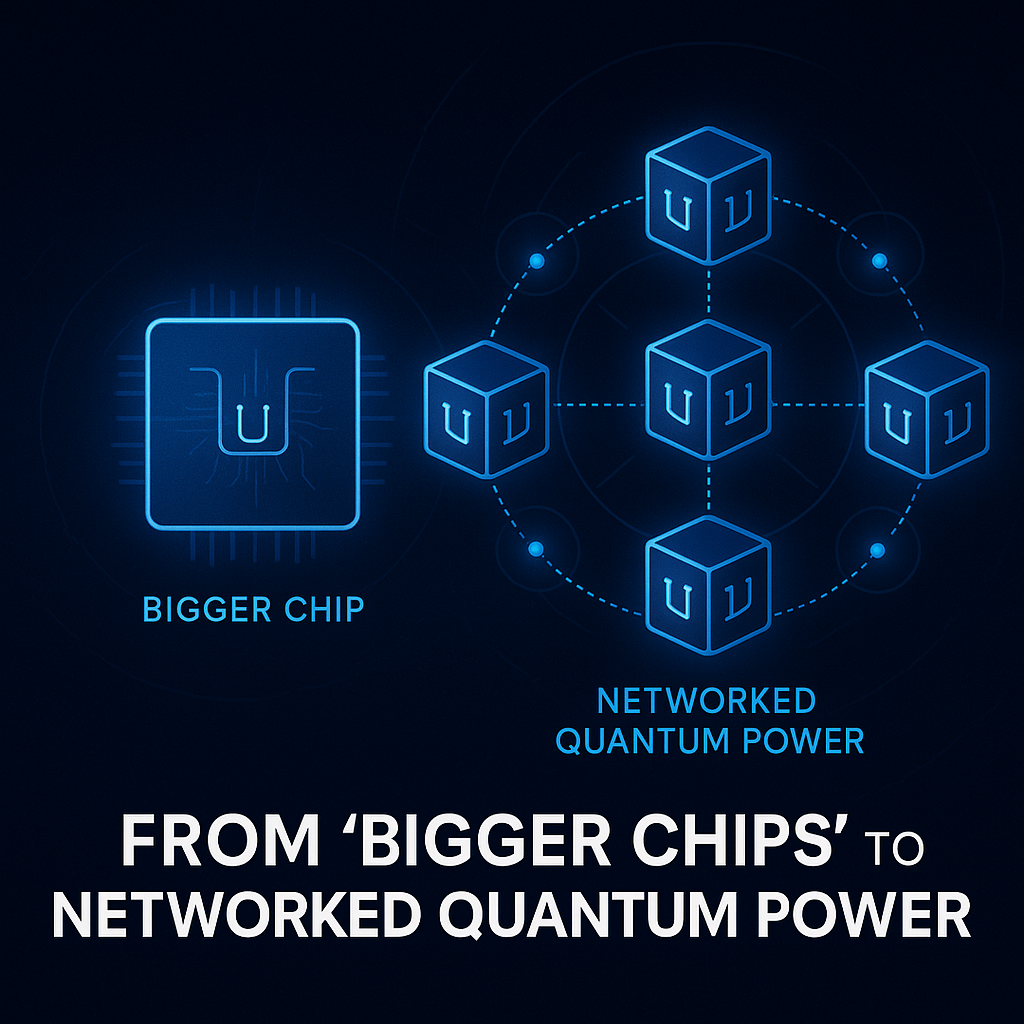
1. From “Bigger Chips” to Networked Quantum Power
Most headlines still celebrate “record-breaking devices”:
- Caltech’s 6,100 neutral-atom qubit array operating at room temperature is a good example of how fast single systems are scaling. (California Institute of Technology)
At the same time, companies such as IBM and Google are pushing towards chips with hundreds–thousands of superconducting qubits, inching closer to fault-tolerant regimes. (ACM Digital Library)
But building one monster device hits brutal limits:
- Cooling and shielding millions of qubits in one cryostat becomes nightmarishly complex.
- Every additional control line makes the system more fragile.
- Manufacturing yield and cost explode.
So researchers and industry labs are slowly shifting the question:
“Instead of one monster quantum computer…
can we connect many smaller quantum processors and make them act like one?”
That is exactly what distributed quantum computing and quantum networks try to achieve. Recent surveys and architecture papers treat multi-node systems as a primary path to scalable quantum computing rather than a side branch. (ACM Digital Library)
2. What Is Distributed Quantum Computing?
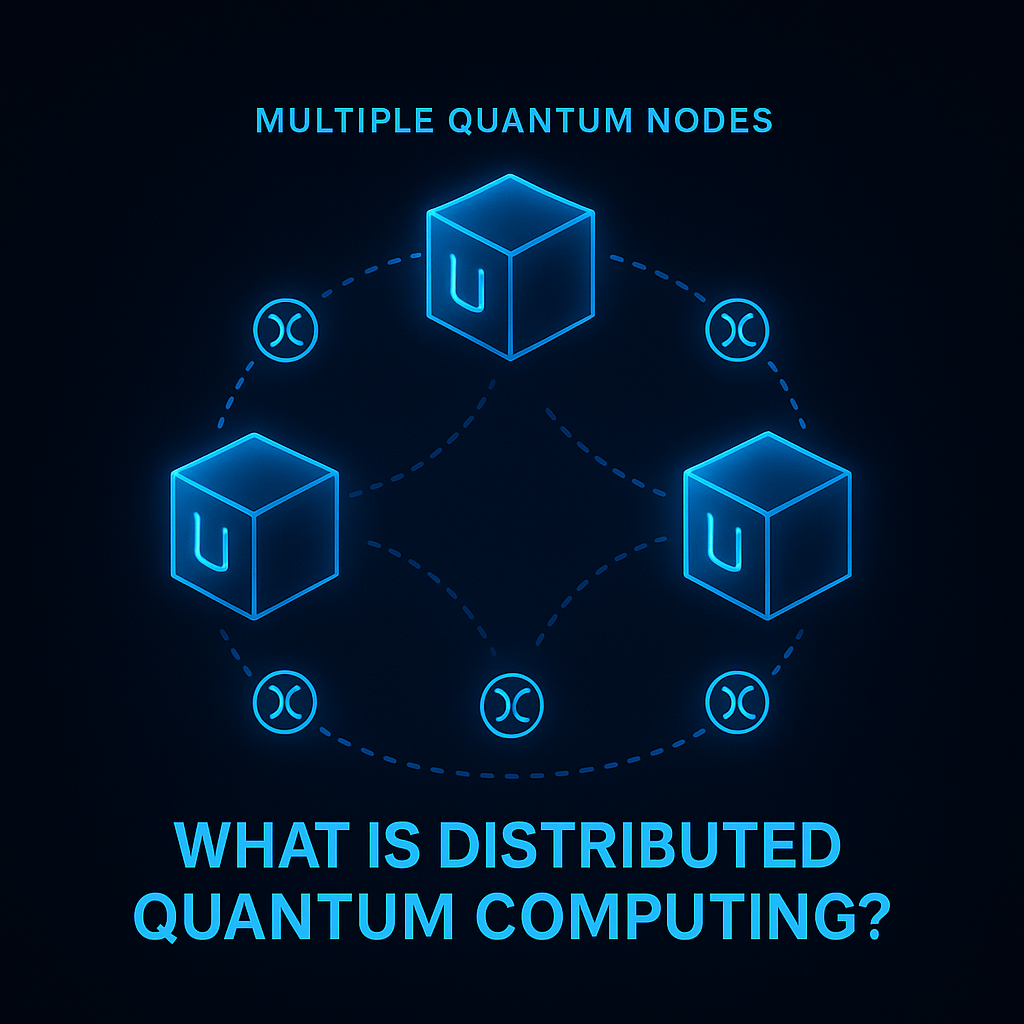
Imagine today’s quantum device as:
One very powerful calculator sitting on a single desk.
Distributed quantum computing is:
Many such calculators on different desks, connected with special quantum “cables”, solving one big problem together.
More formally:
- You have multiple quantum processors (nodes).
- Each node has its own qubits and can run local quantum gates.
- Nodes are connected by:
- Classical links (normal networks, like today’s internet), and
- Quantum links (where entangled photons or other quantum states carry information).
The crucial difference from ordinary distributed computing is:
Nodes don’t just send data; they share entanglement and can perform non-local quantum operations across machines.
This is no longer theoretical. In 2025, Oxford University experimentally distributed a quantum algorithm across two trapped-ion processors connected by an optical link, using quantum teleportation to implement gates between qubits residing in different modules. (Nature)
That’s exactly the kind of building block you need to create a networked quantum supercomputer.
3. What Is a Quantum Network or “Quantum Internet”?
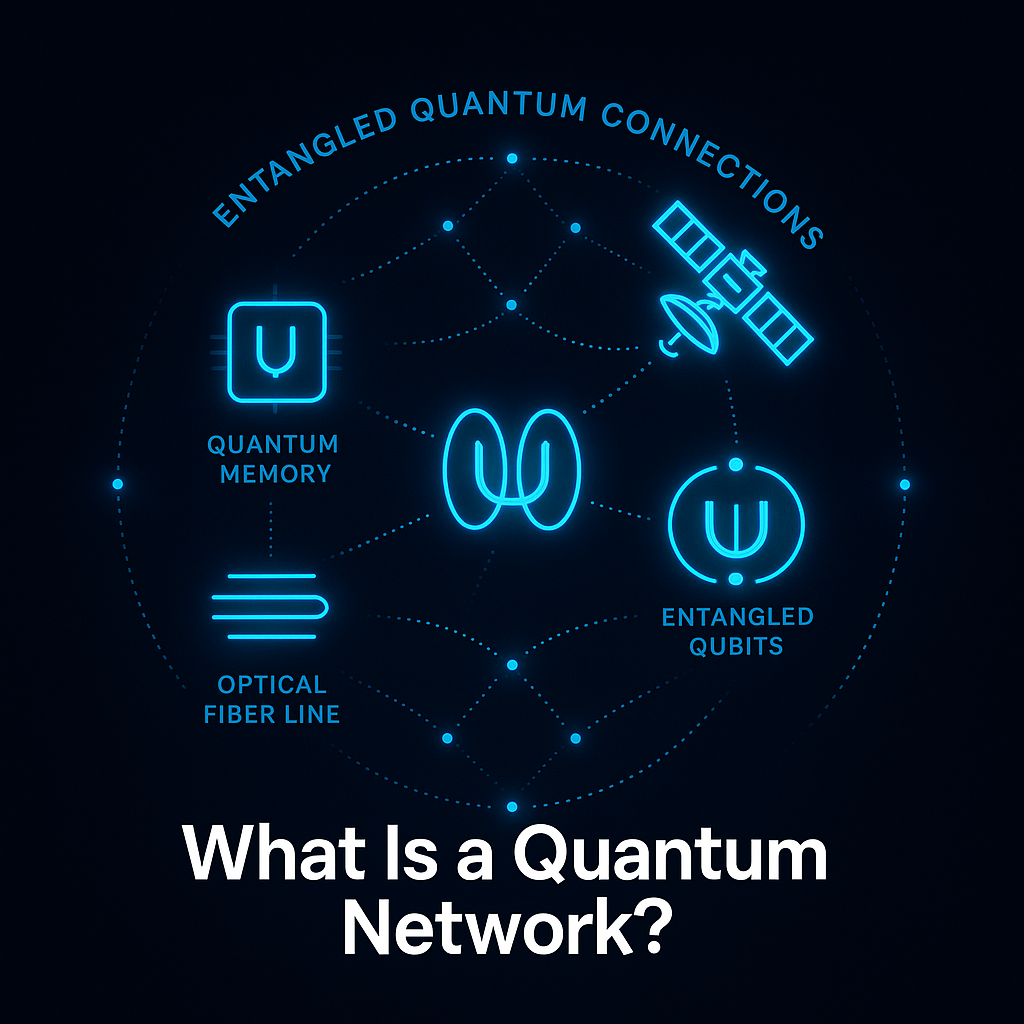
A quantum network connects quantum devices — computers, memories, sensors — using channels that carry single photons or other quantum states. (Wikipedia)
You can think of three layers:
- End Nodes
- Quantum computers, quantum memories, or quantum sensors at each location.
2. Quantum Channels
- Optical fibre, free-space links (through air), or satellites that carry photons.
3. Quantum Repeaters & Routers
- Devices that extend entanglement over long distances using:
- Quantum memories
- Entanglement swapping
- Teleportation-style protocols
Compare it with the classical internet:
Classical internet:
- You send bits (0s and 1s).
- Repeaters copy and amplify the signal.
Quantum internet:
- You send qubits encoded in photons.
- Repeaters never copy (no-cloning theorem); instead, they swap entanglement and use teleportation to extend quantum correlations.
A simple mental picture:
- City A and City B are too far apart; photons get lost.
- Place an intermediate node M.
- Create entangled pairs between A–M and M–B.
- Perform a special joint measurement at M to “swap” entanglement so A and B become entangled — even though they never directly interacted.
This is the magic that allows the quantum internet to span cities, countries, and continents.
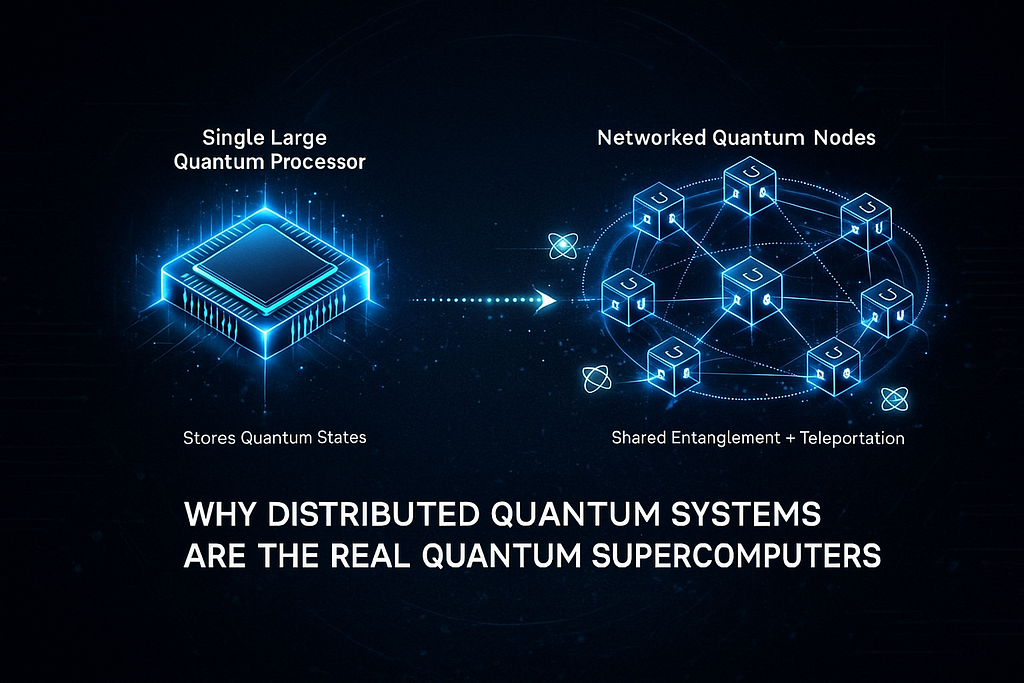
4. Why Distributed Quantum Systems Are the Real Quantum Supercomputers
Picture three possible futures:
- Monster Chip Future
One giant chip with millions of qubits inside a single cryostat. - Cloud of Boxes Future
Lots of mid-scale quantum devices, connected in a data centre. - Planet-Scale Quantum Cloud
Quantum devices located in different cities and continents, linked via quantum networks and satellites.
Scenario 1 looks elegant in press images, but is incredibly fragile and hard to manufacture.
Scenarios 2 and 3 are modular, realistic, and already emerging.
Why the networked approach wins:
4.1 Scalability
- You scale by adding nodes, not by endlessly enlarging one chip.
- Architectures for multi-node superconducting and ion-trap systems explicitly assume such modular, networked growth. (ACM Digital Library)
4.2 Specialisation
You can tune different nodes for:
- Long-lived memory (storing quantum states longer).
- Fast gates (for heavy computation).
- High-fidelity communication (network qubits, photonic links).
This is similar to classical data centres where some machines specialise in storage, some in CPU-heavy workloads, some in networking. (MIT News)
4.3 Resilience & Upgradability
- You can replace or upgrade individual nodes without shutting down the entire system.
- You can mix hardware types (neutral atoms, ions, superconducting qubits) in one logical quantum cloud over time.
4.4 Geographic Reach
Quantum networks enable:
- Quantum-safe communication (QKD links between banks, defence, and data centres). (Wikipedia)
- Shared quantum compute access between cities — relevant for India, the EU, US, and emerging hubs in the Global South.
In short: The future “quantum supercomputer” is almost certainly a network of quantum machines, not a single machine.
5. How Distributed Quantum Computing Actually Works
Let’s use a simple analogy.
The Giant Puzzle Story
You and a friend are solving a huge jigsaw puzzle:
- It doesn’t fit on one table.
- You keep half the pieces; your friend keeps the other half on another table.
- You both work in parallel, but sometimes need to check how edges match.
In classical distributed computing, you’d simply copy and send data (photos of your half) back and forth.
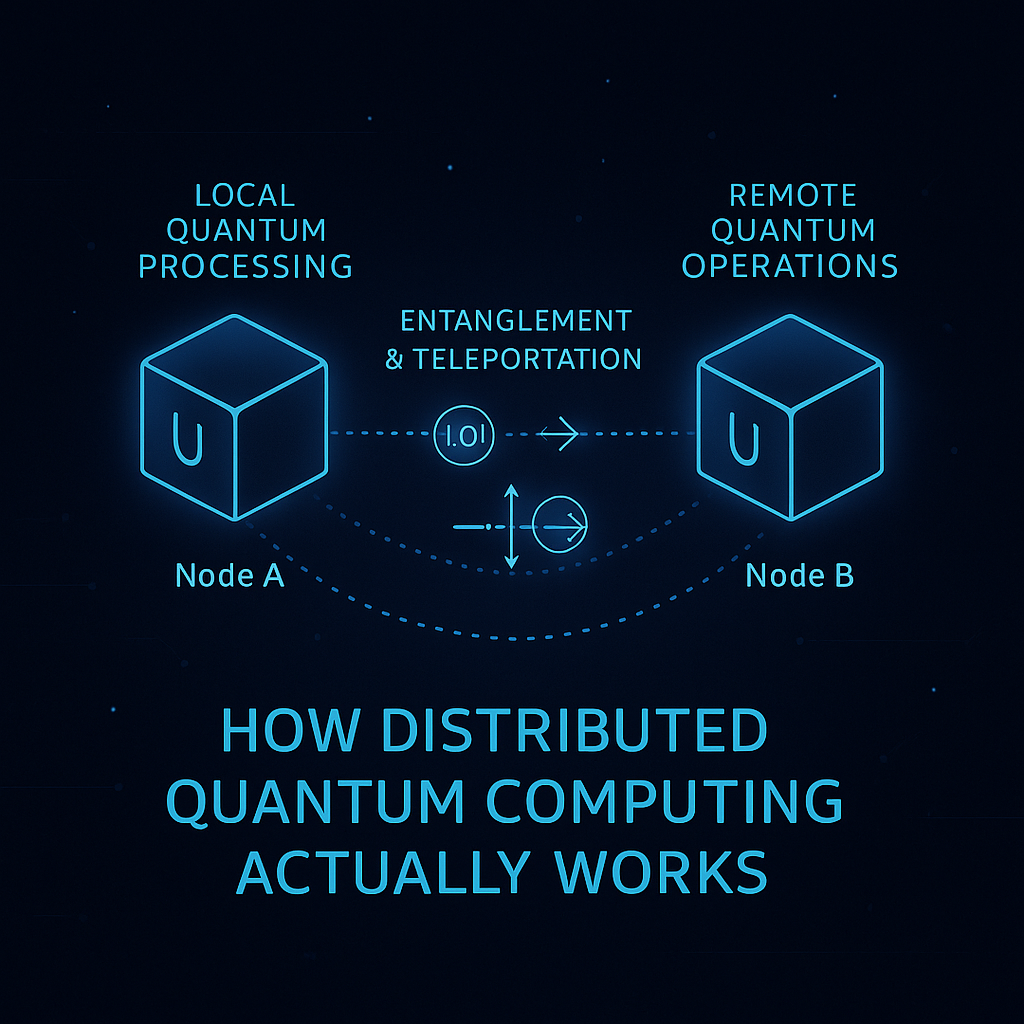
In quantum computing, you cannot freely copy quantum states. Instead, distributed quantum systems do three clever things:
- Pre-Share Entanglement
Nodes create entangled qubits between them over the quantum network. - Use Quantum Teleportation
A qubit’s state in node A can be transferred to node B without physically moving the qubit — using entanglement plus a small classical message. (Wikipedia) - Execute Remote Gates
Some logical operations behave as if qubits on different nodes were sitting on one chip.
In the Oxford trapped-ion experiment:
- Each module hosted:
- Circuit qubits (for local computation), and
- Network qubits (for entanglement and teleportation).
- They demonstrated high-fidelity gates between modules and even ran a distributed Grover’s search algorithm across them — an early but important proof that real algorithms can be split across nodes. (Nature)
6. The Building Blocks: Memories, Repeaters, and Interconnects
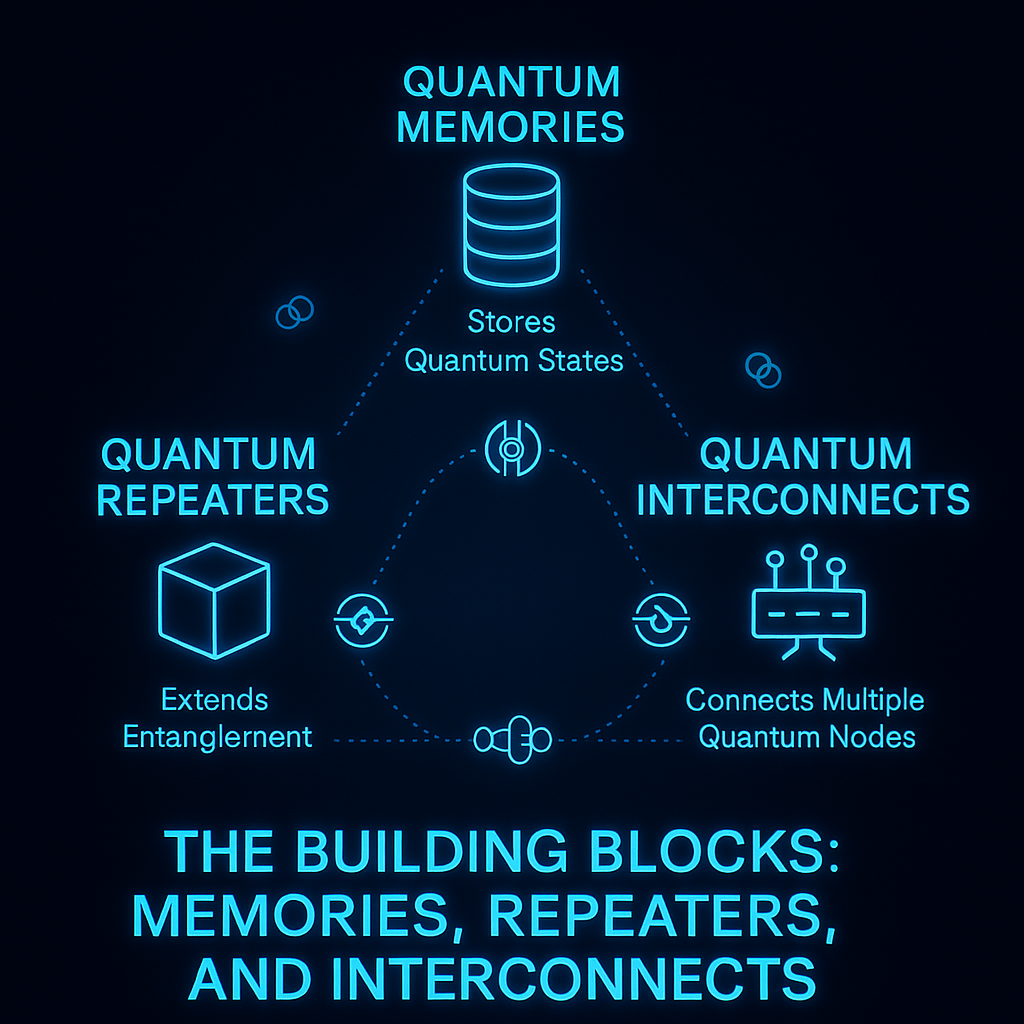
To make all of this practical, we need several key technologies.
6.1 Quantum Memories
Quantum memories store qubits for long enough to:
- Wait for other network links to succeed.
- Synchronize multi-step protocols such as entanglement swapping.
They are critical for:
- Quantum repeaters (long-distance networks).
- Distributed algorithms that require coordinated operations across nodes. (Wikipedia)
6.2 Quantum Repeaters
As photons travel through fibre, they:
- Get absorbed.
- Accumulate noise and decoherence.
We can’t simply amplify them (no-cloning theorem), so we need quantum repeaters that:
- Divide long distances into shorter segments.
- Create entanglement between neighbouring nodes.
- Use entanglement swapping to extend that entanglement step by step.
Think of them as refuelling stations on a very long highway — without them, no long-distance quantum internet.
6.3 Multi-Processor Interconnects
Inside a lab or quantum data centre, we also need “short-range” network gear.
- MIT researchers recently demonstrated an interconnect that can route microwave photons between multiple superconducting processors with all-to-all connectivity, showing how a network of chips can behave like one extended system. (MIT News)
These are essentially the switches and routers of future quantum data centres.
7. Global Landscape: India, the US, the EU and the Global South
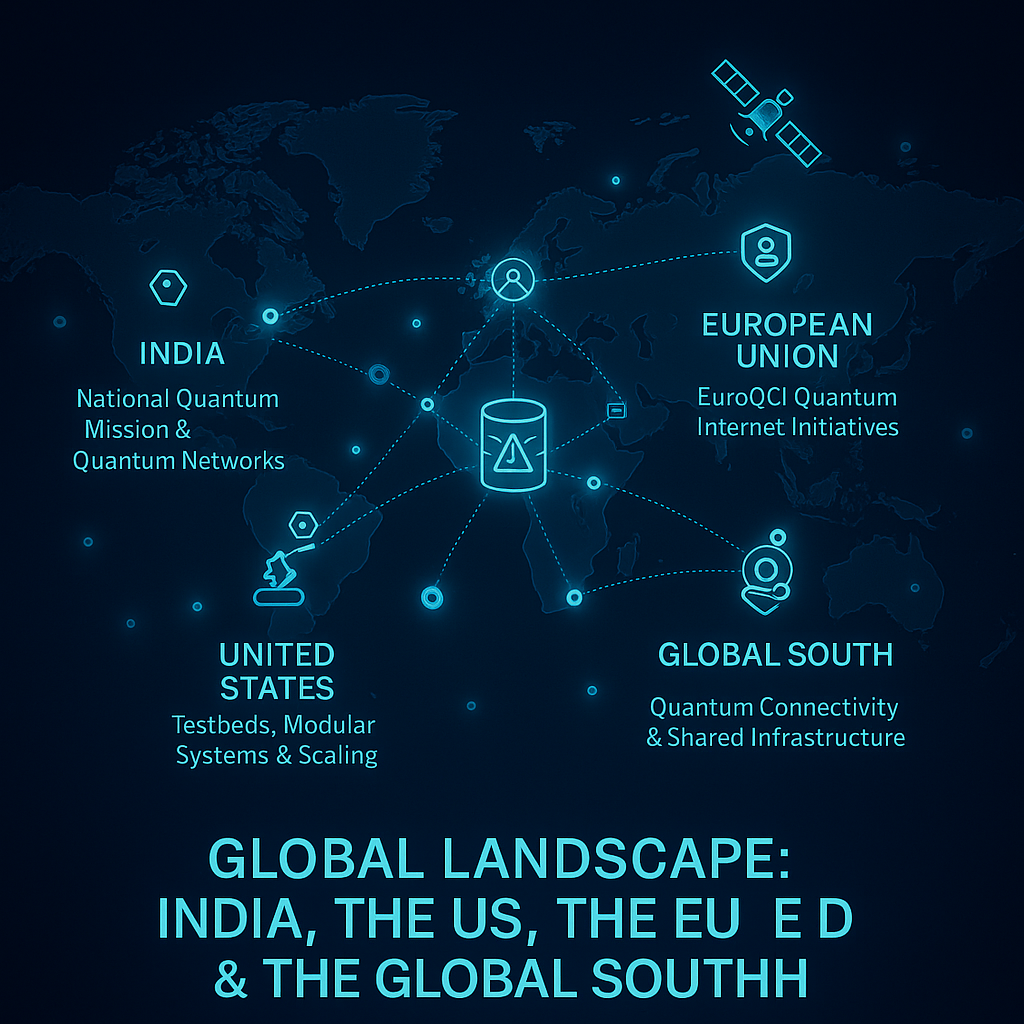
Every major region is now investing in distributed quantum systems and networks.
7.1 India
India’s National Quantum Mission (NQM) explicitly targets:
- Multi-node quantum networks with quantum memories, entanglement swapping, and synchronised repeaters across 2–3 nodes. (Press Information Bureau)
- Long-distance QKD and satellite-based secure quantum communication.
Recent demonstrations include:
- DRDO–IIT Delhi free-space quantum communication over ~1 km — an important step towards city-scale and defence-grade quantum-secure links. (Press Information Bureau)
States such as Andhra Pradesh, Telangana, and Tamil Nadu are already exploring quantum communication testbeds along defence and industrial corridors.
7.2 United States
The US is investing through:
- Department of Energy and NSF quantum networking testbeds and regional quantum centres.
- Industrial efforts by IBM, Google, and start-ups to build modular, multi-chip systems that naturally extend into multi-node networks. (ACM Digital Library)
7.3 European Union
The EU Quantum Flagship and the EuroQCI (European Quantum Communication Infrastructure) programme aim to build continent-wide quantum-secure networks across terrestrial fibre and satellites. (qt.eu)
These efforts naturally dovetail with metropolitan quantum networks in countries like the Netherlands, Austria, and Germany.
7.4 Global South
For many countries in the Global South, the opportunity is strategic:
- You can reuse existing telecom fibre and satellite links.
- You do not need to own the world’s largest quantum computer.
- Instead, you connect as:
- A quantum client to global hubs, or
- A regional node offering QKD-secured services and specialised applications. (Wikipedia)
This creates a shared quantum ecosystem where a few hubs host heavy-duty processors, and many regions participate as first-class quantum citizens.
8. Where Multi-Node Quantum Systems Will Actually Matter
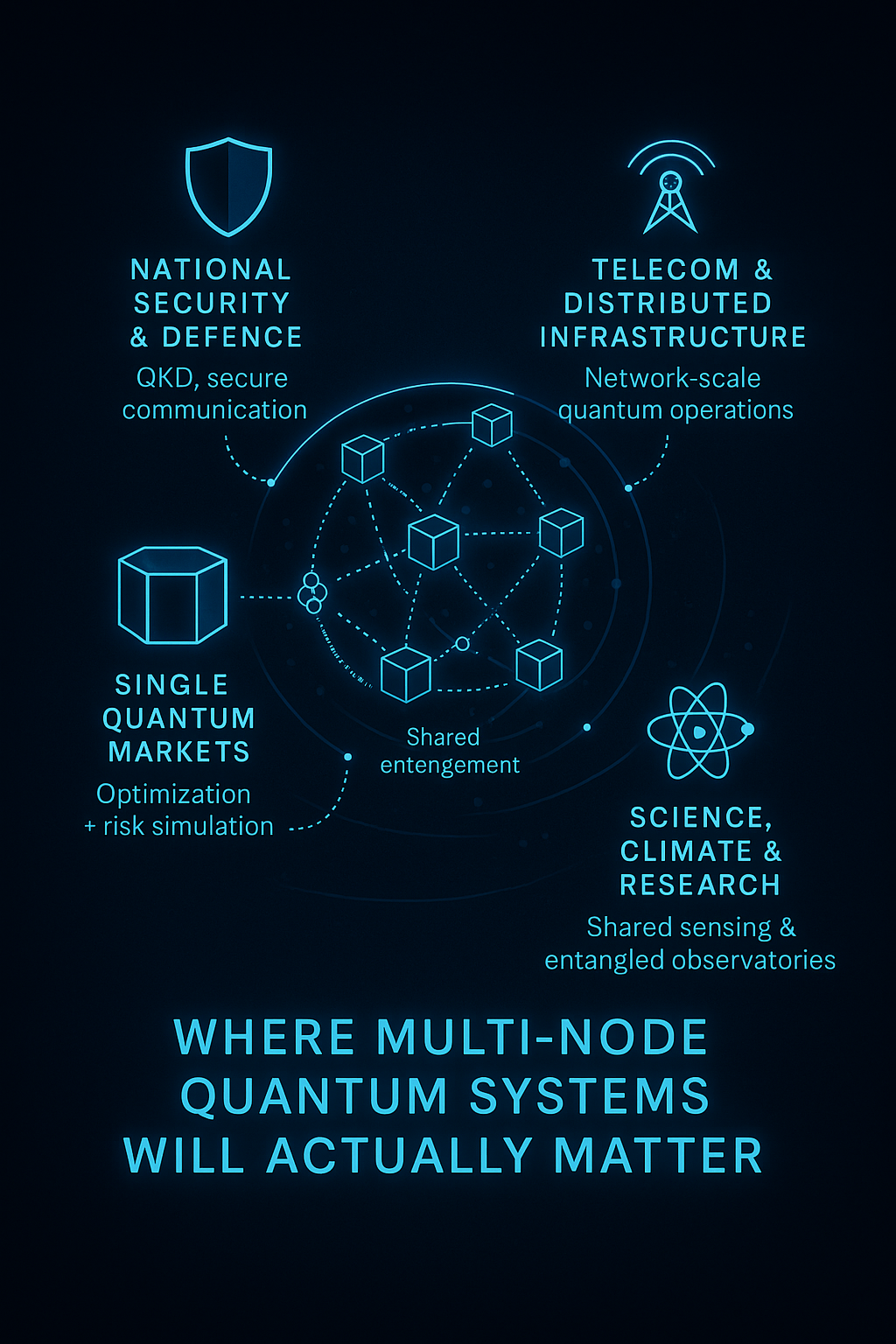
8.1 Ultra-Secure Communication & National Security
Quantum networks are already being trialled for:
- QKD links between banks, defence corridors, and government agencies.
- Future “quantum internet” services that provide tamper-evident communication and highly secure cross-border data exchange. (Wikipedia)
For countries like India and EU member states, distributed quantum communication aligns directly with data sovereignty and critical infrastructure protection.
8.2 Distributed Quantum Computing as a Cloud Service
Cloud providers could:
- Host multiple QPUs in different locations.
- Use quantum networks to stitch them into a virtual supercomputer.
For enterprises, this looks like:
- Submitting a job that:
- Automatically routes across several QPUs,
- Balances noise, latency, and capacity,
- Chooses specialised devices for simulation, optimisation, or chemistry.
8.3 Finance, Logistics, and Telecom
Multi-node systems can support:
- Risk simulations where different books or geographies run on different nodes but share one global quantum state.
- Network and route optimisation for telecoms and logistics, where each node represents a city, data centre, or region — especially relevant for large countries such as India or federated markets like the EU. (Wikipedia)
8.4 Science, Climate & Sensing
Imagine:
- Quantum sensors deployed in different observatories, entangled to detect tiny astrophysical or climate-related signals beyond classical limits.
- Distributed quantum networks that blend sensing + computing into one scientific instrument. (sps-aviation.com)
This is where the line between “quantum computer” and “quantum instrument” starts to blur.
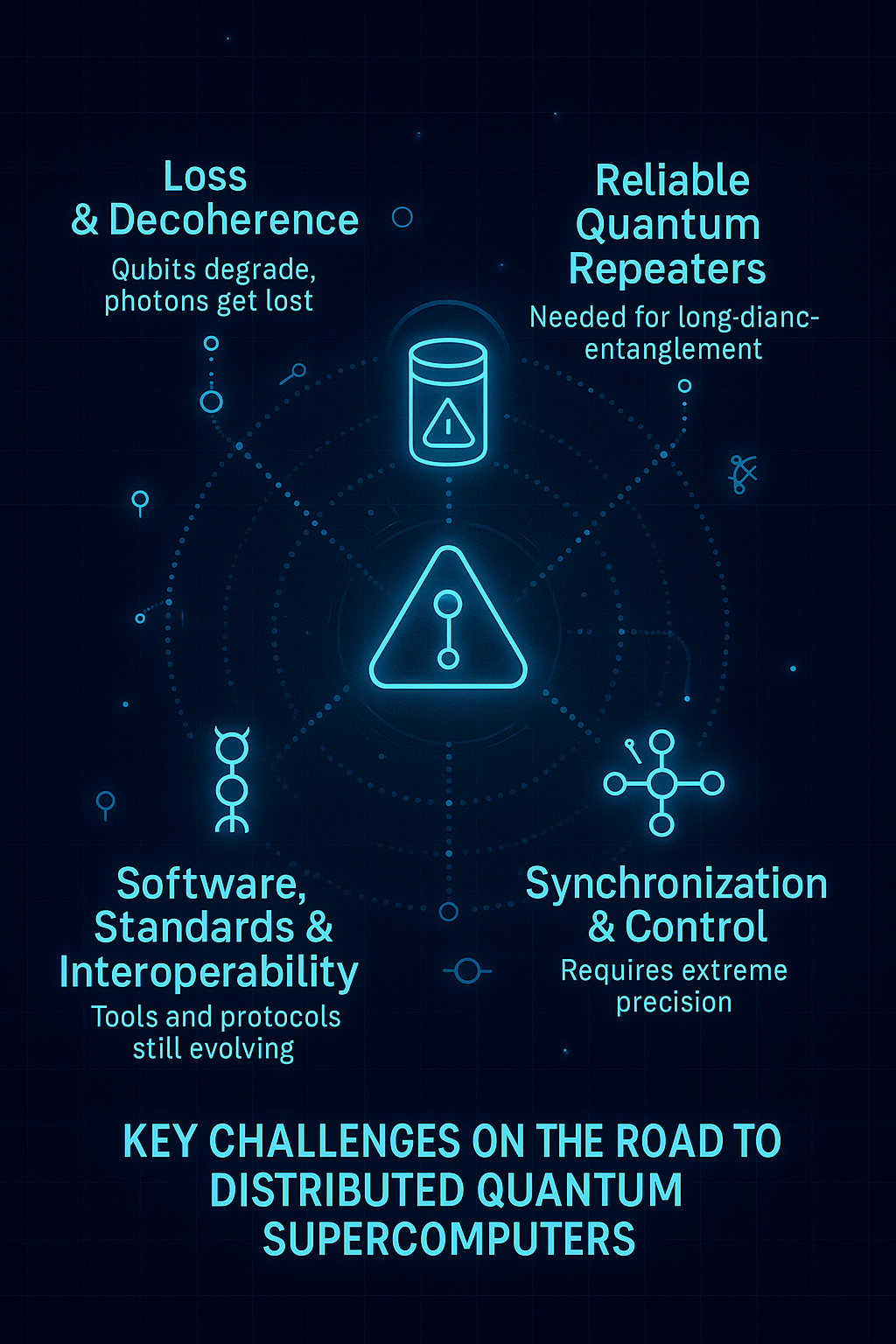
9. Key Challenges on the Road to Distributed Quantum Supercomputers
We should be honest: this is hard.
9.1 Loss and Decoherence
- Photons get lost in fibre.
- Qubits lose coherence over time.
Improving coherence times and reducing transmission loss are active areas of materials, photonics, and systems research. (arXiv)
9.2 Practical Quantum Repeaters
We still need deployable repeater nodes that:
- Integrate quantum memories.
- Operate at telecom wavelengths.
- Survive real-world network conditions and costs. (Wikipedia)
9.3 Synchronisation & Control
Distributed quantum operations demand:
- Sub-nanosecond timing in some platforms.
- Coordination between classical control systems and quantum hardware across distances.
9.4 Standards and Interoperability
We are still in “pre-standardisation” mode:
- IRTF’s Quantum Internet Research Group (QIRG), ITU-T initiatives, and IEEE projects are early steps towards common protocols. (Wikipedia)
But we still lack the equivalent of a “TCP/IP for quantum networks” that everyone agrees on.
9.5 Software Stacks
Most quantum software frameworks today assume a single device.
Future stacks must:
- Compile algorithms into multi-node circuits.
- Decide when to teleport, when to just send classical data.
- Map logical qubits across nodes dynamically, based on noise and availability. (ACM Digital Library)
10. What Leaders, Policymakers, and Enterprises Should Do Now
If you’re a government planner, regulator, CIO, CTO, or ecosystem builder in India, the EU, the US or the Global South, here is a practical checklist.
10.1 Track the Right Signals
Don’t just follow “qubit counts”. Watch for:
- Demonstrations of multi-node experiments (like Oxford’s distributed algorithm). (Nature)
- Progress on quantum repeaters and long-distance entanglement.
- National roadmaps explicitly mentioning multi-node networks (e.g., India’s NQM objectives). (Press Information Bureau)
10.2 Align with National Quantum Missions
- In India, actively engage with NQM pilots on communication and quantum networks.
- In the EU, align with EuroQCI and related national testbeds. (Digital Strategy)
- In the US and other regions, plug into DOE/NSF or regional quantum network initiatives.
10.3 Invest in Hybrid Talent
You will need people who understand:
- Quantum physics + networks + cloud/telecom.
- Not just algorithms, but full-stack systems engineering.
These people will become the architects of your quantum-ready infrastructure.
10.4 Plan for Quantum-Ready Infrastructure
Start asking:
- How can our existing fibre be upgraded for QKD or future quantum links?
- Which data centres might host early QPUs or connect to quantum cloud providers?
- How do our identity, key management, and compliance systems need to evolve to integrate quantum-safe and quantum-native security?
The organisations that treat quantum networking as a connectivity and architecture problem, not only a “mysterious physics project”, will move faster.
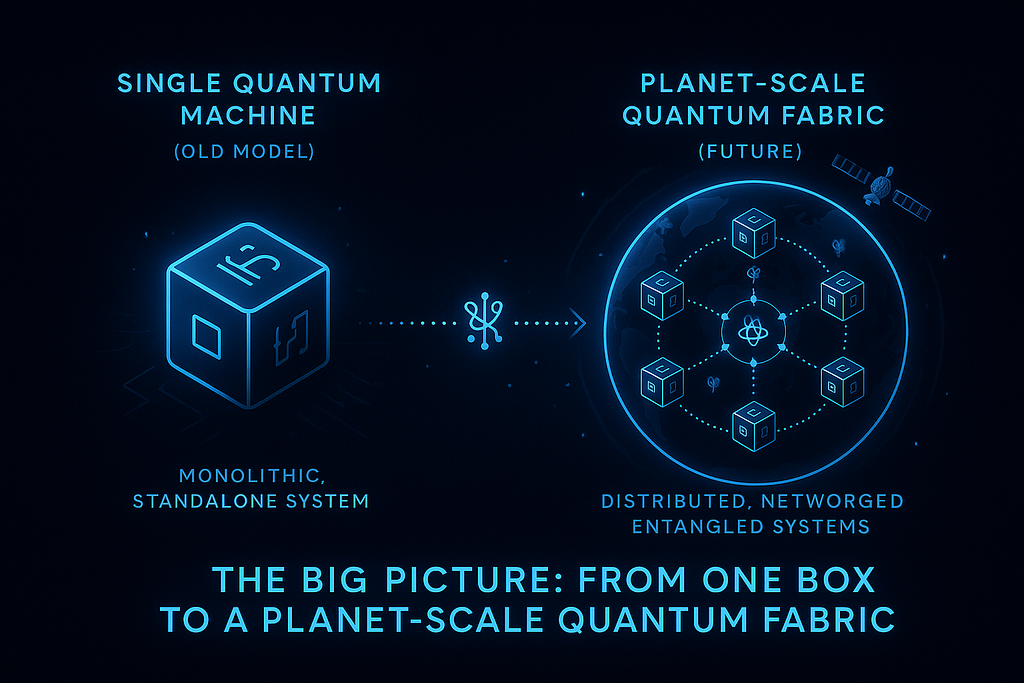
11. The Big Picture: From One Box to a Planet-Scale Quantum Fabric
When we say: “Multi-node quantum systems will become the real quantum supercomputers,”
We’re really saying the internet mindset will beat the mainframe mindset.
Just as classical computing evolved: Mainframes → distributed servers → global cloud + internet
Quantum computing is evolving: Single chips → connected modules → distributed quantum clouds + quantum internet
So the strategic question for countries, banks, telecoms, hyperscalers, and research ecosystems is no longer: “When will one quantum computer be powerful enough?”
The better question is: “How do we plug into a world where quantum power is distributed, networked, and shared across regions?”
That is the world distributed quantum computing and quantum networks are quietly building today — in Bengaluru and Berlin, in Washington and Wellington, in Hyderabad and Helsinki.
12. Conclusion
- The race to quantum advantage will not be won by a single, isolated machine.
- It will be won by ecosystems that combine:
- Robust quantum devices,
- High-quality quantum and classical networks, and
- A governance and talent model that can scale across organisations and borders.
- For India, the EU, the US and the Global South, this is not just a technology issue — it is a strategic infrastructure decision, on the same level as 5G, cloud, and AI.
If you are designing a national roadmap, a bank’s long-term risk strategy, a telecom backbone, or a cross-border data-sharing framework, this is the moment to add one more line to your plan:
“Make our networks ready for distributed quantum systems.”
The shiny single box may get the photo on the cover.
The planet-scale quantum fabric will quietly shape the future.
Glossary
Distributed Quantum Computing (DQC)
Running one quantum algorithm across multiple quantum processors connected by quantum links, instead of one giant chip.
- Quantum Network / Quantum Internet
A network that carries qubits (often as photons) between quantum devices, enabling entanglement and quantum-secure communication across distance. - Quantum Node
A location in the network — such as a quantum computer, memory, or sensor — that can send, receive, and process quantum information. - Quantum Memory
A device that can store qubits long enough to coordinate multi-step protocols and long-distance communication. - Quantum Repeater
The quantum equivalent of a network repeater, used to extend entanglement over long distances without copying the signal. - Quantum Teleportation
A protocol that transfers a quantum state from one place to another using entanglement plus classical communication, without moving the particle itself. - Quantum Key Distribution (QKD)
A method of creating shared cryptographic keys whose security is guaranteed by quantum physics, already piloted in India, China, the EU, and other regions. - EuroQCI
The European Quantum Communication Infrastructure initiative to build a secure, EU-wide quantum communication backbone. - National Quantum Mission (NQM) — India
India’s flagship quantum programme, including goals for multi-node quantum networks, satellite QKD and indigenous quantum hardware. - Quantum-Ready Infrastructure
Existing fibre, cloud, and security systems designed so they can evolve to integrate quantum communication and distributed quantum computing.
Frequently Asked Questions (FAQ)
Q1. Why can’t we just wait for a million-qubit chip instead of worrying about networks?
Because physics, engineering, and economics all push against one gigantic device. Cooling, wiring, yield, and control complexity grow faster than linearly. Modular, networked systems are far more realistic — and align with how classical supercomputing evolved.
Q2. Does distributed quantum computing reduce the need for error correction?
It doesn’t eliminate error correction, but it offers architectural flexibility. You can combine nodes with different error-correcting codes, move workloads, and isolate faults. Over time, this can reduce overall overhead compared to forcing everything into one architecture.
Q3. Is a quantum internet only about security (QKD)?
No. QKD is the first commercial use case, but quantum networks will also enable distributed computation, networked sensors, clock synchronisation, and new forms of scientific instrumentation.
Q4. How is this relevant for countries that don’t have big quantum labs?
You don’t need to build the largest quantum computer to participate. By preparing your telecom fibre, cloud, and regulatory frameworks for quantum connectivity, you can become a key node or gateway in future global quantum networks.
Q5. What should enterprises actually do in the next 2–3 years?
- Run pilot projects with QKD or early quantum network testbeds.
- Build internal expertise on distributed quantum architectures.
- Include quantum-ready infrastructure in cloud, security, and data-centre plans.
- Engage with national missions and standards bodies early rather than waiting for “finished” products.
References & Further Reading
These are good starting points if you want to go deeper:
- Caltech’s 6,100-Qubit Neutral-Atom Processor — Press releases and research articles on record-scale neutral-atom arrays operating at room temperature, with long coherence times and high gate fidelities. (California Institute of Technology)
- Oxford: Distributed Quantum Computing Across an Optical Network Link — Nature article and related summaries on distributing Grover’s algorithm across trapped-ion modules connected via photonic links. (Nature)
- MIT Interconnects for Multi-Processor Quantum Systems — Work on routing single and microwave photons between superconducting processors, enabling all-to-all communication in modular architectures. (MIT News)
- India’s National Quantum Mission (NQM) — Official mission documents outlining goals for multi-node networks, QKD backbones, and domestic quantum hardware development. (Press Information Bureau)
- DRDO–IIT Delhi Free-Space Quantum Communication Demo — Press notes and analyses describing India’s 1-km entanglement-based free-space QKD experiment. (Press Information Bureau)
- Quantum Network & Quantum Internet Overviews — High-level introductions to quantum networks, standards efforts, and applications (e.g., work by Wehner et al. and subsequent reviews). (Wikipedia)
- EU Quantum Flagship and EuroQCI — Official pages and policy articles on Europe’s plans for a continental quantum communication infrastructure spanning fibre and satellites. (qt.eu)
How Distributed Quantum Computing and Quantum Networks Will Become the World’s First Real Quantum… was originally published in DataDrivenInvestor on Medium, where people are continuing the conversation by highlighting and responding to this story.
