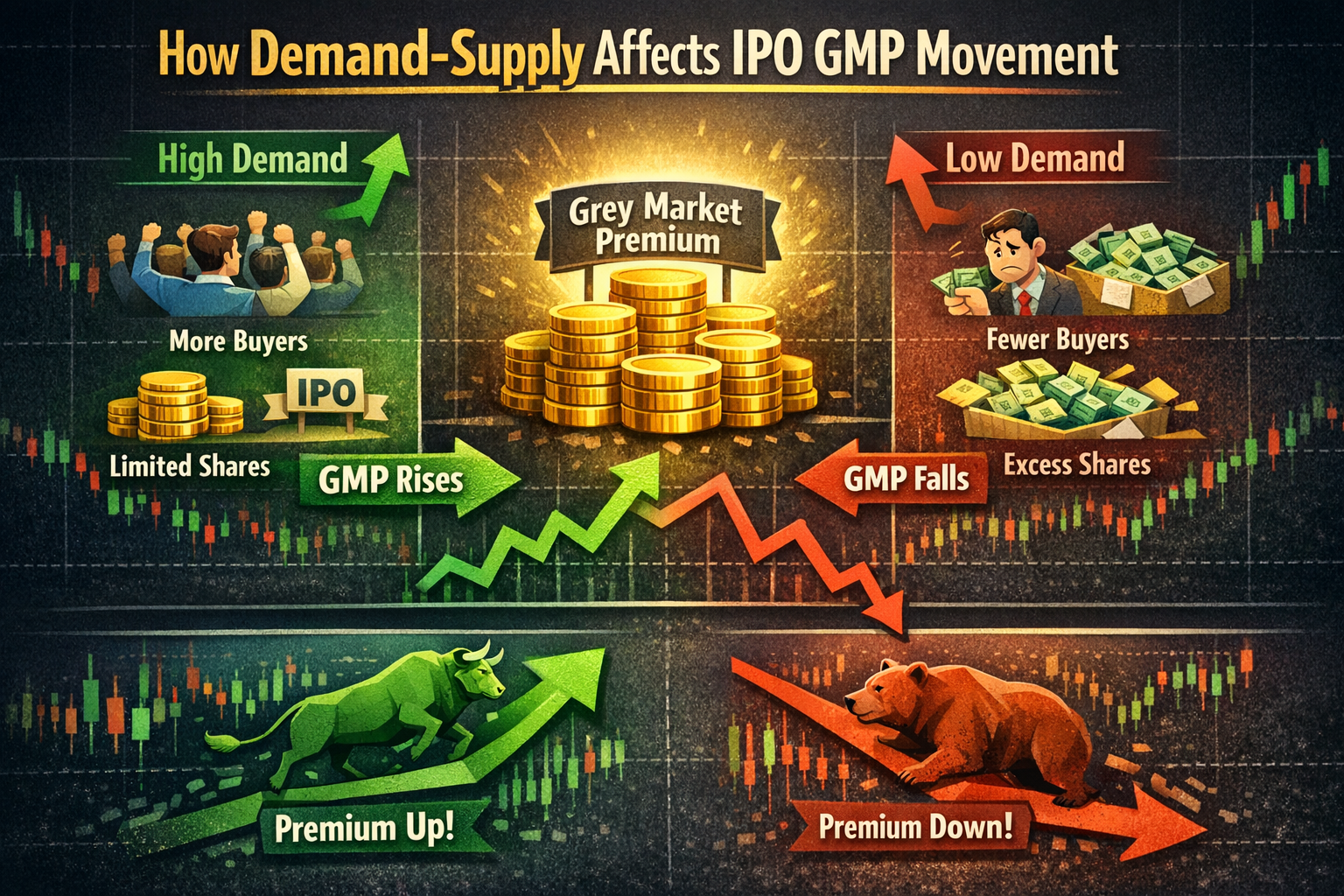
How Demand-Supply Affects IPO GMP Movement
--
1. Introduction
An IPO (Initial Public Offering) is the process through which a company offers its shares to the public for the first time. Before the official listing on stock exchanges, there is an informal market known as the grey market where shares are traded based on expectations. This is where the concept of GMP (Grey Market Premium) comes into play.
The demand and supply in IPO plays a critical role in determining how GMP behaves. When investor demand is high and available shares are limited, GMP tends to rise. On the other hand, weak demand or excess supply can push it down.
Understanding this relationship is essential because many investors track GMP as an early indicator of listing sentiment. However, GMP is not a guaranteed predictor — it simply reflects market expectations before listing.
2. What Is IPO GMP?
The IPO grey market premium refers to the price at which IPO shares are traded unofficially before they are listed on stock exchanges. It indicates how much investors are willing to pay above the issue price.
For example, if an IPO is priced at ₹100 and its GMP is ₹20, it suggests that the shares are trading at ₹120 in the grey market.
This is where tracking ipo gmp becomes useful. It helps investors understand market sentiment before listing and gauge potential listing performance. However, since this market is unregulated, GMP is purely speculative.
3. Understanding Demand and Supply in IPOs
To understand GMP movement, you first need to understand demand and supply in IPO.
Demand
Demand refers to the number of investors applying for shares. This includes:
- Retail investors
- High Net-worth Individuals (HNIs)
- Institutional investors
Higher demand means more competition for shares.
Supply
Supply refers to the number of shares offered in the IPO. This depends on:
- Issue size
- Number of shares available
- Allocation categories
Oversubscription
When demand exceeds supply, the IPO gets oversubscribed. For example:
- 10x subscription = demand is 10 times the available shares
Oversubscription is a key driver of GMP changes.
4. How Demand Affects IPO GMP Movement
Demand is one of the strongest drivers of IPO GMP movement.
High Demand → Rising GMP
When there is strong IPO market demand, investors are willing to pay a premium to secure shares. This leads to:
- Increase in GMP
- Positive sentiment
- Higher listing expectations
Retail and HNI Participation
- Retail investors create broad-based demand
- HNIs often apply with large capital, increasing subscription numbers
Market Buzz and Hype
Sometimes demand is driven by:
- Media coverage
- Industry trends
- Brand recognition
This can push GMP higher, even if fundamentals are average.
5. How Supply Affects IPO GMP Movement
While demand pushes GMP upward, supply can limit or reduce it.
Large Issue Size
If an IPO has a large number of shares:
- Supply increases
- Availability becomes easier
- GMP may remain stable or low
Lower Scarcity
When shares are easily available, investors don’t feel the need to pay a high premium.
Impact on Premium
Even if demand is decent, excess supply can:
- Cap GMP growth
- Reduce listing gains expectations
Thus, supply acts as a balancing factor in GMP movement.
6. Role of Market Conditions
Market conditions significantly influence GMP trends.
Bull Market
In a rising market:
- Investor confidence is high
- Demand increases
- GMP rises
Bear Market
In a falling market:
- Investors become cautious
- Demand drops
- GMP declines
Tracking broader indicators like sensex today helps investors understand overall sentiment. If the market is strong, IPOs tend to perform better in the grey market as well.
7. Demand-Supply Imbalance and GMP Trends
The real movement in GMP happens when there is an imbalance between demand and supply.
Oversubscription → GMP Rise
When IPO subscription data shows high oversubscription:
- Demand exceeds supply
- GMP increases rapidly
Weak Demand → GMP Fall
If subscription levels are low:
- Shares remain available
- GMP drops or stays flat
Example Scenario
- IPO subscribed 50x → strong GMP rise
- IPO subscribed 1.2x → weak or negligible GMP
This clearly shows how IPO GMP movement reflects the imbalance between buyers and available shares.
8. Limitations of GMP as an Indicator
While GMP is widely tracked, it has several limitations.
Unofficial Market
- No regulatory oversight
- Prices are based on informal deals
Speculative Nature
- Driven by sentiment, not fundamentals
- Can change quickly
Misleading Signals
- High GMP does not guarantee strong listing
- Low GMP does not always mean poor performance
Therefore, investors should treat GMP as just one of many indicators.
9. Should Investors Rely on GMP Trends?
Relying only on GMP is not advisable.
Combine with Fundamentals
Investors should also analyze:
- Company financials
- Business model
- Industry outlook
Use Subscription Data
IPO subscription data gives a clearer picture of real demand.
Balanced Approach
GMP should be used along with:
- Market trends
- Risk appetite
- Investment goals
This ensures more informed decision-making.
10. Role of IPO in Investment Strategy
An ipo can play different roles depending on an investor’s strategy.
Short-Term Approach
- Focus on listing gains
- Heavily influenced by GMP
Long-Term Approach
- Focus on company growth
- Less dependent on GMP
Risk Management
IPO investments carry risks such as:
- Volatility on listing day
- Overvaluation
- Market fluctuations
A disciplined approach is necessary for both short-term and long-term investors.
11. Practical Example
Let’s understand with a simple example:
Scenario
- IPO issue price: ₹200
- Initial GMP: ₹10
Demand Surge
- Strong retail and HNI participation
- Subscription reaches 30x
GMP Reaction
- GMP rises from ₹10 to ₹60
Listing Outcome
- Stock lists at ₹250
This shows how rising demand can push GMP higher, but actual listing still depends on overall market conditions and investor sentiment.
12. FAQ Section
1. What is IPO GMP?
IPO GMP is the premium at which shares trade in the grey market before listing.
2. How does demand affect IPO GMP?
Higher demand increases competition for shares, leading to a rise in GMP.
3. Why does GMP change daily?
GMP changes based on market sentiment, demand fluctuations, and external factors.
4. What role does sensex today play?
It reflects overall market sentiment, which influences investor confidence and GMP trends.
5. Should investors rely on IPO GMP?
No, GMP should be used along with fundamental analysis and market data.