How Blockchains Agree on One Truth (Consensus Without a Central Authority)
--
A blockchain doesn’t just store transactions.
It continuously answers a harder question:
Out of all possible transactions happening across the network, which ones are actually valid — and in what order?
Because in a decentralized system, there is no central server deciding this.
Every node sees the network slightly differently.
Transactions arrive at different times. Some conflict. Some are delayed. Some are intentionally malicious.
Yet somehow, the network converges on a single version of history.
That process is called consensus.
The Problem Consensus Solves
Imagine a simple scenario.
Two transactions are broadcast at nearly the same time:
- one sends funds from Address A to Address B
- another tries to send the same funds from Address A to Address C
Both cannot be valid.
In a centralized system, a server would decide which one came first.
In a blockchain, there is no such authority.
So the system needs a mechanism where:
- participants independently verify transactions
- the network collectively agrees on ordering
- conflicting states are resolved
How Agreement Emerges
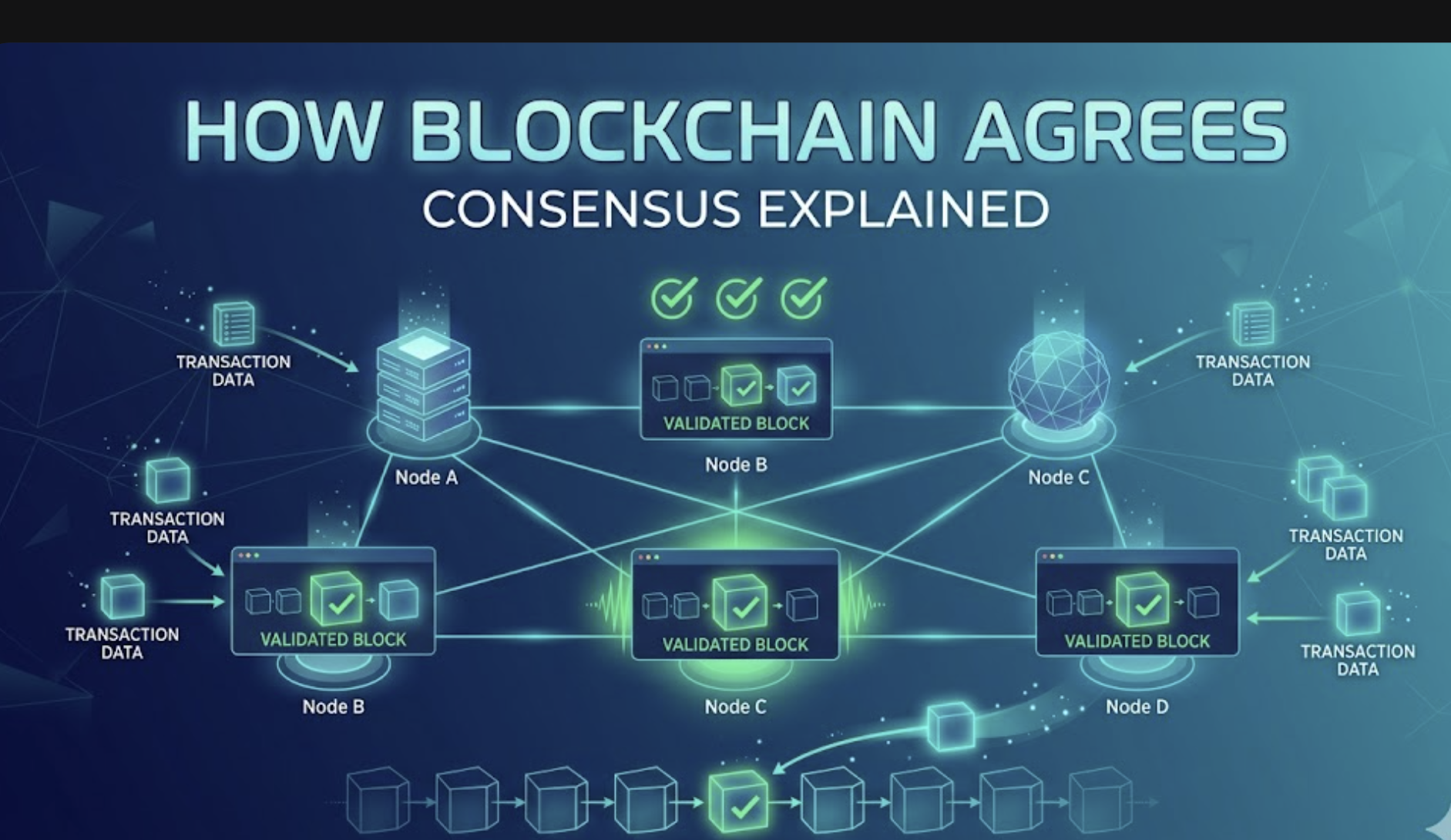
At a high level, consensus is not about everyone talking to everyone.
It’s about:
- proposing blocks
- validating them
- agreeing on which block becomes part of the chain
Different blockchains implement this differently, but the structure is similar:
- A participant proposes a block
- Others verify its validity
- The network accepts one version as canonical
Once accepted, that block becomes part of shared history.
Proof of Work (Computation as a Filter)
In systems like Bitcoin, consensus is achieved through Proof of Work.
Here, proposing a block requires solving a computational puzzle.
This puzzle:
- is hard to solve
- but easy to verify
Miners compete to solve it.
The first one to succeed earns the right to add the next block.
Why This Works
Because solving the puzzle requires real-world resources (electricity and hardware), it becomes expensive to manipulate the system.
To rewrite history, an attacker would need to:
- outpace the rest of the network
- continuously spend more computational power than everyone else combined
That cost acts as a deterrent.
Proof of Stake (Capital as a Filter)
Modern systems like Ethereum use Proof of Stake.
Instead of computation, the system uses economic stake.
Participants lock up tokens to become validators.
The network then selects validators to:
- propose blocks
- verify transactions
If a validator behaves incorrectly, part of their stake can be penalized.
Why This Works
Instead of burning energy, the system relies on economic incentives.
To attack the network, you would need to control a large portion of the total stake.
And doing so puts your own capital at risk.
What Consensus Really Optimizes For
Both approaches are trying to solve the same core problem:
How do you make it expensive to lie?
- Proof of Work → cost in computation
- Proof of Stake → cost in capital
Neither is perfect.
Proof of Work:
- secure, but energy-intensive
Proof of Stake:
- efficient, but introduces new assumptions about incentives
The Hidden Trade-Off
Consensus mechanisms don’t just secure the network.
They define:
- how fast blocks are created
- how transactions are finalized
- how decentralized the system really is
For example:
- faster blocks → quicker confirmations → higher risk of conflicts
- stricter validation → more security → slower throughput
Every design choice affects performance.
Why This Matters in Practice
When you send a transaction, it’s not “done” immediately.
It becomes more secure over time as more blocks are added after it.
This is why exchanges wait for multiple confirmations.
Because consensus is not a single moment — it’s a process of increasing certainty.
The Useful Way to Think About It
Consensus is not just a technical mechanism.
It’s the foundation that allows a system with no central authority to behave predictably.
Without it:
- transactions could be reversed
- balances could be inconsistent
- trust would collapse
With it:
- the network maintains a shared state
- participants can rely on outcomes
- systems can operate without intermediaries
Understanding consensus is less about memorizing algorithms and more about recognizing the constraint it solves:
agreement without trust.
Everything else in blockchain — from fees to block limits to scalability, connects back to this one requirement.