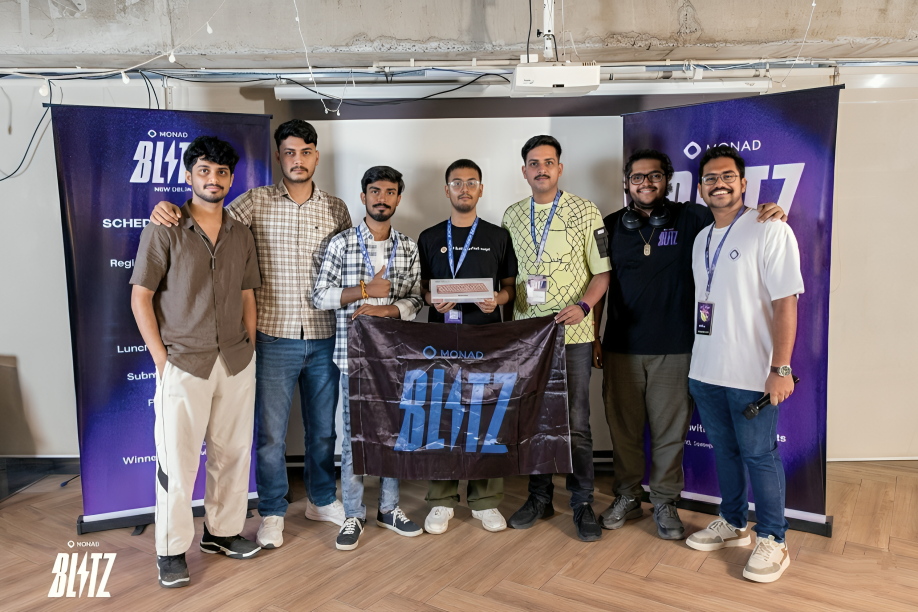
How a Polytechnic Student Won Monad Blitz Delhi with an AI Writing Tool Built in 48 Hours
--
I’m not from an IIT. Not from an NIT. I’m a second-semester Polytechnic Diploma student from Jabalpur — a city most people in the startup world haven’t heard of.
When my team walked into 91 Springboard, Noida for Monad Blitz New Delhi, we were the underdogs in every sense of the word. No fancy college name. No senior mentors on speed dial. Just three people, one idea, and 48 hours.
We walked out with the Best Idea and Implementation Award.
This is the full story.
The Problem We Were Trying to Solve
Every writer has a voice. But the moment you open a blank document, that voice disappears.
AI writing tools today are powerful — but they’re generic. ChatGPT sounds like ChatGPT. Jasper sounds like Jasper. None of them sound like you.
The real problem isn’t that AI can’t write. It’s that AI can’t write like you.
That’s the gap GhostWriter was built to fill.
What is GhostWriter?
GhostWriter is a local-first AI writing assistant that extracts your "Writing DNA" — your sentence patterns, vocabulary, tone, and rhythm — directly from documents you’ve already written.
Feed it your old essays, reports, or articles. It learns how you write. Then it helps you write more — in your own voice, not a generic AI voice.
The kicker? It runs entirely in your browser. No server. No cloud. Your writing data never leaves your device.
Here’s the stack we built it on:
React 18 + TypeScript + Vite 5 — fast, modern frontend
llama.cpp compiled to WebAssembly — runs the AI model locally inside your browser
Groq API — fallback for when local inference is too slow
Hardhat + Monad Testnet — two Solidity smart contracts for on-chain features
GhostDNA.sol — stores your writing fingerprint on-chain
GhostStamp.sol — timestamps and verifies your original content
The blockchain layer wasn’t just a hackathon gimmick. It solves a real problem: proving your writing is yours in a world where AI-generated content is everywhere.
The 48-Hour Build
Let me be honest — it was chaos.
Hour 0–6: Locked in the idea. Argued about scope. Cut half the features. Settled on the core loop: upload docs → extract DNA → write with AI → stamp on-chain.
Hour 6–18: The WebAssembly integration nearly broke us. Running llama.cpp in a browser is not something many people have done in production. We hit memory limits, loading time issues, and a browser crash that deleted two hours of work.
Hour 18–30: Groq API fallback saved us. We built a graceful switch — if local inference fails or is too slow, it routes to Groq. Users get the same experience either way.
Hour 30–42: Smart contracts deployed on Monad Testnet. GhostDNA.sol and GhostStamp.sol went live. Tested. Broke. Fixed. Tested again.
Hour 42–48: Demo prep. Slides. Presentation practice. Three hours of sleep.
My teammates Om Gupta (frontend) and Arpit Bhardwaj (blockchain) carried this. I led the product direction and kept us from building too much. Knowing what not to build is half the battle in a hackathon.
The Moment We Won
When they called Team NADAYAPRABHU for the Best Idea and Implementation Award, I genuinely didn’t process it for a few seconds.
Not because I didn’t believe in the product. But because I know what it means when a Polytechnic student from Jabalpur stands on a stage in Noida with the Monad Protocol team.
It means the barrier isn’t your college. It’s your execution.
What This Opened Up
Winning Monad Blitz wasn’t just a trophy moment. It opened real doors:
Future collaboration with Monad Protocol and BuilderBase — conversations I wouldn’t have had otherwise
Validation for ChainM8 India — my blockchain education platform that I’m building to bring exactly this kind of opportunity to more students across India
A proof point — that local AI + on-chain identity is a real product direction, not just a demo
What I’m Building Next
GhostWriter proved one thing to me: the intersection of local AI and on-chain identity is underexplored and deeply valuable.
My next experiment is in NFC + Web3 — physical taps triggering on-chain actions. More on that soon.
If you’re a developer, founder, or student in the Indian Web3/AI ecosystem — follow along. I’ll be documenting the entire journey here.
And if you want to collaborate, build, or just talk blockchain in India — find me on Twitter or LinkedIn.
We’re just getting started.
Hrithik Soni is the Founder & CEO of ChainM8 India — a blockchain education and community platform. He is an AWS Certified Solutions Architect and Data Engineer, and a Polytechnic Diploma CSE student at BGIEM, Jabalpur