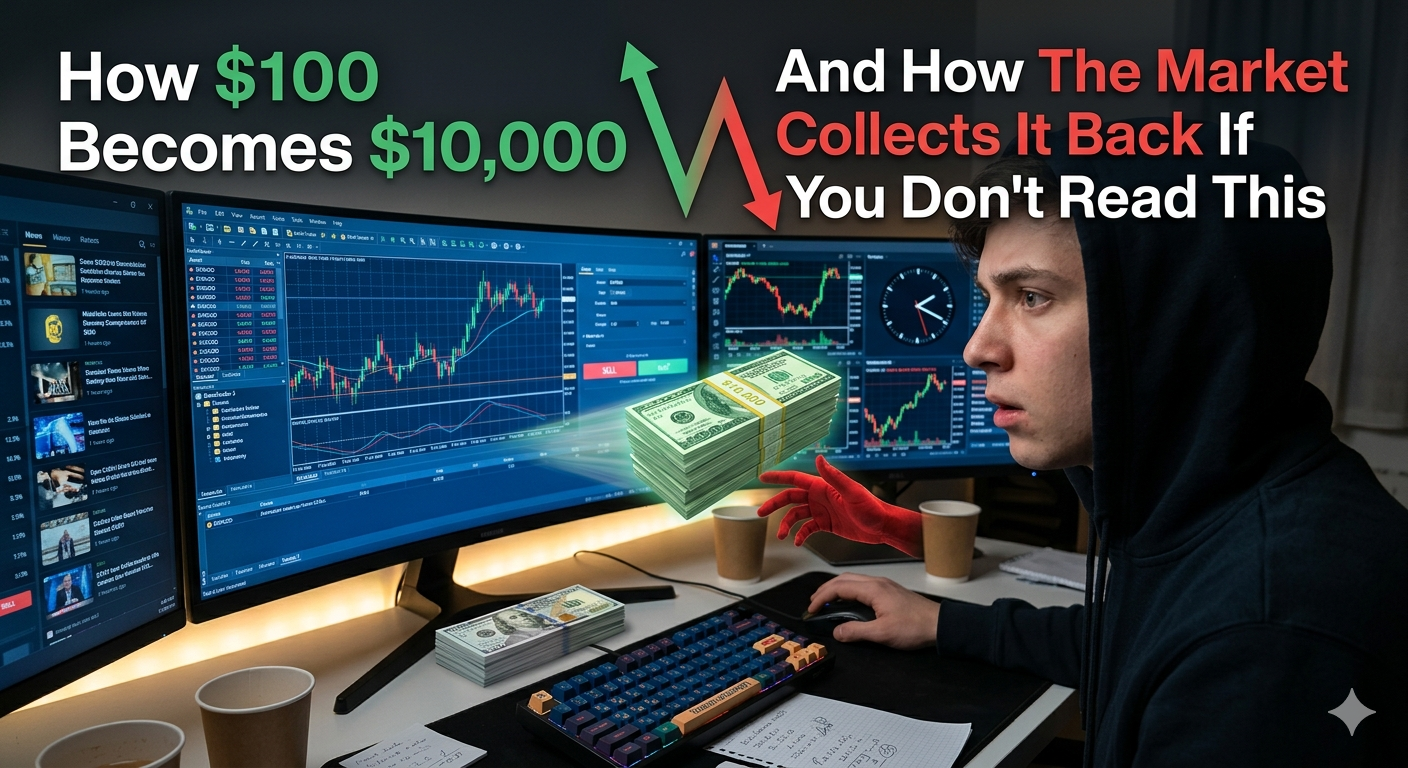
How $100 Becomes $10,000 — And How The Market Collects It Back If You Don’t Read This
 Jayblisz5 min read·1 hour ago
--
Four forex terms that can protect you before you place your first real trade
We’ve all seen ads pop up: a trader turns a small deposit, like $100, into thousands in just days. The screenshots look convincing, the numbers are right there on the screen, and you can’t help but wonder how it’s possible when your bank offers barely 20% interest annually. The secret? It’s all about leverage.
And before you get excited, here is something worth reading slowly before you touch any of it:
It does not matter the amount of money you have. If you go in blindly without financial discipline, your funds become a loan from the market. And best believe — the market will collect it back. With interest.
That is not to scare you. That is to prepare you. Because the four terms we are covering today are the difference between a trader who survives long enough to learn and one who blows their account before they understand what happened.
Leverage — The Double-Edged Sword
Leverage is like borrowed power in trading. Imagine you have $100, but your broker lets you trade as if you have $10,000-this is a 1:100 leverage ratio. It sounds great because it boosts your potential profits, but here’s the catch: it also magnifies your losses equally.
If a trade goes 1% against you with that level of leverage, you can lose your entire deposit in no time. This is why leverage can be a dangerous tool if not handled properly. While it can be genuinely powerful when used carefully with good risk management, it can also lead to devastating losses when mishandled due to the tempting ads that make it seem easy.
Margin — What You Actually Put Down To Open That Trade
When you use leverage, you’re not getting free money. You need to put down a security deposit called margin. Think of it like renting an apartment — you pay a deposit to your landlord to secure your lease. Your broker does the same, but with your trading account.
Here is where it gets important.
If your trade moves against you and your account balance falls too low to cover the margin requirement, your broker sends what is called a margin call. This is essentially a message saying your security deposit is running out. Add more funds, or we will close your trade automatically.
Most beginners do not know margin calls exist until they receive one. By then, the damage is usually already done.
This is the part I wish I had understood before I ever handed anyone money to invest on my behalf. Knowing how margin works would have made me ask very different questions before trusting anyone with funds.
Lot Size — How Much Of The Market You Are Actually Buying
Every trade involves a lot size. A standard lot is 100,000 units, but there are smaller options: mini lots (10,000) and micro lots (1,000). It’s like buying rice; you can choose a full bag, half a bag, or just a cup. Same rice. Different quantities. Different cost. Different risk if the price changes. Larger lots mean greater potential profit — and higher risk of loss.
When you choose your lot size, you are deciding how much of the market you are buying. A bigger lot means a bigger profit if you are right. Bigger loss if you are wrong.
This is why lot size and leverage must always be considered together. A large lot size combined with high leverage on a small account is one of the fastest ways to lose everything before you even understand what went wrong.
Start with micro lots. Always. No matter what the signal says.
Stop Loss and Take Profit — Your Safety Net Before You Enter
A stop loss is a pre-set instruction you give to your trading platform.
You are essentially saying — if this trade moves against me by this many pips, close it automatically. Do not wait for me to react. Just close it.
Take profit is the opposite. You are saying — if this trade reaches this profit level, close it and lock in the gain.
Together, these two tools are the most important habits in trading. Not because they guarantee you will never lose. But because they decide in advance how much you are willing to lose, before emotions enter the picture.
Here is the reality. The moment a trade starts going wrong, your brain will tell you to wait. It might turn around. Give it more time. That voice has cost more traders more money than any bad strategy ever has.
A stop loss removes that voice from the equation.
You decided the number when your head was clear. The platform respects that decision even when your emotions want to override it.
No serious trader enters a trade without a stop loss. Not because they are pessimists. Because they understand that protecting what you have is more important than chasing what you want.
How These Four Work Together
These terms are not separate ideas. They are one system.
Your leverage increases your buying power, your margin secures your trade, your lot size dictates your market control, and your stop loss helps manage your risks. Understanding how they interact is vital for a successful trading journey!
Get one of them wrong, and the others cannot save you.
If you intend to be here in six months, you have to get these four right. When you do, you are not just trading — you have mastered proper risk management.
Those ads showing small deposits turning into thousands are not lying.
Leverage makes that possible.
What they are not showing you is the trader who blew three accounts before they learned how to use it properly. Or the one who did not set a stop loss because they were sure the trade would turn around.
The market is real. The opportunity is real. But it does not reward blind confidence.
It rewards discipline.
Next week, we move away from forex and into something every country is navigating right now — managing money when everything around you keeps getting more expensive.
Share this with anyone who has ever seen one of those ads and wondered how. Now they know — and more importantly, they know what to do with that information.
Follow along — we are all learning, unlearning, and relearning together.
#JAyblisz #FinanceforBeginners #WAGMI