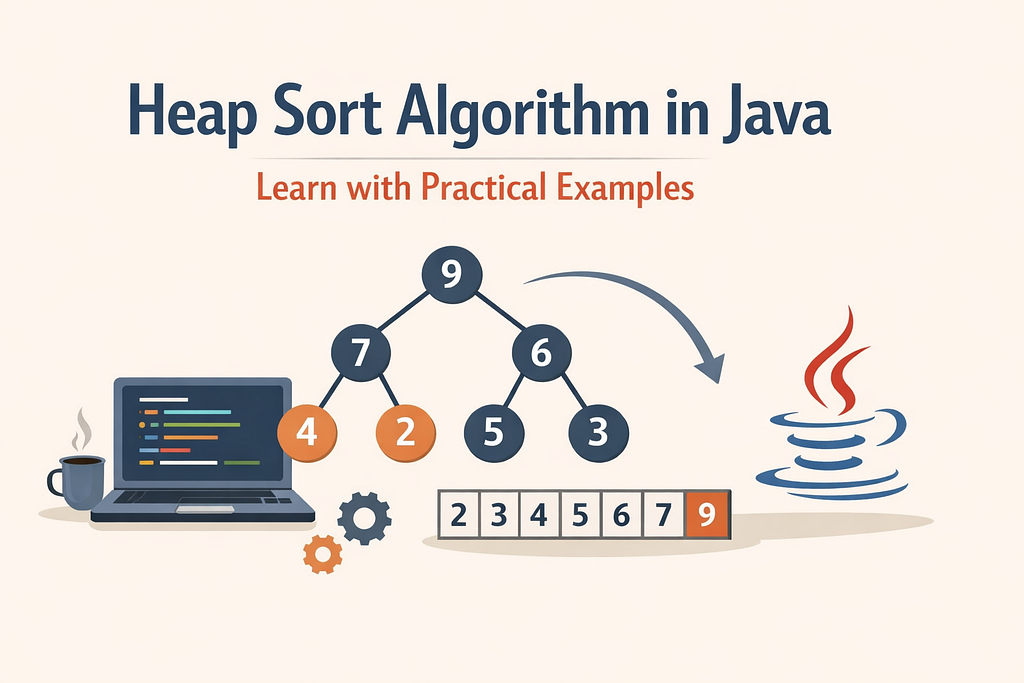
Heap Sort is known for its efficiency, predictable performance, and in-place sorting behavior, making it a strong choice when memory usage must be kept minimal without sacrificing time complexity.
The algorithm is based on the binary heap data structure, which was formalized in the 1960s as part of research into efficient priority queues, most notably by J. W. J. Williams, who introduced Heap Sort in 1964. Heap Sort leverages this structure to repeatedly extract the largest (or smallest) element in a controlled and efficient way.
Unlike divide-and-conquer algorithms such as Merge Sort, Heap Sort takes a different path: it organizes data into a tree-like structure and maintains a strict ordering property. This approach allows it to consistently achieve O(n log n) performance without requiring additional memory.
So where does Heap Sort fit in real-world applications, and when should you consider using it?
In this article, we’ll break down how Heap Sort works, provide a clean Java implementation, and explore the situations where it truly shines.
What Is a Heap? 🌳
A heap is a special kind of complete binary tree, which means all levels are fully filled except possibly the last, and the last level is filled from left to right. There are two main types:
- Max heap: every parent node is greater than or equal to its children
- Min heap: every parent node is less than or equal to its children
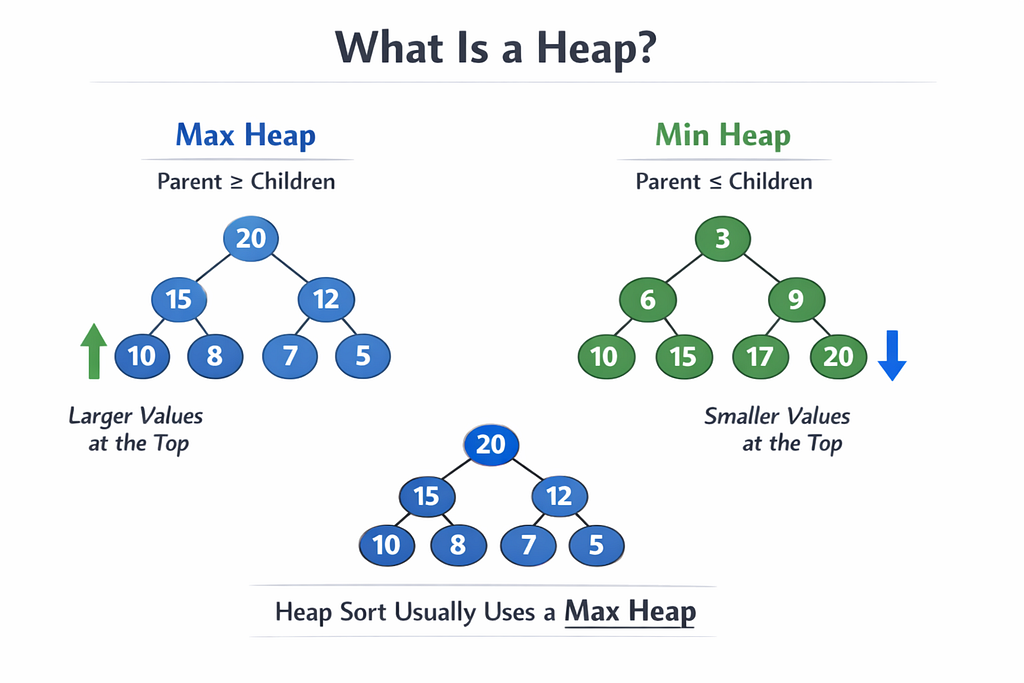
Heap Sort typically uses a max heap, so the largest value is always at the root (the top of the tree). This makes it easy to repeatedly remove the largest element.
What Is Heap Sort? 🔄
Heap Sort is built on a simple idea: build a heap → extract elements → rebuild the heap.
It works by transforming an array into a max heap, a complete binary tree where each parent node is greater than or equal to its children. Once this structure is built, the largest element is always at the root. From there, the algorithm repeatedly:
- Swaps the root with the last element
- Shrinks the heap
- Restores the heap property
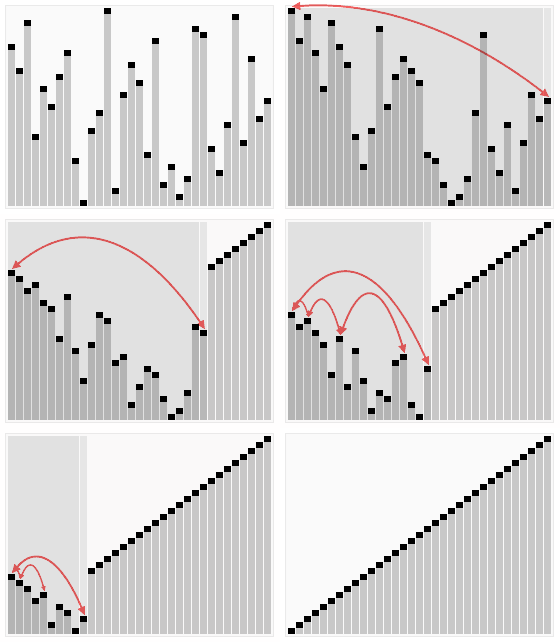
Unlike Merge Sort, Heap Sort is in-place, meaning it does not require additional memory. Instead of combining sorted pieces, it gradually builds the sorted array by moving the largest elements to their correct positions.
This guarantees a time complexity of O(n log n) in all cases — with no worst-case surprises.
When Should You Use Heap Sort? 🧐
In everyday Java programming, you’ll rarely need to implement Heap Sort yourself. Java’s built-in sorting methods are highly optimized and should almost always be your first choice:
import java.util.*;

public class Main {
    public static void main(String[] args) {
        int[] arr = {5, 2, 9, 1, 3};

        Arrays.sort(arr);

        System.out.println(Arrays.toString(arr));
    }
}
Behind the scenes, Java uses different algorithms such as Quicksort and TimSort depending on the data type.
So where does Heap Sort fit in?
Heap Sort is mainly useful when memory usage and predictable performance matter more than raw speed. Unlike e.g. Merge Sort, which guarantees O(n log n) time but requires O(n) extra space, Heap Sort works in-place with O(1) additional memory. This makes it a strong option for memory-constrained environments. It also offers consistent O(n log n) performance in all cases, with no risk of worst-case degradation.
The trade-off is that Heap Sort is not stable, meaning equal elements may not preserve their original order. This can matter when sorting structured data with multiple fields.
In short, Heap Sort is a good choice when you need predictable performance and minimal memory usage. If stability or better real-world speed matters more, Merge Sort or Java’s built-in sorting is usually preferable.
From Theory to Practice 🛠️
Heap Sort operates in two connected phases: first, it reorganizes the array into a max heap, and then it repeatedly removes the largest element while restoring the heap structure. The idea is simple in theory, but the implementation shows how powerful that structure really is.
1. Core Implementation
Here’s a clean Java implementation that brings it all together:
public class Main {

    // Main heap sort function
    public static void heapSort(int[] arr) {
        int n = arr.length;

        // Step 1: Build max heap
        for (int i = n / 2 - 1; i >= 0; i--) {
            heapify(arr, n, i);
        }

        // Step 2: Extract elements from heap
        for (int i = n - 1; i > 0; i--) {

            // Move current root to end
            int temp = arr[0];
            arr[0] = arr[i];
            arr[i] = temp;

            // Restore heap property
            heapify(arr, i, 0);
        }
    }

    // Heapify a subtree rooted at index i
    private static void heapify(int[] arr, int n, int i) {
        int largest = i;
        int left = 2 * i + 1;
        int right = 2 * i + 2;

        // Check left child
        if (left < n && arr[left] > arr[largest]) {
            largest = left;
        }

        // Check right child
        if (right < n && arr[right] > arr[largest]) {
            largest = right;
        }

        // If root is not largest
        if (largest != i) {
            int swap = arr[i];
            arr[i] = arr[largest];
            arr[largest] = swap;

            // Recursively heapify affected subtree
            heapify(arr, n, largest);
        }
    }

    public static void main(String[] args) {
        int[] arr = {12, 11, 13, 5, 6, 7};

        heapSort(arr);

        for (int num : arr) {
            System.out.print(num + " ");
        }
    }
}
At first glance, this might feel similar to other sorting algorithms, but the key difference lies in how Heap Sort maintains structure. Instead of dividing the array like Merge Sort, it continuously enforces a heap property where the largest element always rises to the root. From there, it is swapped into its final position, and the heap is rebuilt around the remaining elements.
2. Why Heap Sort Is So Reliable
One of Heap Sort’s defining strengths is its predictability. Its performance does not depend on the input distribution. Whether the array is already sorted, reversed, or completely random, the algorithm behaves the same way: it builds a heap, repeatedly extracts the maximum element, and restores the heap after each extraction.
This consistency guarantees O(n log n) performance in all cases. Unlike e.g. the popular Quicksort algorithm, there are no pivot-related edge cases that degrade performance. That makes Heap Sort appealing in systems where worst-case guarantees matter more than raw speed.
3. The Cost of In-Place Sorting
Despite its theoretical reliability, Heap Sort is not the default choice in most real-world systems. The reason is not complexity, but memory access patterns.
Heap operations jump around the array rather than scanning it sequentially, which leads to poor cache locality. Even though the algorithm is in-place and uses O(1) extra space, these non-sequential memory accesses often make it slower in practice than Quicksort.
This is also why modern language libraries tend to split their choices: Quicksort (or variants) for primitive arrays where speed and cache efficiency matter, and Timsort for object sorting where stability and real-world data patterns are important. Heap Sort remains valuable, but more as a guaranteed fallback than a default solution.
4. Iterative Nature (No Recursion Needed)
Another interesting aspect of Heap Sort is how little it relies on recursion. The core algorithm is already loop-driven, and even the heapify step can be rewritten iteratively without changing its behavior. In fact, the entire Heap Sort process can be implemented without any recursion at all. Nothing in the algorithm truly requires a call stack—everything can be expressed through simple iteration over array indices.
Here’s what the full iterative implementation looks like in Java:
public class Main {

    public static void heapSort(int[] arr) {
        int n = arr.length;

        // Build max heap (bottom-up)
        for (int i = n / 2 - 1; i >= 0; i--) {
            heapifyIterative(arr, n, i);
        }

        // Extract elements from heap one by one
        for (int i = n - 1; i > 0; i--) {

            // Move current root (max) to the end
            int temp = arr[0];
            arr[0] = arr[i];
            arr[i] = temp;

            // Restore heap property on reduced heap
            heapifyIterative(arr, i, 0);
        }
    }

    private static void heapifyIterative(int[] arr, int n, int i) {
        while (true) {
            int largest = i;
            int left = 2 * i + 1;
            int right = 2 * i + 2;

            if (left < n && arr[left] > arr[largest]) {
                largest = left;
            }

            if (right < n && arr[right] > arr[largest]) {
                largest = right;
            }

            // If heap property is satisfied, stop
            if (largest == i) break;

            // Swap current node with largest child
            int temp = arr[i];
            arr[i] = arr[largest];
            arr[largest] = temp;

            // Continue heapifying down the tree
            i = largest;
        }
    }

    public static void main(String[] args) {
        int[] arr = {12, 11, 13, 5, 6, 7};

        heapSort(arr);

        for (int num : arr) {
            System.out.print(num + " ");
        }
    }
}
What changes here is not the algorithm itself, but its execution style. Instead of recursion handling the downward “bubble,” a loop repeatedly pushes elements down the heap until the property is restored. This removes call-stack overhead and makes control flow more direct and predictable, which is useful in performance-sensitive or constrained environments.
Where Heap Sort Becomes Useful 💡
Heap Sort is less about raw speed and more about predictable performance and strict memory control. It is most valuable in systems where reliability and resource constraints matter more than average-case optimization.
1. Memory-constrained and embedded systems
In embedded and low-level systems such as industrial sensors, robotics controllers, or IoT monitoring devices, data is often streamed continuously and must be processed under tight memory constraints. For example, a factory monitoring system may collect vibration readings from machines and periodically sort them to detect abnormal patterns — such as sudden spikes that could indicate early signs of mechanical failure.
Because these systems typically run on microcontrollers with fixed and very limited memory, allocating additional arrays is often undesirable or not even possible. Heap Sort is well-suited here because it performs sorting in-place, requiring only O(1) extra space while maintaining O(n log n) time complexity.
public class Main {

    public static void heapSort(int[] arr) {
        int n = arr.length;

        for (int i = n / 2 - 1; i >= 0; i--) {
            heapify(arr, n, i);
        }

        for (int i = n - 1; i > 0; i--) {
            int temp = arr[0];
            arr[0] = arr[i];
            arr[i] = temp;

            heapify(arr, i, 0);
        }
    }

    private static void heapify(int[] arr, int n, int i) {
        int largest = i;
        int left = 2 * i + 1;
        int right = 2 * i + 2;

        if (left < n && arr[left] > arr[largest]) largest = left;
        if (right < n && arr[right] > arr[largest]) largest = right;

        if (largest != i) {
            int temp = arr[i];
            arr[i] = arr[largest];
            arr[largest] = temp;

            heapify(arr, n, largest);
        }
    }

    public static void main(String[] args) {
        int[] vibrations = {34, 12, 78, 56, 90, 23};
        heapSort(vibrations);

        for (int v : vibrations) {
            System.out.print(v + " ");
        }
    }
}
In such environments, the main advantage is not just efficient sorting, but predictable memory usage that keeps long-running systems stable.
2. Scheduled Task Execution with Priorities
Operating systems and backend platforms frequently rely on heaps to manage execution order dynamically, but Heap Sort can also be useful in batch scenarios where all tasks are collected first and then processed in priority order.
This approach is common in offline systems such as report generation pipelines, scheduled maintenance tasks, or batch processing jobs in backend services — where execution order is determined upfront rather than continuously adjusted at runtime.
public class Main {

    public static void heapSort(int[][] jobs) {
        int n = jobs.length;

        for (int i = n / 2 - 1; i >= 0; i--) {
            heapify(jobs, n, i);
        }

        for (int i = n - 1; i > 0; i--) {
            int[] temp = jobs[0];
            jobs[0] = jobs[i];
            jobs[i] = temp;

            heapify(jobs, i, 0);
        }
    }

    private static void heapify(int[][] jobs, int n, int i) {
        int largest = i;
        int left = 2 * i + 1;
        int right = 2 * i + 2;

        if (left < n && jobs[left][1] > jobs[largest][1]) {
            largest = left;
        }

        if (right < n && jobs[right][1] > jobs[largest][1]) {
            largest = right;
        }

        if (largest != i) {
            int[] temp = jobs[i];
            jobs[i] = jobs[largest];
            jobs[largest] = temp;

            heapify(jobs, n, largest);
        }
    }

    public static void main(String[] args) {
        // {jobId, priority}
        int[][] jobs = {
            {1, 3},
            {2, 10},
            {3, 5},
            {4, 1}
        };

        heapSort(jobs);

        for (int[] job : jobs) {
            System.out.println("Job " + job[0] + " priority " + job[1]);
        }
    }
}
Conclusion 📣
Heap Sort is a great example of how a simple idea — maintaining a structured hierarchy — can lead to a powerful and predictable sorting algorithm. While it is rarely the default choice in everyday Java development, it plays an important role in systems where memory usage must stay minimal and performance must remain consistent under all conditions.
Throughout this article, we saw how Heap Sort transforms an unsorted array into a structured heap, then gradually extracts elements to produce a sorted result. This approach guarantees O(n log n) performance without relying on recursion-heavy or memory-intensive techniques, making it especially valuable in constrained or system-level environments.
At the same time, Heap Sort also highlights an important engineering trade-off: efficiency is not just about speed. Cache behavior, stability, and real-world workload patterns often matter just as much. This is why modern Java libraries typically prefer more adaptive algorithms like TimSort or optimized Quicksort variants.
In the end, Heap Sort is best understood not as the “go-to” sorting method, but as a reliable tool in the broader toolbox of algorithm design — especially when predictability and memory efficiency matter more than raw performance.
Happy coding! 😃
🙏 Thanks for reading to the end! If you have any questions, feel free to drop a comment below.
If you enjoyed this article, follow me on medium or social media — I’d love to connect and follow you back:
Heap Sort Algorithm in Java: Learn with Practical Examples was originally published in Level Up Coding on Medium, where people are continuing the conversation by highlighting and responding to this story.