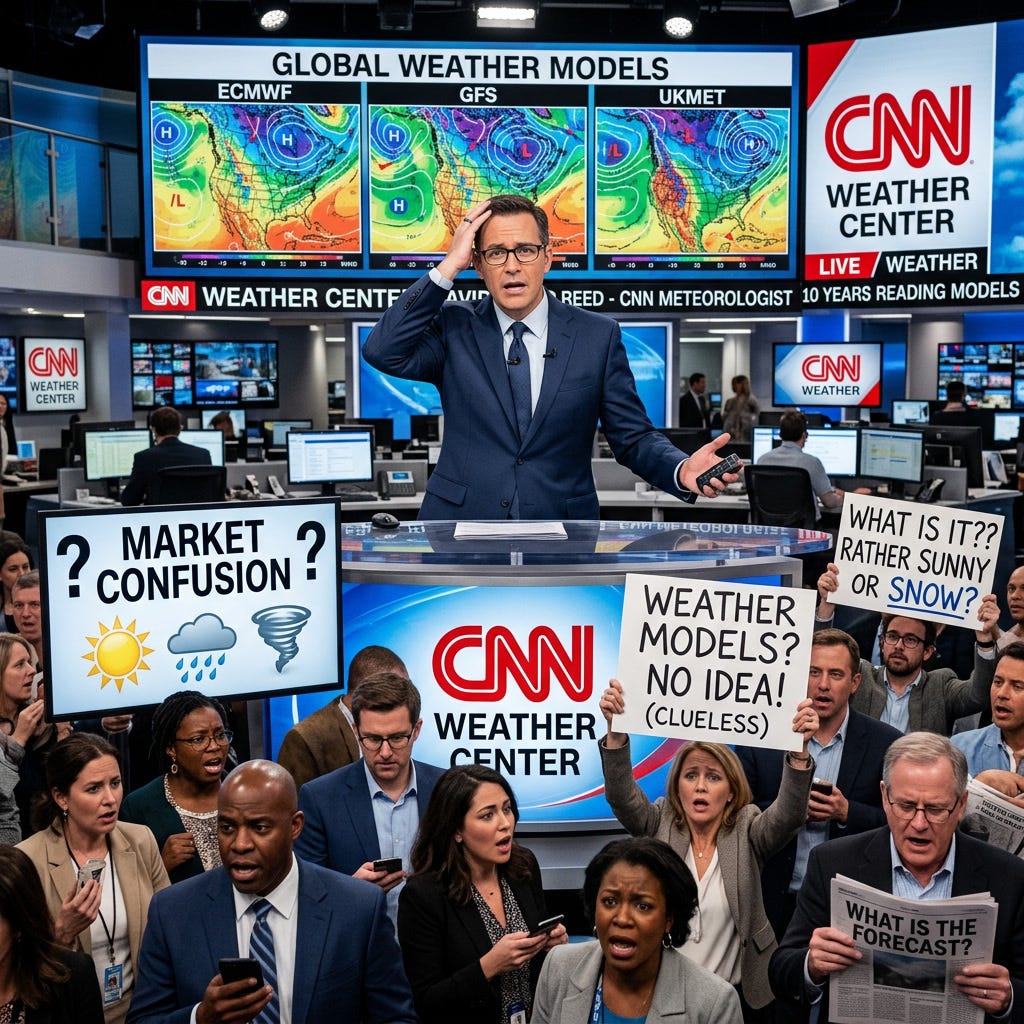
He Forecasted Storms for CNN for 10 Years. Then He Found a Market That Was Still Guessing.
 Jordan Rose4 min read·1 hour ago
--
The market priced his expertise at 0.3 cents a trade. His first month proved it was worth $37,000.
The resignation letter was short.
After a decade of standing in front of green screens, pointing at pressure systems, and warning millions of viewers about incoming storms, he handed in his notice. Not because he was burned out. Not because the ratings were slipping.
Because he’d found something the market didn’t know it was giving away.
The Edge No Algorithm Has
Weather prediction markets are a niche corner of the broader prediction market ecosystem. Traders bet on whether temperatures in specific cities will hit specific thresholds on specific days. The market prices in probability. If the market thinks there’s a 1% chance Seoul hits 11°C on a given day, you can buy that outcome for around 1 cent.
The problem with these markets — and the opportunity — is that they’re priced largely by algorithms and amateur participants. What they lack is genuine meteorological expertise.
Enter a man who spent ten years doing exactly this for a living.
He wasn’t reading the news about the weather. He was reading the models — the GFS, the ECMWF, ensemble forecasts, mesoscale convective systems. The same outputs that power professional forecasting. He understood not just what the models said, but when to trust them and when they were wrong.
The market had no idea.
Month One: 1,846 Trades. $37,000 Profit.
The numbers from his first month of full-time trading are difficult to look at without doing a double-take.
1,846 trades executed. Not gambles. Trades — each one rooted in a forecast read the same way he’d been reading them on camera for a decade.
$37,000 in profit. Biggest single win: $4,031.
The PnL curve goes in one direction: up. Not because every trade won. But because when he was right, he was very right — and the market had massively underpriced the probability.
The Trades That Tell the Story
Seoul 11°C NO Entry: $23 → Exit: $3,438 | Return: +14,610% | Market odds: 0.3%
Hong Kong 28°C Entry: $20 → Exit: $2,770 | Return: +13,533% | Market odds: 0.7%
Seoul 12°C Entry: $108 → Exit: $2,111 | Return: +1,853% | Market odds: 3.2%
Seoul 7°C Entry: $333 → Exit: $3,678 | Return: +1,001% | Market odds: 8.5%
Seoul 11°C Entry: $507 → Exit: $4,538 | Return: +794% | Market odds: 5.5%
The market priced that first Seoul trade as a 0.3% probability event. He thought it was 60–80% likely.
That’s not luck. That’s not a hot streak. That’s a decade of reading the same models the market ignores — and knowing exactly when they’re pointing at something the consensus has missed.
A 0.3 cent entry on a 70% likely outcome isn’t risky. It’s one of the most asymmetric bets available in any market, anywhere.
Why This Edge Is Real (and Rare)
Most retail traders operate in markets where their opponents are professionals. You’re trading equities against hedge funds with PhDs and microsecond execution. You’re trading crypto against quant desks running 24/7 sentiment scrapers.
Weather markets are different.
The participants pricing these markets don’t have meteorology degrees. They’re not running ensemble model comparisons at 2am. They’re not cross-referencing Korean Meteorological Administration data against ECMWF runs to identify where the models diverge.
He is.
The edge isn’t about being smarter than the market in some abstract sense. It’s about having domain knowledge that the market structurally cannot price in, because almost nobody with that knowledge has thought to show up.
Until now.
The Same Skill. A Different Screen.
What’s remarkable about his story isn’t that he reinvented himself. It’s that he didn’t.
He’s doing exactly what he did on television. Reading models. Interpreting forecasts. Making probability assessments about temperature outcomes in global cities.
The only difference is that now, instead of telling viewers what the weather will be, he’s betting on it — in markets that have systematically undervalued what he knows.
The green screen is gone. The edge isn’t.
What This Means for Everyone Else
You cannot replicate ten years of meteorological training overnight. But his story points to something broader about prediction markets and domain expertise.
The most underpriced edges in markets are professional skills that haven’t crossed over yet.
Meteorologists who trade weather. Cardiologists who trade FDA approval outcomes. Supply chain managers who trade commodity spreads. Every domain expert carries knowledge that a generalist market systematically misprice.
He just happened to notice before anyone else did.
His first month was $37,000. His entry prices tell you everything: the market was giving away certainties at lottery-ticket prices.
He had the receipts to know the difference.
Weather prediction markets are a form of speculative trading and carry significant financial risk. Past performance does not guarantee future results. This article is for informational purposes only and does not constitute financial advice.