Havenlon Series: Execution Control in the Age of AI (8/15)
 Havenlon2 min read·Just now
--
Part 8 of the Havenlon Series on Execution Control in the Age of AI.
The Missing Layer in Crypto: Execution Control
Crypto is great at building primitives.
We have:
- keys and signatures
- smart contracts
- consensus
- decentralization
- composability
But there’s a missing layer.
A layer that decides what is allowed to execute.
Because crypto doesn’t fail when cryptography breaks.
It fails when execution happens under the wrong conditions:
- the wrong signer
- the wrong intent
- the wrong context
- the wrong policy
- the wrong approval path
And on-chain, “wrong execution” is still execution.
Irreversible. Final.
The industry confuses “signing” with “control”
Most systems treat signing as the final step.
If it’s signed, it executes.
If it executes, it’s “correct.”
That’s backwards.
Signing is not control.
Signing is merely permission.
Real control means:
permission can be refused.
Before execution.
Even if software is compromised.
Even if the cloud is hijacked.
Even if an AI agent is manipulated.
This is why Havenlon emphasizes a physical, non-custodial execution boundary: keys stay in local hardware and remain non-exportable; cloud systems and operators cannot access them.
Execution control is not just security — it’s governance
Execution control sits between intent and action.
It answers questions software alone cannot reliably answer:
- Is this request legitimate?
- Is the intent consistent?
- Does it violate policy?
- Is the environment trusted?
- Is this within limits?
- Is authorization complete?
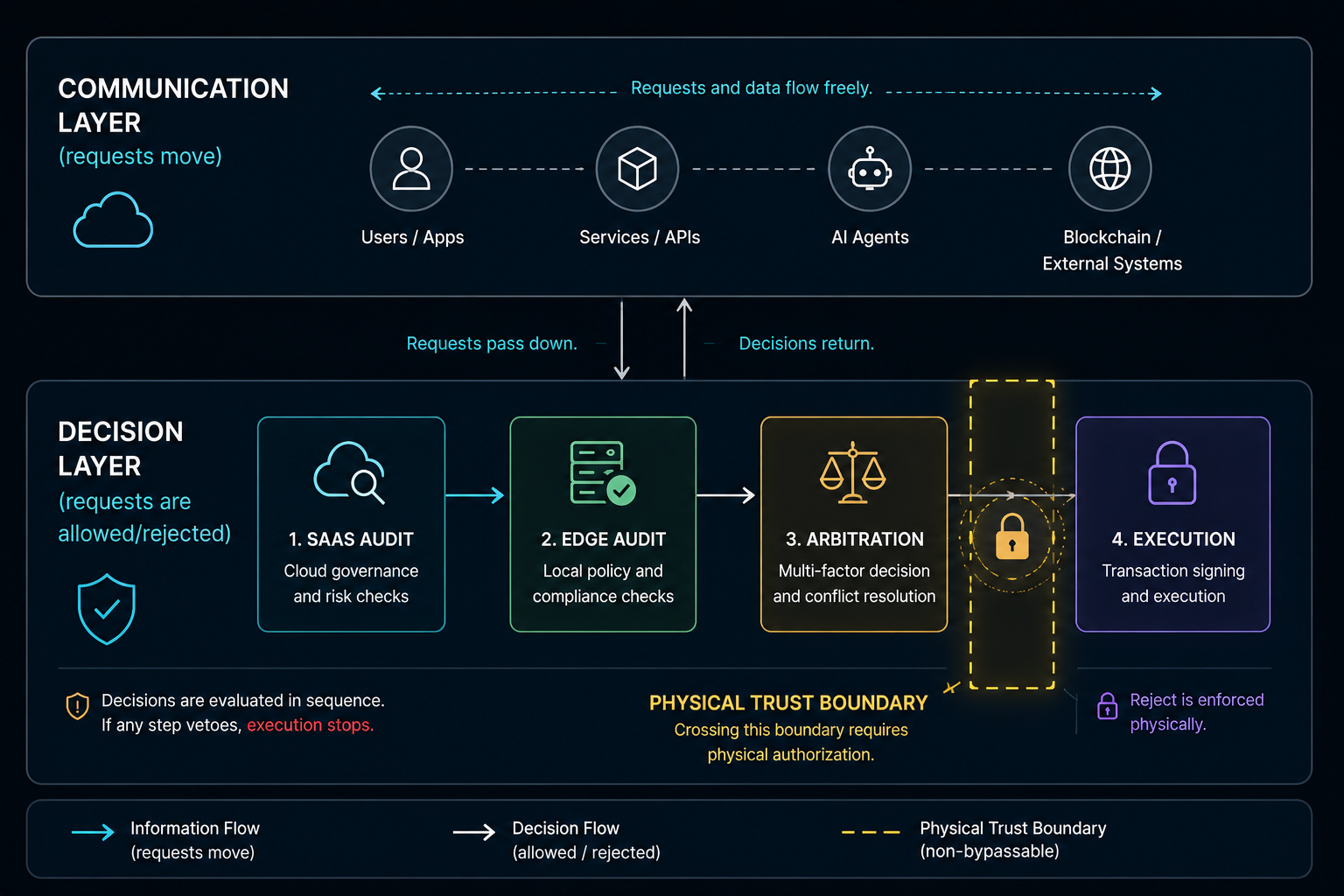
In Havenlon’s risk model, the final execution decision is not a single “allow.”
It is a logical intersection of multiple constraints — cloud governance, edge compliance, and physical constraints.
If any factor fails, execution must stop.
That’s a veto principle.
Where the missing layer should live
If execution control lives in software, it can be bypassed.
So the missing layer must be:
- hardware-anchored
- physically isolated
- non-custodial
- verifiable and auditable
This is why Havenlon separates communication from decision-making, and separates governance from execution.
Cloud can coordinate.
Apps can initiate.
AI can propose.
But execution is only permitted after it crosses a physical trust boundary.
Closing
Crypto has spent a decade building how value moves.
Now we need to build how value is controlled.
Because the future is not only smart contracts.
It is AI-native execution.
And in that future, the most dangerous thing is not a smarter agent.
It’s an agent with execution rights.
Execution control is the missing layer.
Not a feature.
Not a wallet.
Infrastructure.
Because in the end,
it’s not about what systems can do.
It’s about what they are allowed to do.