
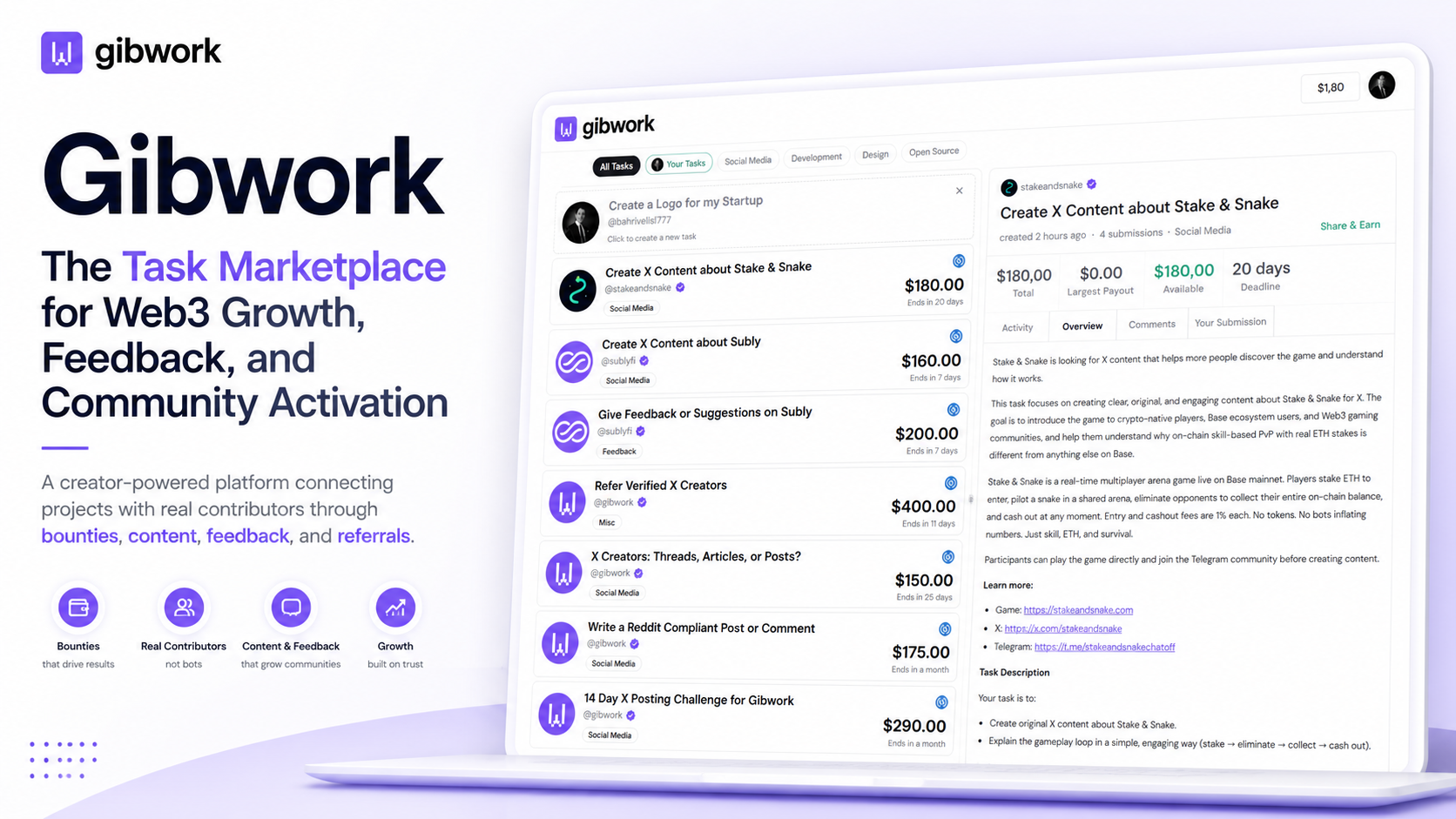
Gibwork: The Onchain Work Layer for Solana
--
Crypto has spent years trying to onboard the next wave of users.
Most projects follow the same playbook:
Launch a token.
Promise an airdrop.
Build a Discord.
Ask people to stay active.
But Gibwork takes a more practical route:
Don’t just ask people to join.
Give them something to do.
And pay them when they do it.
That is what makes Gibwork interesting.
It is not just another freelance marketplace.
It is an onchain work layer built around tasks, bounties, services, and crypto-native payments.
What Is Gibwork?
Gibwork is a work marketplace where people can create tasks, complete jobs, and earn crypto.
The idea is simple:
Someone needs work done.
Someone else does the work.
Payment happens through crypto.
But the real value is in how Gibwork adapts this model for Web3.
Instead of copying traditional freelance platforms, Gibwork focuses on the type of work crypto projects actually need.
That includes:
- Community tasks
- Social media campaigns
- Design work
- Development tasks
- Open-source bounties
- GitHub issue rewards
- Service listings
- Private tasks
This makes Gibwork especially useful for early-stage Web3 teams.
Because most crypto projects do not only need developers.
Sometimes they need a thread written.
Sometimes they need a landing page designed.
Sometimes they need a bug fixed.
Sometimes they need a GitHub issue solved.
Sometimes they need real users to test a product.
Gibwork brings these needs into one marketplace.
For anyone who wants to explore the platform directly, the task board is here:
https://app.gib.work?referral=bahriyeli5777
Why Gibwork Matters
One of Web3’s biggest problems is not lack of attention.
It is lack of productive contribution.
Many users sit in Discord servers.
They comment under posts.
They complete basic quests.
They wait for a possible airdrop.
But very little of that activity creates real value.
Gibwork changes the structure.
A task is created.
The requirements are clear.
A contributor completes the work.
The work is reviewed.
The reward is claimed.
That creates a direct connection between contribution and payment.
This matters because the next phase of Web3 will not be built by passive communities.
It will be built by active contributors.
People who write.
Design.
Build.
Test.
Translate.
Debug.
Create.
Improve.
Gibwork gives those contributors a place to find work and get paid for it.
Built for Crypto-Native Work
Traditional freelance platforms were not built for Web3.
They are often slow, expensive, and disconnected from crypto-native communities.
Gibwork is different because it is designed around the way Web3 projects operate.
A Solana project can create a task.
A contributor can complete it.
Payment can happen in crypto.
The entire flow feels native to the ecosystem.
This is important because Web3 work is often fast, global, and fragmented.
A project might need a developer in one country, a designer in another, and a content creator somewhere else.
Gibwork makes that coordination easier.
It turns scattered work requests into structured opportunities.
SPL Token Task Creation
One of Gibwork’s strongest features is the ability to create tasks using Solana SPL tokens.
This gives projects more flexibility.
A project can use its own token to reward contributors.
A community can create incentives around specific actions.
A team can activate users without relying only on traditional payments.
This is bigger than just “paying people in crypto.”
It gives tokens a practical use case.
A token becomes more than something people trade.
It can be used to reward work, attract contributors, and create movement inside an ecosystem.
That is a powerful idea.
Because in crypto, the strongest tokens are not just speculative assets.
They are connected to real activity.
Gibwork helps connect token incentives with actual work.
Open-Source Bounties
Another important part of Gibwork is its open-source bounty model.
Projects can create bounties around GitHub issues.
This is extremely useful for Web3 teams.
Open-source projects often have many problems to solve, but limited internal resources.
There are bugs to fix.
Features to improve.
Documentation to update.
Issues waiting for contributors.
A bounty system makes this easier.
The project defines the problem.
A developer works on the issue.
The solution is submitted.
The contributor earns a reward if the work is accepted.
This benefits both sides.
Developers can build reputation and earn crypto.
Projects can attract talent without hiring full-time.
The ecosystem gets stronger through real contributions.
This is one of the clearest use cases for onchain work.
Private Tasks
Not every task should be public.
Some jobs are only meant for specific contributors.
Gibwork supports private tasks, which makes the platform more flexible.
A team can assign work to selected people.
A project can run a closed testing campaign.
A founder can send a task to a trusted contributor.
A community can coordinate work without exposing everything publicly.
This matters because Web3 teams often operate across different levels of trust.
Some work can be public.
Some work needs to stay limited.
Gibwork supports both.
Earning on Gibwork
For contributors, the process is simple.
You browse available tasks.
Choose something you can complete.
Read the requirements carefully.
Submit the work.
Wait for approval.
Claim the reward.
That simplicity is important.
Many crypto products are still too complicated.
Wallets, networks, signatures, bridges, gas fees, and technical steps can overwhelm normal users.
Gibwork keeps the core experience clear:
Find work.
Do the work.
Submit it.
Get paid.
For people who already understand Web3, this is a natural workflow.
For new users, it can be a practical entry point into crypto.
Instead of buying a token first, they can earn by contributing.
That is a much healthier onboarding path.
A good way to understand the platform is to start by browsing small tasks first:
https://app.gib.work?referral=bahriyeli5777
Value for Web3 Teams
Gibwork is not only useful for contributors.
It is also useful for teams, founders, DAOs, and communities.
A project can create a task instead of hiring someone full-time.
This works especially well for smaller jobs such as:
- Writing content
- Designing graphics
- Fixing bugs
- Testing products
- Creating tutorials
- Translating materials
- Solving GitHub issues
- Running community campaigns
This gives early-stage teams more flexibility.
They can move faster without building a large internal team.
They can also test contributors before forming deeper relationships.
In many cases, a small task can become the first step toward a long-term collaboration.
That is one of the hidden strengths of Gibwork.
It does not only help people complete one-off jobs.
It helps teams discover talent.
Service Listings
Gibwork also allows users to offer their own services.
This turns the platform into more than a task board.
A designer can list design services.
A developer can offer technical work.
A writer can offer content creation.
A community manager can offer moderation or growth support.
This is important because not every opportunity starts with a project posting a task.
Sometimes the contributor should be the one making the offer.
Service listings allow skilled people to package their abilities and make them visible to Web3 teams.
That creates a two-sided marketplace:
Projects can post tasks.
Contributors can offer services.
This makes Gibwork more dynamic.
Referral System
Gibwork also includes a referral system.
Users can invite others to the platform through a referral link and earn rewards when those referrals create activity.
This is a smart growth mechanism.
Web3 communities already spread through networks, friends, creators, and contributors.
Referral systems turn that natural sharing behavior into an incentive loop.
If the platform grows, contributors benefit.
If more projects join, workers get more opportunities.
If more workers join, projects get more talent.
That network effect is important for any work marketplace.
Marketplaces only become valuable when both sides are active.
Gibwork’s referral model helps push that flywheel forward.
Decaf Integration
Another interesting part of Gibwork is its Decaf integration.
For crypto work platforms, earning is only one side of the experience.
The other side is usability.
People need to access their rewards easily.
They need to move funds.
They need a smoother connection between crypto income and real-world use.
Decaf helps reduce that friction by giving users a more practical wallet and off-ramp experience.
This is especially important for freelancers.
Because earning crypto is great.
But if users cannot easily use what they earn, the experience is incomplete.
Gibwork’s integration with Decaf makes the earning flow more useful beyond the platform itself.
The Bigger Picture
Gibwork is solving a simple but important problem:
Web3 work is scattered.
A task might start in Discord.
Details might be shared in Telegram.
Payment might be discussed in DMs.
Delivery might happen through a random link.
Tracking who did what becomes messy.
That does not scale.
Gibwork turns this into a cleaner workflow.
There is a task.
There are requirements.
There is a submission.
There is a review.
There is a reward.
Simple systems are often the most powerful ones.
Because they reduce friction.
And in Web3, reducing friction is everything.
Who Should Use Gibwork?
Gibwork is useful for several groups.
For Web3 projects, it provides a way to distribute work and reward contributors.
For freelancers, it creates a crypto-native income channel.
For developers, it offers access to open-source bounties and GitHub-based work.
For community members, it creates a path to become real contributors.
For early-stage teams, it offers a flexible alternative to full-time hiring.
This is why Gibwork’s audience is bigger than just “freelancers.”
It is for anyone who wants to participate in the Web3 work economy.
The Strongest Narrative
The strongest way to understand Gibwork is this:
Gibwork is building an onchain work layer for Solana.
Not just a job board.
Not just a bounty site.
Not just a freelance marketplace.
A work layer.
A place where projects can create tasks, contributors can earn, services can be listed, and crypto payments can become part of everyday digital work.
Most crypto products ask users one question:
“Will you buy our token?”
Gibwork asks a better question:
“Do you want to work and earn?”
That question is much more powerful.
Because it points toward real activity.
Real contribution.
Real users.
Real economic flow.
And that is exactly what Web3 needs more of.
You can explore Gibwork here: