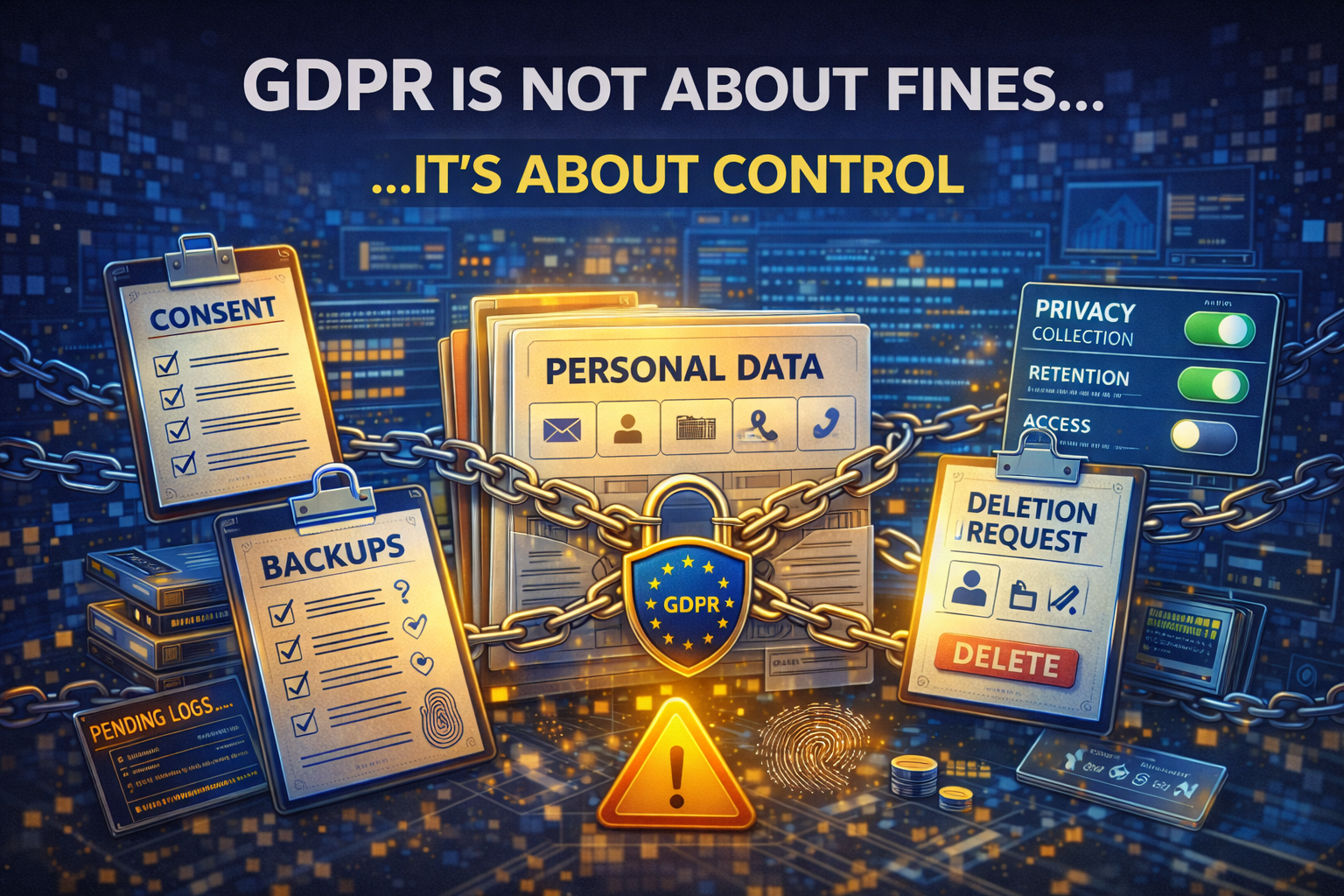
GDPR Is Not About Fines. It’s About Control.
Most founders first think about GDPR when someone mentions penalties.
 Fintech By Tanu4 min read·Just now
--
Large numbers.
Regulatory action.
Legal exposure.
Fear becomes the entry point.
But GDPR isn’t fundamentally about punishment.
It’s about control.
Control over personal data.
Control over access.
Control over accountability.
And once you understand that, GDPR stops being a legal burden and starts becoming a systems question.
The Common Startup Mistake
Early-stage companies move fast.
Collect data.
Test features.
Improve targeting.
Track behavior.
Data feels like fuel.
The more you collect, the more insight you gain.
But GDPR flips that mindset.
It asks:
Why are you collecting this?
How long will you keep it?
Who can access it?
Can you delete it completely?
Most startups don’t have clean answers.
Not because they’re careless but because growth usually precedes governance.
The First Real Deletion Request
The moment GDPR becomes real is when a user asks:
“Delete my data.”
Sounds simple.
Until you trace the footprint.
Is their data in:
- The primary database?
- Backups?
- Analytics tools?
- Email marketing systems?
- Logging infrastructure?
- Third-party integrations?
Deleting one record isn’t just a query.
It’s a cross-system coordination problem.
And if your architecture isn’t clean, that request exposes fragility.
A Pause for Founders and CTOs
If you’re building fintech or SaaS today, ask yourself:
Could we map our data flow clearly from collection to storage to deletion?
Not vaguely.
Visually.
Precisely.
If the answer is no, GDPR isn’t the issue.
Architecture is.
GDPR simply forces visibility into systems that grew organically.
Data Minimization Is Strategic, Not Restrictive
One of GDPR’s core principles is data minimization.
Collect only what you need.
At first, this feels limiting.
Why restrict optional data?
Why reduce analytics scope?
But minimizing data has hidden advantages:
- Lower breach exposure
- Simpler audits
- Faster deletion
- Reduced storage costs
- Clearer governance
Every unnecessary data field is future liability.
Discipline reduces future friction.
Consent Is Not Just a Banner
Many companies treat GDPR as a UI exercise.
Add a cookie banner.
Add a consent checkbox.
Update privacy policy.
That’s surface-level compliance.
True consent means:
- Clear explanation
- Specific purpose
- Revocable control
- Traceable recordkeeping
Consent must be logged.
Auditable.
Defensible.
And aligned with backend behavior.
If systems use data differently than policies describe, trust erodes.
The Backup Problem
One of the least discussed GDPR challenges is backups.
Even if you delete user data from live systems:
What about:
- Cold storage backups?
- Archived databases?
- Log aggregators?
GDPR doesn’t ignore backups.
It requires defined retention policies and deletion mechanisms.
That forces teams to rethink infrastructure layering.
Compliance becomes distributed systems engineering.
GDPR and Security Intersect
GDPR isn’t just about deletion.
It’s about protection.
If a breach occurs, you must:
- Detect it
- Assess impact
- Notify authorities within defined timelines
- Inform affected users
That requires:
- Real-time monitoring
- Incident response plans
- Data classification
- Clear responsibility ownership
Security maturity and GDPR maturity move together.
You can’t separate them.
The Investor and Enterprise Angle
As fintech and SaaS companies grow, GDPR becomes part of due diligence.
Investors ask about data governance.
Enterprise clients request documentation.
Procurement teams require clarity on:
- Data retention
- Sub-processors
- Cross-border transfers
- Encryption standards
Companies that treat GDPR seriously early face smoother growth conversations later.
Reactive compliance is always more expensive.
The Cultural Shift GDPR Forces
GDPR changes how teams think internally.
Developers become more conscious of logging practices.
Product teams evaluate data collection more critically.
Support teams handle user requests with defined workflows.
Legal and engineering collaborate more closely.
Compliance becomes embedded not external.
And embedded discipline scales better than ad hoc fixes.
The Global Implication
Even companies outside the EU often adapt to GDPR standards.
Why?
Because it has influenced global privacy expectations.
Customers increasingly expect:
- Transparency
- Control
- Portability
- Clear communication
Privacy is no longer optional reputation management.
It’s brand trust.
And trust compounds.
The Real Lesson
GDPR is not just about avoiding penalties.
It’s about building systems that respect user ownership of data.
It asks uncomfortable but important questions:
Why are we storing this?
Who benefits?
How long is it necessary?
Those questions improve product clarity.
They reduce systemic risk.
They increase long-term resilience.
Closing Thought
GDPR may feel heavy at first.
It slows impulsive data collection.
It forces documentation.
It demands structure.
But companies that design intentionally around privacy often build cleaner, more durable systems.
And in fintech especially, durability matters.
If this perspective helped you rethink GDPR beyond legal compliance, feel free to clap so other builders can discover it.
And I’d genuinely love to hear:
What was the most challenging GDPR moment you faced while scaling your product?
Because those moments often reveal where maturity truly begins.