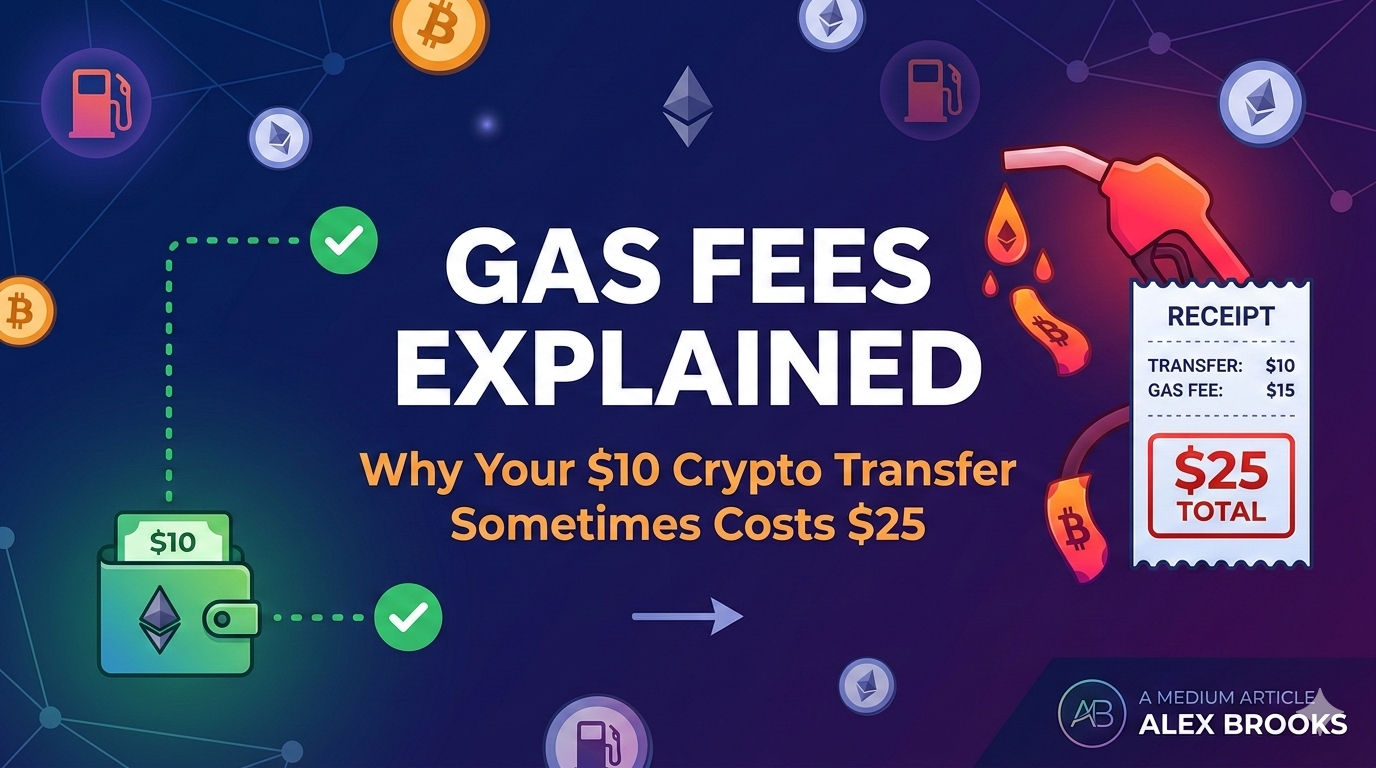
Gas Fees Explained: Why Your $10 Crypto Transfer Sometimes Costs $25
 Alex Brooks - Crypto and Web3 Editor10 min read·Just now
--
You just tried to send $10 worth of crypto to a friend. The wallet told you the fee is $18. You canceled the transaction and stared at your phone wondering what just happened. Here is the simple explanation nobody gives you.
I still remember the first time this happened to me.
I wanted to send $15 worth of Ethereum to my cousin as a birthday gift. Simple, right? I opened my wallet, entered the amount, and then saw the fee: $22.
I was sending $15 but it would cost me $22 just to send it. I laughed at how ridiculous that sounded. Then I canceled the transaction and sent him a gift card instead.
That was my introduction to gas fees. And if you are new to crypto, this is probably the most confusing and frustrating part of using it.
Good news: once you understand how gas fees work, you can almost always avoid paying too much. Let me explain everything in simple language.
What Are Gas Fees?
Think of a blockchain (like Ethereum) as a busy highway.
Thousands of people are trying to send crypto transactions at the same time. All these transactions need to be processed and recorded on the blockchain. The people who do this processing work (called miners or validators) need to get paid for their work.
Gas fees are basically the payment you give to these workers to process your transaction.
The word “gas” comes from Ethereum. Just like a car needs fuel (gas) to run, transactions need “gas” to get processed on the Ethereum network.
No gas = your transaction goes nowhere. It just sits there, ignored.
Why Do Gas Fees Change So Much?
This is where most people get confused. Gas fees are not fixed. They go up and down based on how busy the network is at that exact moment.
Here is a simple analogy:
Imagine you need to mail a package. During normal times, shipping costs $5. But during Christmas week, everyone is shipping packages. The shipping company charges $30 because demand is so high.
Same thing with crypto. When thousands of people are trying to send transactions at the same time, fees shoot up. When the network is quiet, fees drop back down.
This is why your $10 transfer sometimes costs $3 and sometimes costs $25. The technology did not change. The demand did.
What Factors Affect How Much You Pay?
Three main things determine your gas fee:
1. Which Blockchain You Are Using
This is the biggest factor. Different blockchains charge completely different fees.
Ethereum is the most popular blockchain but also the most expensive. During busy periods, a simple transfer can cost $10 to $50.
Polygon, Solana, TRON, and other “Layer 2” networks process the same transactions for pennies. We will talk more about this shortly.
2. How Busy the Network Is (Right Now)
Traffic on the blockchain changes minute by minute. A major NFT launch, a crypto market crash, or even a viral DeFi project can suddenly clog the network and spike fees.
It is like checking Google Maps before driving. The same road can take 10 minutes at 7am or 45 minutes at 6pm.
3. How Fast You Want Your Transaction Processed
Most wallets give you speed options: Slow, Normal, or Fast.
If you choose Fast, you pay a higher fee. Why? Because you are essentially paying the validators more to prioritize your transaction over others. It is like paying for express shipping instead of standard delivery.
If you are not in a hurry, always choose the slowest option. The transaction will still go through, just in a few extra minutes.
How Gas Fees Are Calculated (Simple Version)
You do not need to be a math expert here. Just understand the basic idea.
Gas fees on Ethereum work like this:
Gas Fee = Gas Units Used x Gas Price
Gas Units is how much computing work your transaction requires. A simple ETH transfer uses less work than a complex DeFi operation.
Gas Price is measured in “Gwei” (pronounced “Gway”). Gwei is just a tiny unit of Ethereum. 1 Gwei = 0.000000001 ETH.
When everyone says “gas prices are high right now,” they mean the Gwei price is high because the network is busy.
You do not need to calculate this yourself. Your wallet app calculates it automatically and shows you the estimated fee. But now you understand why that number changes all the time.
The Real Cost of Gas Fees (Real Examples)
Let me show you some real fee comparisons so you understand the scale of the problem.
Sending $100 worth of USDT to a friend:
- Ethereum network: $8 to $45 fee (depending on congestion)
- Polygon network: $0.01 to $0.05 fee
- TRON network: $0.50 to $1 fee
- Solana network: $0.001 to $0.01 fee
The exact same transaction. The exact same amount. Completely different costs depending on which network you use.
Swapping $200 of ETH for USDC:
- Ethereum (Uniswap): $15 to $80 fee
- Polygon (QuickSwap): $0.01 to $0.10 fee
- Solana (Jupiter): $0.001 to $0.005 fee
You can see why choosing the right network matters so much.
Why Is Ethereum So Expensive?
Ethereum is expensive for two reasons.
First, it is the most popular blockchain. More users mean more competition for block space, which means higher fees.
Second, Ethereum’s original design has limited capacity. It can only process a certain number of transactions per second. When demand exceeds capacity, fees go up.
Ethereum developers have been working on solutions for years. The “Ethereum 2.0” upgrades have improved things, but fees can still spike heavily during busy periods.
This is why newer networks like Polygon, Solana, and TRON were created. They handle more transactions per second and charge much less.
Which Networks Have the Lowest Gas Fees?
Here is a simple fee comparison table for reference:
NetworkAverage FeeSpeedBest ForSolanaUnder $0.01Very FastSmall transfers, NFTsPolygon$0.01 to $0.05FastEveryday transactionsTRON$0.50 to $1FastUSDT transfersBNB Chain$0.10 to $0.50FastVarious tokensEthereum$5 to $50MediumDeFi, large transfersBitcoin$1 to $30SlowBitcoin transfers only
Rule of thumb: For everyday small transactions, always use Polygon, Solana, or TRON. Save Ethereum for larger transactions where the fee is a smaller percentage of the total amount.
How to Avoid Paying High Gas Fees (7 Practical Tips)
Tip 1: Choose the Right Network
This is the single biggest way to save money on fees.
When you send crypto, most wallets let you choose which network to use. Before you hit send, check if you can switch from Ethereum to Polygon or Solana.
For USDT transfers specifically, TRON network is the cheapest and most widely supported. A transfer that costs $40 on Ethereum costs $0.50 on TRON.
Important: Make sure the person receiving the crypto is also using the same network. Sending Polygon USDT to someone expecting Ethereum USDT will cause problems.
Tip 2: Transact During Off-Peak Hours
Network traffic follows patterns. Here is a general guide:
Low traffic times (cheaper fees):
- Late at night (US time): 10pm to 6am EST
- Early morning on weekdays
- Weekends (especially Sunday morning)
High traffic times (expensive fees):
- US market hours: 9am to 5pm EST
- Announcement days (major crypto news)
- NFT launch days
- Market crash or pump days
If your transaction is not urgent, wait for off-peak hours. You can save 50% to 80% on fees just by waiting a few hours.
Tip 3: Use Layer 2 Networks
Layer 2 networks are built on top of Ethereum but process transactions much cheaper and faster.
Think of Ethereum as a main highway that is always congested. Layer 2 networks are parallel toll-free roads that move faster.
Popular Layer 2 networks:
- Polygon: Great for everyday transactions and DeFi
- Arbitrum: Popular for DeFi applications
- Optimism: Growing ecosystem with low fees
Many wallets (including Oppi Wallet) support multiple networks. Switch to these for everyday transactions.
Tip 4: Check Current Gas Prices Before Transacting
Before you send, check if fees are normal or spiking. Two useful tools:
For Ethereum: ethgasstation.info or etherscan.io/gastracker shows current gas prices and predictions.
For other networks: Most wallet apps show the current network fee before you confirm a transaction. If it looks unusually high, wait and check again later.
Tip 5: Batch Your Transactions
Instead of sending 5 small transactions separately, combine them into one larger transaction where possible.
For example: Instead of sending $20 to three different people three times, find a way to send it all at once. You pay one fee instead of three.
This is especially useful for business payments or regular recurring transfers.
Tip 6: Avoid Transacting During Market Events
When crypto prices crash or pump suddenly, everyone rushes to transact at the same time. Fees spike massively.
If you see major crypto news causing market movement, wait a few hours before transacting. Fees will return to normal once the panic or excitement settles.
Tip 7: Use Wallets That Show Fee Estimates Clearly
Some wallets are better than others at showing you the real total cost (including fees) before you confirm.
Good wallets show you: amount + fee = total cost. If you see this breakdown clearly, you can make informed decisions.
Wallets like Oppi Wallet show network fees transparently before you confirm any transaction, so you never get surprised after the fact.
When Gas Fees Are Worth Paying (And When They’re Not)
Here is a simple rule I follow:
Gas fee should be less than 2% of the transaction amount.
So if you are sending $500, paying a $10 fee is fine (2%). But paying $10 to send $20 is a terrible deal (50% fee).
When fees are worth it:
- Large transactions ($500 or more)
- Time-sensitive transactions (urgent payments)
- DeFi transactions with significant potential returns
- Situations where no cheaper network alternative exists
When fees are NOT worth it:
- Sending small amounts ($50 or less) on Ethereum
- Testing transactions (use a cheaper network)
- Non-urgent transfers you can wait on
- When a cheaper network option is available
The Bitcoin Gas Fee Situation
Bitcoin has its own version of fees called “transaction fees” or “miner fees.” They work similarly to Ethereum gas fees.
Bitcoin fees are measured in “satoshis per byte” (sat/vB). The more complex your transaction and the busier the network, the more you pay.
Bitcoin fees are generally lower than Ethereum but can still spike to $20 to $30 during heavy periods.
Unlike Ethereum, there is no “Layer 2 equivalent” for Bitcoin that is universally accepted. The Lightning Network helps with small Bitcoin payments but is not widely supported yet.
For everyday small Bitcoin transfers, the fees can genuinely make it impractical. This is one reason many people prefer using stablecoins on cheap networks (like USDT on TRON) instead of Bitcoin for daily payments.
How Modern Wallets Are Solving the Gas Fee Problem
The crypto industry knows gas fees are a huge barrier. Here is what is being done about it:
Network Fee Subsidies
Some wallets absorb small transaction fees for their users. Instead of paying network fees yourself, the wallet pays them and charges you a slightly higher exchange rate instead.
Gasless Transactions
New technology allows certain transactions to be processed without users paying gas directly. The DApp or wallet pays it on your behalf.
Layer 2 Defaults
More wallets are defaulting to Layer 2 networks instead of Ethereum mainnet. This automatically gives users lower fees without them needing to manually switch networks.
Fee Prediction Tools
AI-powered tools predict the best time to transact based on network patterns. Some wallets are beginning to integrate these suggestions.
Gas Fees and Spending Crypto Daily
If you want to use crypto for everyday spending (like paying for Netflix, booking flights, or shopping online), gas fees are a real concern.
Here is the practical approach I follow:
For daily spending: I load stablecoins (USDT or USDC) onto my Oppi Wallet virtual card using the Polygon or TRON network. The transfer fee is under $0.05. Then I spend using the card anywhere Mastercard works.
For international transfers: I use USDT on TRON network. It is fast, cheap, and widely supported.
For holding Bitcoin or Ethereum: I minimize transactions to save on fees. I do not send small amounts unless necessary.
This simple approach keeps my monthly gas fee costs under $2 total, no matter how many times I spend crypto.
The Future of Gas Fees
Good news: fees are getting better.
Ethereum upgrades continue to reduce costs. Layer 2 adoption is growing fast. New blockchains are launching with near-zero fees. Competition between networks is pushing fees down across the board.
The goal of the crypto industry is to make transactions essentially free for everyday use. We are not fully there yet, but we are much closer than we were in 2021 when Ethereum fees regularly hit $100 per transaction.
By 2027, most everyday crypto transactions should cost less than $0.01. The infrastructure is being built right now.
Quick Reference: Gas Fee Cheat Sheet
Save this for reference:
ALWAYS USE FOR CHEAP TRANSFERS:
- Solana (under $0.01)
- Polygon (under $0.05)
- TRON for USDT (under $1)
USE FOR LARGER TRANSACTIONS ONLY:
- Ethereum (when amount is $300+)
- Bitcoin (when amount is $200+)
BEST TIMES TO TRANSACT:
- Sunday morning
- Late night US time (10pm to 6am EST)
- Midweek quiet periods
AVOID TRANSACTING WHEN:
- Market is moving fast (big news days)
- US market hours (9am to 5pm EST)
- Major NFT launches are happening
GAS FEE RULE:
- Fee should be less than 2% of transaction amount
- If it is more than 2%, wait or switch networks
The Bottom Line
Gas fees are confusing when you first encounter them. But once you understand what they are (payment for network processing) and what affects them (network choice and traffic), you can almost always keep them very low.
The biggest single thing you can do is switch from Ethereum to a cheaper network like Polygon, TRON, or Solana for everyday small transactions. That one change alone can reduce your fees by 95%.
Combine that with timing your transactions during off-peak hours, and you will almost never pay more in fees than you should.
Crypto is supposed to make money movement cheaper and easier. With the right knowledge, it genuinely does.
About the Author
Alex Brooks is a freelance content writer specializing in cryptocurrency and practical Web3 use. Born in the UK with Indian roots, currently based in the USA. He writes about making crypto actually useful for everyday life. Not financial advice, just real experiences and lessons learned.