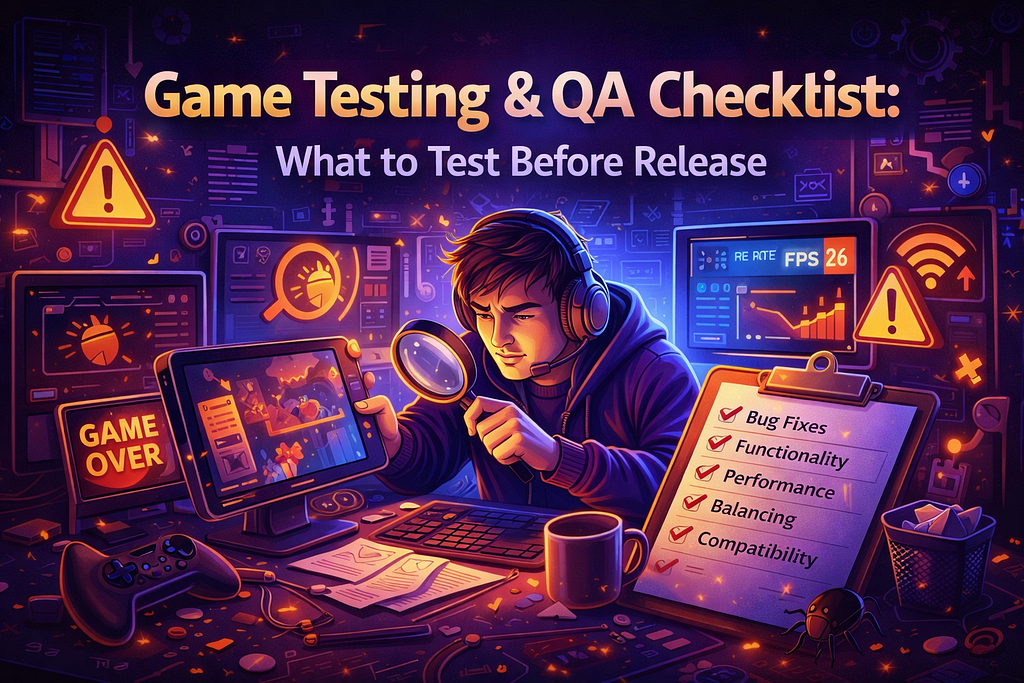
The transition from a “feature-complete” build to a “release-ready” product is perhaps the most precarious phase in the entire production lifecycle. In the gaming landscape of 2026, where player expectations for day-one stability are absolute and digital storefronts are unforgiving of technical failures, a robust Quality Assurance (QA) strategy is not a luxury — it is a survival requirement. For any studio, the goal of testing is not merely to find bugs, but to verify that the player’s experience matches the creative vision across every conceivable hardware configuration.
A common pitfall is treating testing as a final “check-box” task. In reality, modern QA is a multi-layered discipline that spans technical performance, psychological engagement, and legal compliance. Whether you are working with an internal team or a dedicated game testing company, this comprehensive checklist serves as your roadmap to a stable, high-quality launch.
1. Functional Testing: The Foundation of Play
Functional testing ensures that the game actually “works” according to the design specifications. This is the search for “showstopper” bugs that prevent progression or cause crashes.
- Core Mechanics Audit: Does every button press result in the intended action? Verify physics, collision, and character movement across all terrain types.
- Progression and Flow: Can a player move from the start screen to the end credits without getting “soft-locked”? Check all quest triggers, cutscene transitions, and save/load states.
- Edge Case Exploration: What happens if a player tries to open a menu during a loading screen? What if they disconnect their controller mid-combat? These “what-if” scenarios are where the most damaging bugs hide.
- Menu and UI Integrity: Verify that every menu item, slider, and toggle functions correctly. Ensure that text does not overflow its containers and that navigation is intuitive for both mouse/keyboard and controller.
2. Performance and Stress Testing: The Stability Layer
In 2026, performance is a “safety” metric. Frame drops lead to motion sickness in VR and frustration in competitive play.
- Frame Rate Consistency: The game must maintain its target FPS (e.g., 60 or 120 FPS) during the most visually intense scenes (e.g., large explosions or high NPC density).
- Load Time Optimization: Monitor “Time to Play.” In an era of high-speed SSDs, players expect near-instant transitions. Identify and eliminate any “hitch” during background asset streaming.
- Memory Leak Detection: Run the game for 24+ hours continuously. If the performance degrades over time or the application crashes, you likely have a memory leak that will plague long-term players.
- Hardware Matrix Testing: Test the build on the “Minimum Specification” hardware. If the game is cross-platform, verify parity between high-end PCs, handheld consoles (like the Steam Deck 3), and mobile devices.
3. Compatibility and Connectivity Testing
For any provider of game development services, ensuring the game works in the “wild” is the greatest challenge. This involves testing against the unpredictability of real-world environments.
- Network Latency (Netcode): In multiplayer titles, how does the game behave at 50ms, 150ms, and 300ms of lag? Verify that “rollback” or “interpolation” systems handle packet loss without teleporting players.
- Peripheral Support: Test compatibility with various controllers (Xbox, DualSense, 3rd party), flight sticks, racing wheels, and VR haptics.
- OS and Driver Conflicts: Verify the build against multiple versions of Windows, macOS, and mobile operating systems. Check for conflicts with popular background software (e.g., Discord, streaming tools).
4. Accessibility and Localization (The “Global” Check)
A game is only high-quality if everyone can play it. Accessibility is no longer an optional “extra”; it is a standard of professional excellence.
- Visual and Audio Aids: Test high-contrast modes, color-blind filters, and text-to-speech functionality. Ensure all critical audio cues have a visual equivalent (e.g., a “threat indicator” for a sound coming from behind).
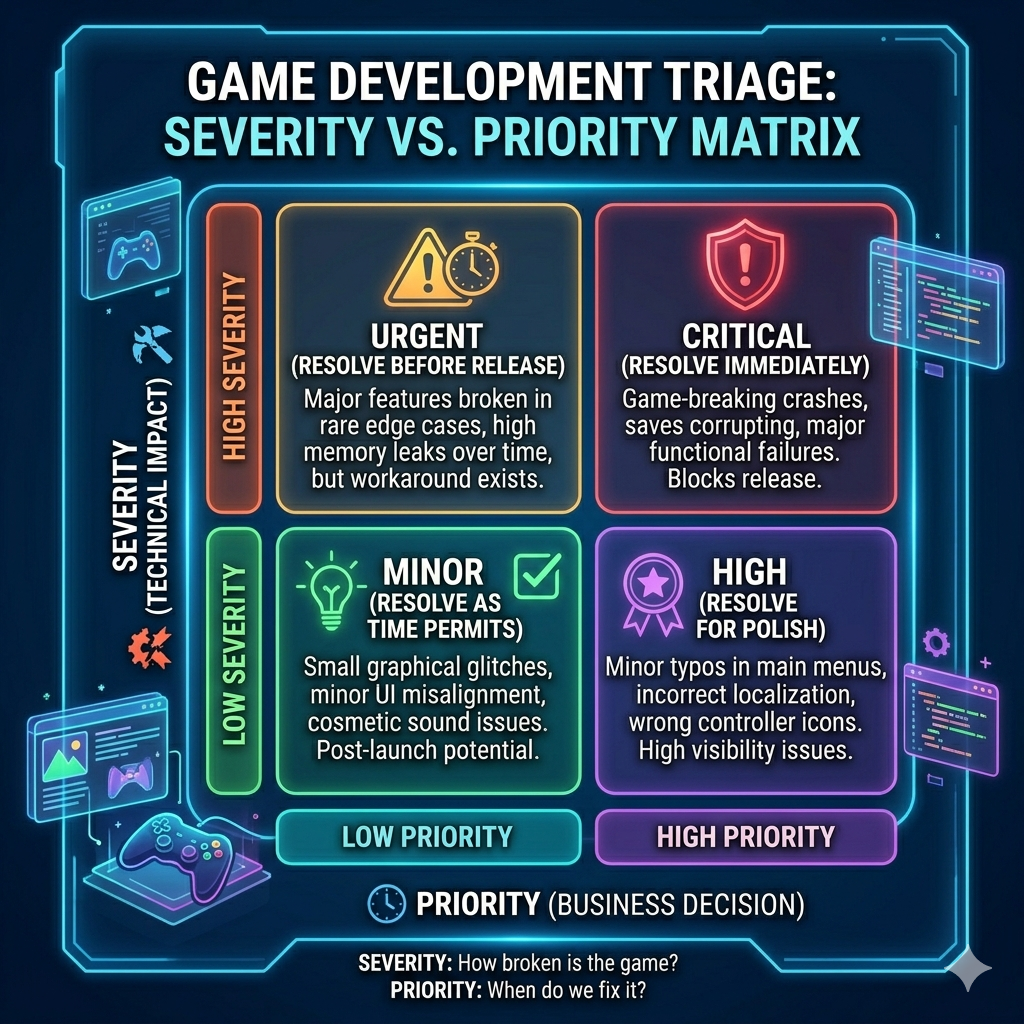
- Localization Quality (LQA): Check that translated text fits within the UI, supports special characters (accents, Cyrillic, Kanji), and is contextually accurate. A “Home” button translated as “House” is a common LQA failure.
- Difficulty Scaling: Verify that “Easy” and “Hard” modes are mathematically balanced and provide the intended experience for their target audiences.
5. Compliance and Certification (The “Gatekeepers”)
Before a game can launch on PlayStation, Xbox, or Nintendo, it must pass a rigorous set of “Technical Requirement” (TR) or “Standardization” (TCR) tests.
- Platform-Specific Requirements: Does the game correctly handle “User Profiles”? Does it show the correct button icons (e.g., ‘A’ for Xbox, ‘Cross’ for PlayStation)?
- Legal and ESRB/PEGI Standards: Verify that the game’s content matches its intended rating. Check for mandatory “Legal Notices” on the splash screens.
- In-App Purchase (IAP) Security: For F2P titles, test the transaction flow multiple times. A failure in the “buy” button is a critical business risk.
6. The “Fun” Factor: Balance and UX Testing
While technical bugs are objective, “fun” is subjective — but it can still be tested.
- The “FTUE” (First Time User Experience): Watch a new player interact with the tutorial. Do they understand the mechanics without being told? Where do they get frustrated?
- Economic Balance: In RPGs or LiveOps titles, verify that the “grind” isn’t too punishing and that the virtual economy remains stable over long periods.
- Difficulty Spikes: Identify any “wall” where the difficulty jumps so sharply that players are likely to “churn” (quit the game).
Conclusion: The “Go/No-Go” Decision
A successful launch is the result of disciplined, documented testing. By following this checklist, you transform QA from a reactive “bug-hunting” exercise into a proactive strategy that defines a professional game development company. Remember: every bug found in the studio is a bug that doesn’t end up in a 1-star review on launch day.
The most successful developers are those who recognize that the “last 10%” of polish takes 50% of the effort — but that effort is exactly what defines a masterpiece in the modern market.
Game Testing & QA Checklist: What to Test Before Release was originally published in Coinmonks on Medium, where people are continuing the conversation by highlighting and responding to this story.