Funding Rates: The Hidden Tax and the Free Edge
 Charles V. — The Chart Whisperer7 min read·Just now
--
The 8-Hour Tax Every Perpetuals Trader Pays (And the Free Edge Hidden Inside It)
Every eight hours, money quietly changes hands between every long and every short on every perpetual contract in the world. Most traders don’t know it’s happening. The ones who do split into two groups: those who read it as one of the cleanest sentiment signals in the market, and those who misread it and wonder why their account bleeds in single digits at a time.
That mechanism is the funding rate. This is how it actually works.
What Funding Rates Are and Why They Exist
Perpetual futures have a structural problem traditional futures do not. They never expire. A standard quarterly futures contract eventually settles against the spot price, which forces convergence. A perpetual has no settlement date. Without something pulling the contract price back, it drifts away from spot indefinitely and the whole product collapses under its own arbitrage gaps.
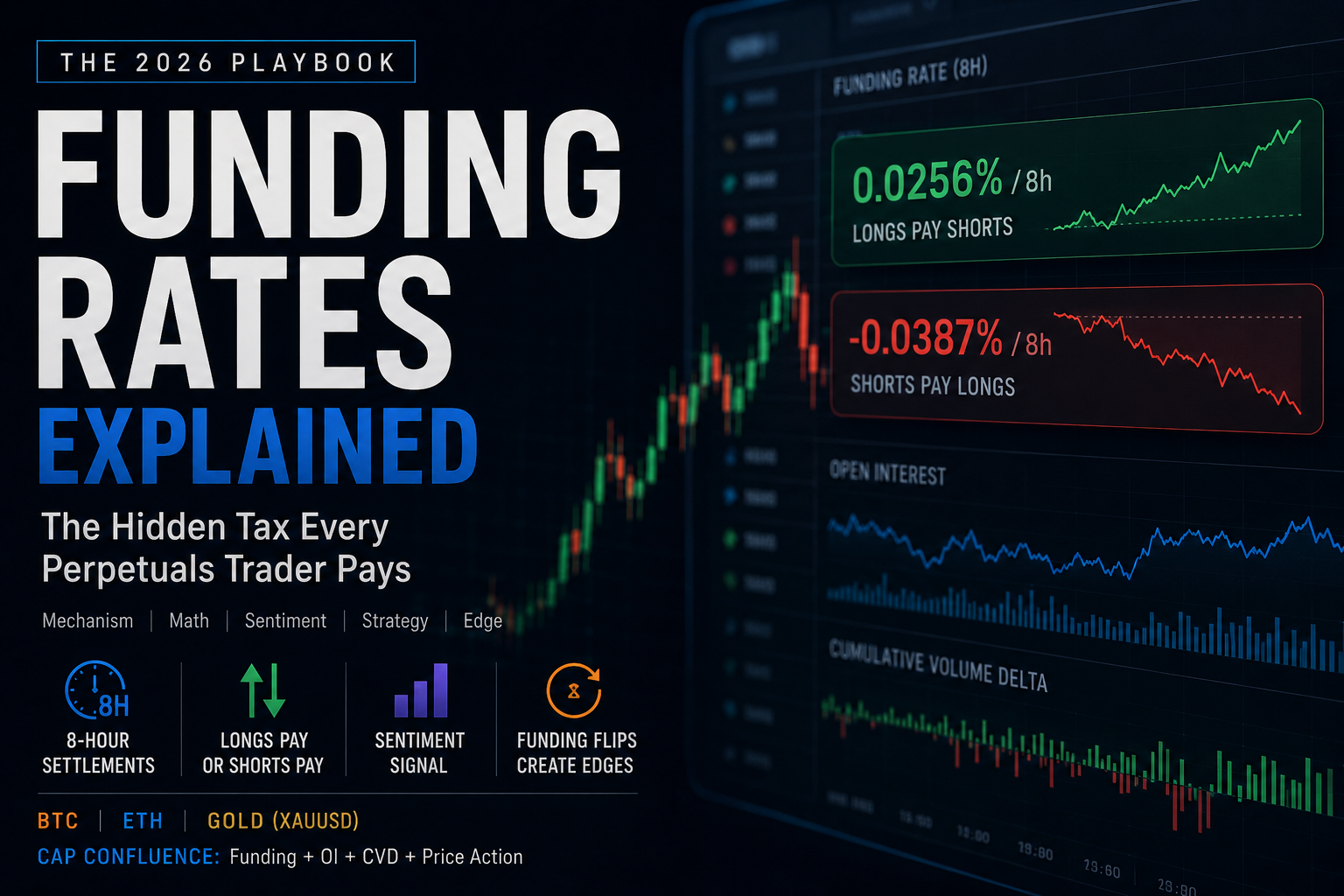
The funding rate is the elastic band that keeps the two markets tied together. When aggressive long demand pushes the perpetual price above spot, funding turns positive and longs start paying shorts a small percentage of their notional every eight hours. The real cost of being long increases. New longs wait for cheaper entries. Equilibrium re-emerges.
When aggressive shorts push the perpetual below spot, funding flips negative. Shorts pay longs. Same mechanism, reversed. It is the most elegant solution any derivatives market has ever designed for the perpetual-pricing problem. And because the rate is broadcast publicly every few seconds on every major venue, it tells you in real time exactly how aggressively each side is positioned.
The Mechanics
Funding is not paid to the exchange. It is a direct peer-to-peer transfer between traders at three fixed UTC timestamps each day: 00:00, 08:00, and 16:00. Hold a position across the timestamp and you are part of the transfer. Close it one minute before and you are out.
The payment uses the full notional value of the position, not just the margin posted. A $100,000 long at 0.05% funding pays $50 every eight hours. Over a week of pinned extreme funding, that cost compounds fast enough to materially change the outcome of a position that doesn’t move in your favor.
The direction is set by the sign of the rate. Positive means the perpetual is above spot and longs pay shorts. Negative means the perpetual is below spot and shorts pay longs. Near-zero means two-sided positioning with no crowd skew. Extreme positive, above 0.05% sustained across venues, means late-cycle crowding on the long side. Extreme negative, below -0.05% sustained, means aggressive short accumulation at full stretch.
What Funding Is Actually Telling You
Here is the misread that destroys more perpetual trades than any other interpretation error. “Funding is positive so the market is bullish and I should be long.” That is backwards.
Funding tells you where the crowd is, not where price is going. Positive funding means longs are aggressive and crowded. That is a confirmation in a young trend. It is a warning in a mature one.
The professional read is layered. Positive funding early in a structural move confirms momentum. Positive funding pinned above 0.04% across Bybit, Binance, and OKX for 24 to 48 hours signals that late money has arrived, real capital has been committed, and the next meaningful move is more likely a flush than an extension.
Neutral funding, near zero, is the most underrated reading. It signals a two-sided market without a dominant crowd. Setups taken into neutral funding enter without fighting the positioning regime. The trend has room precisely because the crowd has not piled in yet.
The frame that matters: funding tells you the cost of joining the crowd. Cheap funding means a non-crowded trade. Expensive funding means the crowd has already done your work, paid for it, and is now exposed.
Extreme Readings — The Contrarian Signal Nobody Respects Until They Get Liquidated
The most consistent funding-based edge is not chasing momentum. It is fading sustained extremes when they align with structural exhaustion.
On the short side: BTC funding pins above 0.04% across three venues for 12 to 36 hours. Open Interest rises in lockstep, meaning new long positions are stacking on top of an already-crowded book. Spot stops printing fresh highs even though futures keep getting bought. CVD divergence opens between the perpetual and spot. A clean failed breakout prints above prior highs with an immediate body close back below.
That is the bearish extreme-long fade. Funding flagged the crowded positioning. Open Interest confirmed real capital was committed. CVD revealed the buying was perpetual-driven, not spot-driven. The structural failure delivered the trigger.
The mirror on the long side: funding below -0.04% for multiple sessions, rising OI as shorts stack, spot bids absorbing every selling burst without printing fresh lows, CVD divergence on the way down, then a Wyckoff Spring print below recent lows with an immediate close back inside the range.
This is the setup that produced the cleanest BTC and ETH rallies of late 2024 and early 2025. The information was visible on funding before it was visible on the candle chart. The traders who waited for the confluence took the trade. The traders who chased the breakout candle a day later paid for it.
The Funding Flip
A funding flip is the moment the rate crosses from sustained positive into negative, or vice versa, after holding one side for an extended period. When funding has been deeply positive for days and finally flips negative, the late long crowd has been flushed. The short side now begins paying. The crowd has rotated.
The flip itself is not the trade. The flip plus structural confluence is the trade. Five conditions must stack to qualify:
Sustained extreme before the flip. Funding must have spent at least 24 to 48 hours above |0.04%|. Brief zero crossings do not qualify.
Open Interest confirms. On a long-to-short flip, OI should decline as longs unwind. Falling OI confirms positions are being closed, not flipped on margin.
CVD aligns with the new flow. If funding flips from positive to negative and the trade is short, perpetual CVD must roll over. CVD divergence on the flip is the institutional fingerprint.
A clean break of structure in the new direction. A flip without a BOS is noise. A flip with a BOS is a regime change.
The trigger candle prints in London or NY Open. Asian-session flips are statistically noisier and frequently reverse on the next overlap.
When all five stack, the funding flip becomes one of the cleanest reversal setups retail traders can read. The data is public. The interpretation is what most traders never build.
The 7-Rule CAP Funding-Confluence Protocol
This is the exact rule set used inside the Continuation Acceleration Protocol to decide when a funding reading is actionable. Funding does not become a trade unless every rule passes.
Rule 1: Read the rate on three venues. Bybit, Binance, and one other. A single-venue reading is noise. Three-venue agreement is signal.
Rule 2: Duration matters more than magnitude. A single 8-hour spike to 0.06% is noise. A 24 to 48-hour pin above 0.04% is regime. Check the previous 6 funding intervals before treating any reading as decisive.
Rule 3: Pair every reading with Open Interest. Rising OI and rising funding means new positions joining the crowded side. Dangerous. Falling OI and sustained funding means old positions unwinding. Less actionable.
Rule 4: Demand CVD agreement. Positive funding with perpetual CVD divergence means aggressive longs are being absorbed. Warning. Negative funding with positive spot CVD means capitulation longs are being bought by real spot. Setup.
Rule 5: Structural confluence is non-negotiable. Funding extremes only matter when they align with a structural level: a higher-timeframe break of structure, an OTE Fibonacci zone, an order block with a fair value gap overlay, or a Wyckoff phase boundary. Without structure, funding is sentiment without a trigger.
Rule 6: Session quality gate. The trigger candle must print in London or NY Open.
Rule 7: Risk sizing does not change. 1 to 2% maximum risk per trade regardless of how clean the funding read looks. Confidence is not a sizing input. Funding confluence improves expectancy, not maximum loss tolerance.
If all 7 pass, the read is actionable. If a single rule fails, the trade does not happen. Funding flips with full confluence happen once or twice a month on BTC during normal regimes. That rarity is the entire point.
The Five Mistakes That Quietly Destroy Perpetuals Accounts
Mistake 1: Reading funding as direction instead of positioning. “Positive funding means I should be long.” That single misread accounts for more bad perpetual trades than any other interpretation error.
Mistake 2: Ignoring funding entirely on trend trades. The trend entry arrives at peak extreme funding, takes a routine pullback, and the position is in pain from both price and accumulated funding cost.
Mistake 3: Holding losing positions across the timestamp. The position is already in drawdown. Funding hits. Now it is deeper in drawdown with a real cost subtracted and no improvement in setup quality.
Mistake 4: Treating single-venue readings as truth. Bybit at 0.06% while Binance sits at 0.02% is not a system-wide extreme. Check three venues. The dispersion between venues is itself a signal.
Mistake 5: Chasing the cash-and-carry yield without pricing the real risks. The annualized rate looks attractive. Then a liquidation cascade hits, the spot leg cannot move fast enough, and the trade ends with a loss many multiples larger than any yield it ever collected. Carry trades are real strategies. They are not passive income.
The Bigger Picture
In the Continuation Acceleration Protocol, funding is one input in a multi-gate decision engine built around Wyckoff phase, Elliott Wave sequence, CVD order flow, Open Interest behavior, break of structure, and OTE precision entry. Its role is specific: it answers how crowded the trade is at the moment of entry. That question determines whether a structurally valid setup is entering an early move or fighting a positioning regime at full stretch.
The data has been broadcast publicly to every participant on every venue for years. What most traders never build is the architecture that turns that broadcast into consistent, mechanical execution.
The full CAP funding-confluence protocol and gate integration breakdown is at chartwhisperer.ca/blog/funding-rates-perpetuals-trading-guide.