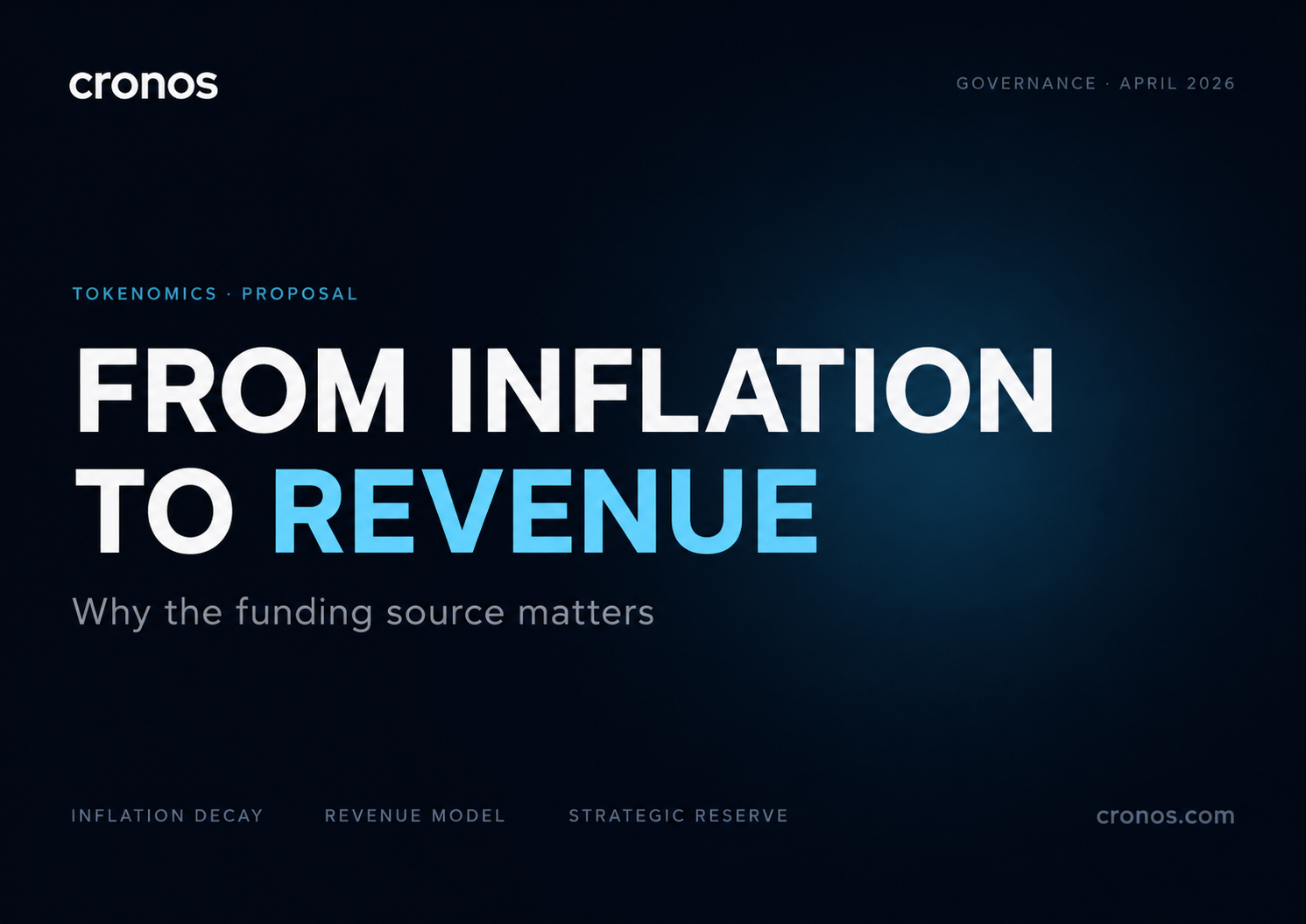
From Inflation to Revenue: Why the Funding Source Matters
 Piero Pasquariello5 min read·Just now
--
The new CRO proposal is not only about staking rewards. It is also about changing what supports those rewards over time
When people look at staking, the first thing they usually notice is the APY.
That makes sense.
APY is easy to compare.
It is easy to screenshot.
It is easy to talk about.
But in the new CRO governance proposal, the bigger question is not only:
How much can stakers earn?
The better question is:
Where do those rewards come from?
That is the part that matters most here.
The current model
Today, CRO staking rewards are mainly supported by emissions.
In simple terms, new CRO is minted and used to help fund staking rewards.
That is not unusual. Many proof-of-stake networks use emissions to reward validators and delegators.
But there is a limit to how long emissions can remain the main source of rewards.
The official proposal points out that CRO is already close to its maximum supply cap of 100B CRO, and this proposal does not change that cap.
That is an important detail.
If a network keeps relying mainly on new emissions, it eventually has to deal with a simple question:
What happens when those emissions need to slow down?
This proposal tries to answer that before it becomes a bigger issue.
Inflation decay
The first part of the proposal is inflation decay.
That means new CRO emissions would gradually decrease over time.
Not suddenly.
Not overnight.
Not with a hard stop from one day to the next.
The idea is to reduce dependence on emissions in a gradual way, while keeping the 100B CRO cap unchanged.
That matters because the goal is not to shock the staking system.
The goal is to create a transition.
A model that depends less on new emissions needs time to move toward a different funding source.
That is where revenue comes in.
The shift to revenue
The bigger direction of the proposal is to move CRO staking rewards from an inflation-funded model toward a revenue-funded model.
In plain English, that means rewards are intended to become less dependent on newly minted CRO over time and more connected to real economic activity.
The official blog points to future revenue flows linked to Cronos App and the broader Cronos ecosystem.
These may include:
- trading fees
- DeFi yields
- prediction markets
- network activity
The idea is simple even if the execution is more complex.
If the ecosystem generates real activity, part of that activity can help support the model behind CRO.
That is a very different direction from relying mainly on emissions forever.
Where tiered staking fits in
This proposal is not only about the funding source.
It also includes a tiered staking structure.
The idea there is to reward longer-term commitment through opt-in tiers, while the broader reward model gradually shifts away from pure emissions.
So even though this article is focused on the funding side, it is worth remembering that the proposal combines multiple pieces:
- inflation decay
- tiered staking
- revenue bridging
- transparency
That is part of why the proposal is broader than a simple staking update.
Why Cronos App matters
This is why Cronos App plays such an important role in the proposal.
It is not mentioned as just another product.
It is presented as an important part of the long-term revenue model the proposal is trying to build toward.
If Cronos App and broader ecosystem activity grow over time, those revenue flows are intended to become more meaningful.
That does not mean everything changes immediately.
It also does not mean outcomes are guaranteed.
This is still a governance proposal, and the model depends on execution, actual revenue, governance decisions, and ecosystem growth.
But the direction is clear:
less reliance on emissions, more connection to real usage.
The role of the strategic reserve
A shift like this cannot happen in one step.
That is why the proposal also mentions the strategic reserve.
The reserve is designed to act as a bridge while revenue ramps over time.
This part matters because emissions do not drop to zero overnight, and revenue does not replace emissions instantly.
The transition is more gradual than that.
In simple terms, the proposal points to a path like this:
- emissions start to decay
- the strategic reserve helps during the transition
- Cronos App and ecosystem revenue are expected to scale over time
- rewards become more connected to real activity
That is why this should not be read as a simple staking update.
It is a change in the funding structure behind the rewards.
Why this matters for users
For users, this matters because staking rewards are only one part of the story.
The other part is sustainability.
A higher APY may grab attention, but the funding source behind it matters more over time.
If rewards come mainly from new emissions, users should understand the supply impact.
If rewards become increasingly connected to revenue, users should understand where that revenue comes from and how it flows back into the ecosystem.
That is also why transparency matters.
The proposal says a dedicated tokenomics page is coming, with visibility into:
- supply
- reserve
- revenue flows
That is important because a revenue-backed model should be understandable.
Users should not have to guess how the model works.
They should be able to follow the numbers and understand the transition more clearly.
The simple takeaway
For me, the key point is simple:
the APY is easy to notice, but the funding source is what really matters.
This proposal is trying to move CRO from a model mainly supported by emissions toward one that becomes more connected to real ecosystem revenue over time.
That does not happen overnight.
It requires inflation decay, strategic reserve support, ecosystem activity, and better transparency around how the model works.
So the real story is not only:
What is the reward?
It is:
What supports the reward?
That is the part users should understand before focusing only on the headline numbers.
This is still a governance proposal, not a guarantee of any outcome. Users should read the official proposal, understand the mechanics, and follow official updates before making any decision.
Read full proposal:
https://blog.cronos.com/p/a-new-era-for-cro
Technical proposal / FAQ:
https://github.com/crypto-org-chain/chain-main/discussions/1291
Official Cronos website:
https://cronos.com
Official Cronos App on X:
https://x.com/CronosApp