--
What Makes a DeFi Strategy Actually Sustainable?
DeFi is full of yield.
Every week, new protocols launch with eye-catching APYs. Capital floods in almost instantly, chasing the highest returns. For a brief moment, everything looks promising—returns are high, participation grows, and momentum builds.
Then the cycle repeats.
Yields begin to compress. Liquidity rotates elsewhere. The opportunity fades.
We’ve all seen this pattern play out again and again:
- New protocol launches with high APY
- Capital rushes in
- Rewards dilute and yields drop
- Liquidity exits in search of the next opportunity
This raises a more important question:
Why do most DeFi strategies fade so quickly?
Defining What “Sustainable” Really Means
In a space driven by rapid innovation and speculation, sustainability is often overlooked.
A truly sustainable yield strategy isn’t defined by how high it performs in the short term—but by how well it holds up over time.
A sustainable DeFi strategy should:
- Generate consistent returns across time
- Avoid relying entirely on token incentives
- Remain viable across different market conditions
This shifts the focus from chasing peaks to building durable performance.
Real Yield vs Temporary Yield
Not all yield is created equal.
Many DeFi strategies rely on emissions—token rewards distributed to attract liquidity. While effective in the short term, these incentives often decline as token supply increases or demand weakens.
We can break yield into two categories:
Temporary Yield
- Driven by token emissions
- Highly sensitive to market sentiment
- Declines as incentives reduce
Real Yield
- Generated from actual economic activity
- Includes trading fees, lending interest, and arbitrage
- More stable and tied to real usage
Over time, real yield tends to be more sustainable, while emissions-driven returns fade.
The Role of Liquidity & Market Conditions
Sustainability is also deeply tied to market structure.
A strategy that performs well in one environment may fail in another. Key factors include:
- Liquidity depth → shallow liquidity increases volatility and slippage
- User activity → more users = more real yield generation
- Market volatility → some strategies depend on it, others break under it
- Demand for the strategy → without demand, returns disappear
Some strategies are fragile—they only work under perfect conditions.
Others are adaptive—they evolve as markets change.
Risk and Cost Awareness
One of the most overlooked aspects of DeFi strategies is the hidden cost layer.
A strategy may look attractive on paper, but real-world execution introduces:
- Gas and execution costs
- Slippage during trades
- Rebalancing inefficiencies
- Changing correlations between assets
When these are factored in, headline APY often overstates actual returns.
This is why risk-adjusted yield matters more than raw yield.
Designing Better DeFi Strategies
Sustainable DeFi strategies aren’t accidental—they’re designed.
Strong approaches often include:
- Diversification across multiple strategies
- Continuous monitoring of performance and risk
- Adaptability to changing market conditions
- Focus on net returns, not just advertised APY
At this level, DeFi starts to resemble a system of capital allocation rather than isolated opportunities.
This is the foundation of managed DeFi and onchain capital deployment.
From Opportunities to Systems: The Role of DeFi Vaults
This is where DeFi vaults come in.
Instead of chasing individual strategies, vaults aim to:
- Allocate capital dynamically
- Optimize across multiple yield sources
- Reduce dependence on short-term incentives
- Maintain consistent performance over time
Concrete vaults are designed with this philosophy in mind.
They focus on:
- Sustainable yield sources
- Active capital management
- Adapting to changing market conditions
- Long-term durability over short-term spikes
A Real Example: Concrete DeFi USDT
To ground this in reality, consider Concrete DeFi USDT.
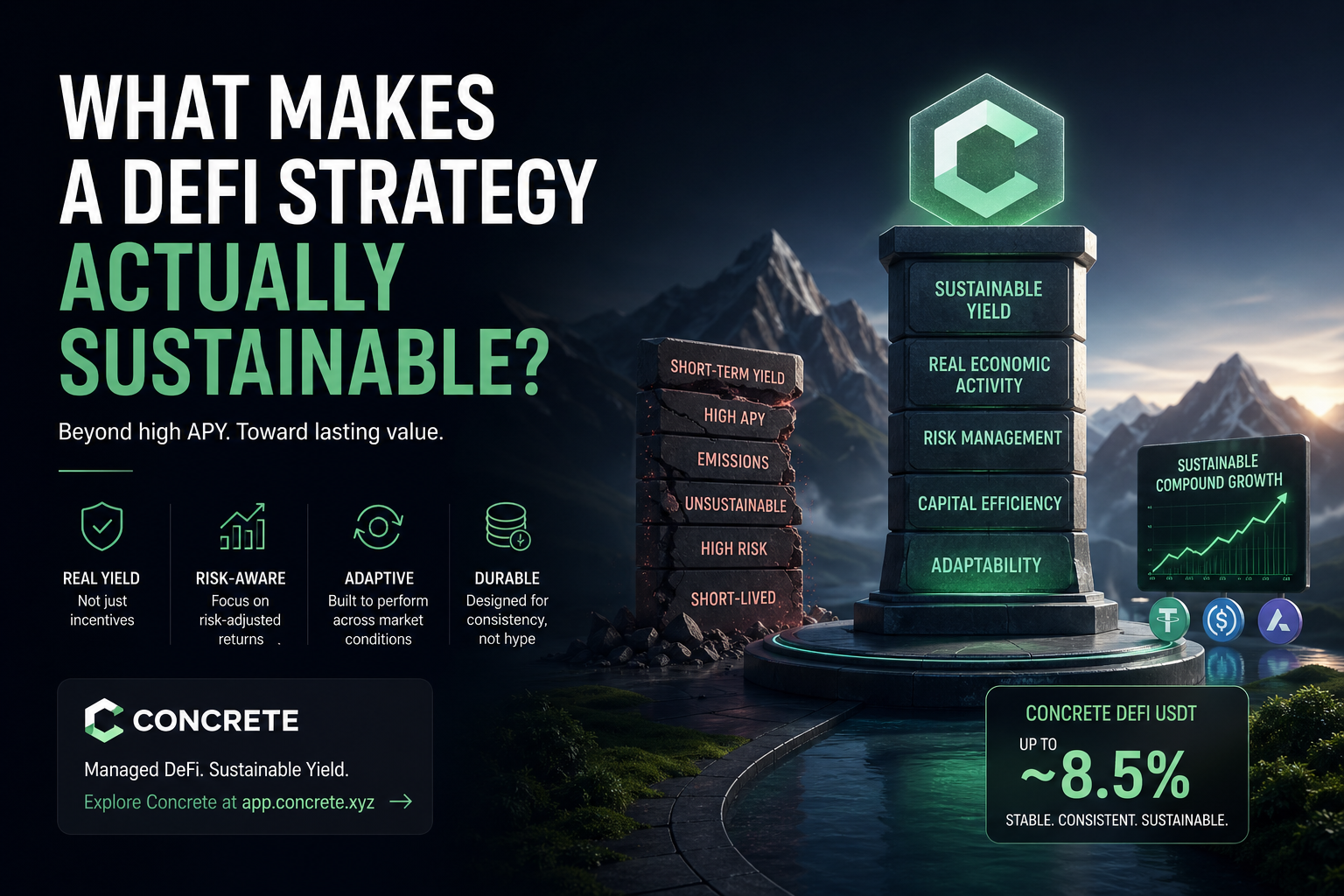
With yields of up to ~8.5%, it may not look as flashy as triple-digit APYs seen elsewhere. But that’s precisely the point.
- It emphasizes stability over hype
- It focuses on consistent returns
- It attracts long-term capital, not short-term speculation
Over time, a steady yield can outperform volatile strategies that spike and collapse.
This is what sustainable yield looks like in practice.
The Bigger Shift in DeFi
DeFi is evolving.
The early phase was defined by:
- High APYs
- Rapid capital rotation
- Incentive-driven growth
But the next phase is different.
We are moving toward:
- Long-term capital strategies
- Institutional DeFi participation
- Systems built for durability
- Infrastructure that outlasts incentives
The future of DeFi won’t be defined by the highest yield.
It will be defined by the strategies that last.
🚨 Explore Concrete at app.concrete.xyz 🚨