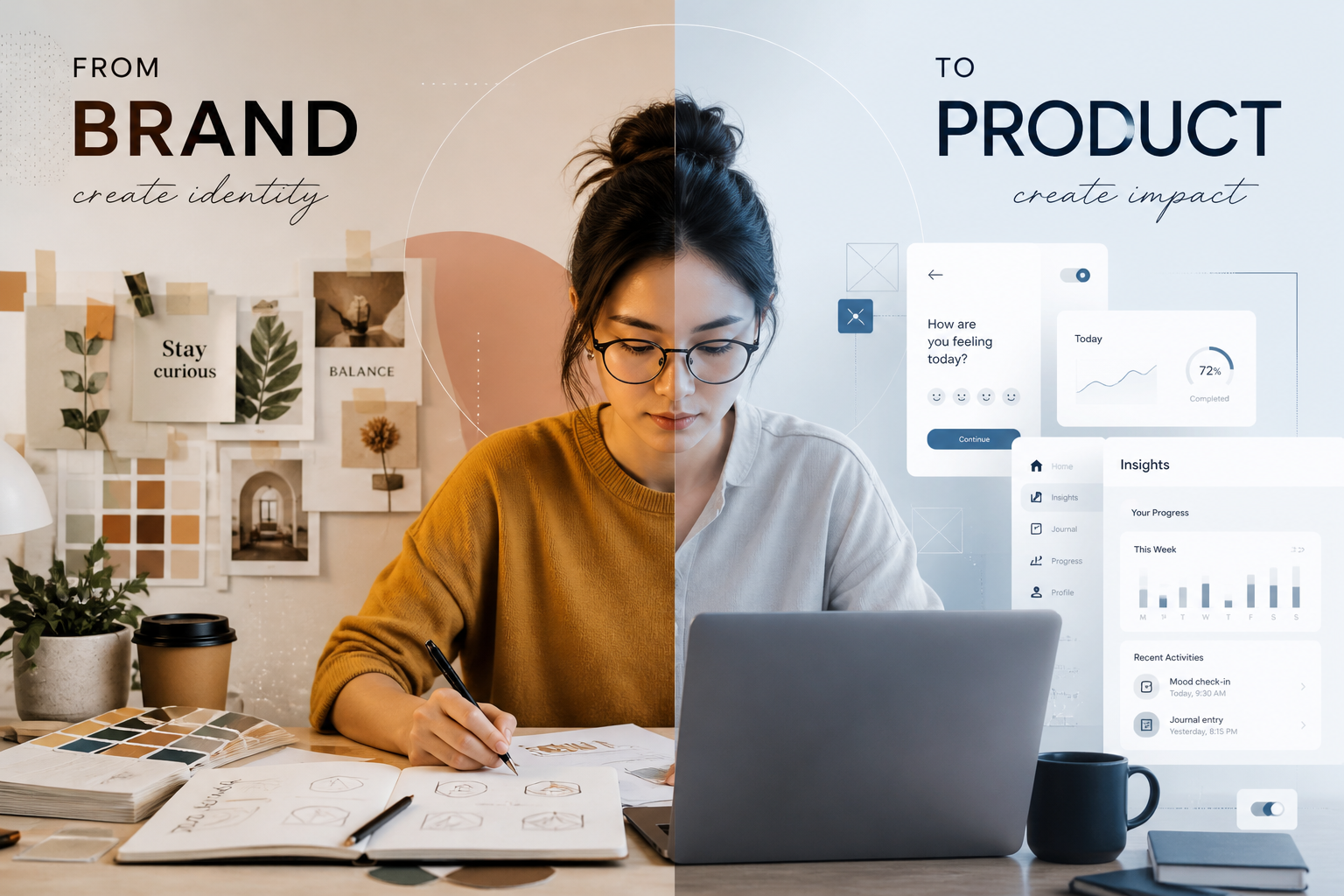
From Brand to Product: How I Learned to Design for Real Life
 Tracy Nguyen6 min read·1 hour ago
--
I didn’t start my career in product design. I started in branding, where my job was to shape how companies look, feel, and present themselves to the world. I worked on visual identities, campaigns, and storytelling through design. It was creative and fulfilling in its own way. There was always a clear end , once something looked right, it felt done.
But over time, I started to feel a gap I couldn’t quite explain.
After a brand launched or a campaign went live, I rarely saw what happened next. I didn’t know if people understood it, if it helped them, or if it changed anything at all. The work felt finished, but the impact felt unclear.
That quiet uncertainty stayed with me.
When Design Ends Too Early
Moving into digital media design felt like a step forward. I started working on websites and landing pages, where I could finally see how people interacted with what I designed. There were metrics, performance insights, and a stronger connection to user behavior.
But even then, most of the work was still short-lived.
I remember spending days refining landing pages , adjusting layouts, testing visuals, improving conversion rates. We would celebrate when numbers went up. But once the campaign ended, everything disappeared. The experience wasn’t built to last. It wasn’t designed to grow with users or support them over time.
That’s when I started realizing something important.
We were designing for attention, not for understanding.
The Moment It Became Real
My perspective really changed when I started working on a product in the emotional well-being space.
At UpBeing, I was part of building the product from early stages to launch. One feature I worked on closely was the daily check-in experience. On the surface, it seemed simple , users log how they feel. But once we started observing behavior, we realized something deeper.
People didn’t always know why they should check in.
Some users dropped off because the value wasn’t clear. Others felt unsure how to express their emotions. The friction wasn’t visual , it was emotional and behavioral.
That changed how I approached design.
Instead of asking “How do we make this screen better?”, I started asking, “How do we make this feel easier for someone who might already be overwhelmed?”
We iterated on tone, simplified the flow, and made the experience feel more supportive rather than transactional. Over time, we saw stronger engagement , thousands of check-ins happening, not because the UI was perfect, but because the experience made sense to people.
That was the first time I truly felt what it means to design for real life.
When “Perfect” Doesn’t Matter
Another shift came when I started working on financial products. It’s a complex, emotional, and high-stakes decision. These weren’t situations where users were casually exploring. People came in with uncertainty, sometimes anxiety, and often incomplete information. They weren’t looking for something visually impressive , they were looking for clarity.
At first, I approached it the way I always had. I focused on making the interface clean, structured, and accurate. Everything looked right. The logic made sense. The design felt polished. But something still wasn’t working. Users hesitated. They weren’t confident in what they were seeing. Some didn’t fully understand it, and others didn’t trust it enough to take the next step.
That’s when it clicked, quietly. The challenge wasn’t the interface , it was the understanding behind it. I remember a moment where we had to pause and ask ourselves a simple but uncomfortable question: Are we actually solving a problem, or are we just presenting information?
That question changed how I approached the work. Instead of focusing on showing the “right” answers, I started thinking about how to guide people through them , helping them understand where they stood, what it meant, and what they could do next. The changes were small on the surface: adjusting the flow, simplifying the language, removing friction where we could. But the impact was clear. People felt more confident. They moved forward with less hesitation.
And that’s when I realized something that has stayed with me ever since: clarity is more valuable than perfection.
Designing Systems, Not Just Screens
Working across different products also taught me the importance of systems.
Working in the public sector introduced a different kind of challenge. It wasn’t about a single feature or a specific flow , it was about designing for scale, consistency, and accessibility across an entire ecosystem.
The work forced me to shift my perspective again. Instead of thinking about isolated screens, I had to consider how everything connects. How patterns repeat. How decisions made in one place could impact experiences elsewhere. It wasn’t just about making something work once , it had to work consistently, across different contexts, for different users, and often under strict constraints.
There was also a level of responsibility that felt different. Accessibility wasn’t optional. Clarity wasn’t a nice-to-have. Every decision had to hold up, not just visually, but functionally and ethically.
It made me realize that design isn’t just about solving problems in the moment. It’s about creating systems that can support people over time, even as the product grows and evolves.
It wasn’t always the most visible work, but it changed how I think about design at a deeper level. I started paying more attention to structure, patterns, and the long-term impact of small decisions.
And in many ways, it reinforced something I had already started to learn:
Good design isn’t just what users see , it’s what holds everything together behind the scenes.
What Changed for Me
Looking back, my career wasn’t a straight path. It was a gradual shift in how I define design.
Branding taught me how to communicate and create emotional resonance.
Digital design taught me how people interact with what we create.
Product design taught me how to connect those things to real problems and real outcomes.
The biggest shift wasn’t in tools or process.
It was in what I pay attention to.
I stopped focusing on making things look finished, and started focusing on whether they actually work for people.
Where I Am Now
Today, I think less about designing features and more about understanding behavior. I spend more time asking questions than jumping into solutions, and I’ve learned to be comfortable with the idea that the first version doesn’t need to be perfect , it just needs to be honest about the problem it’s trying to solve.
Because in the end, users don’t care how polished something is. They care whether it helps them move forward, whether it reduces confusion, whether it makes something in their life just a little bit easier. And if it doesn’t, no amount of good design can make up for that.
There wasn’t a big moment where everything suddenly made sense. It was quieter than that. A gradual realization that users don’t experience design the way I do. They don’t see the system behind it or notice the details I spent hours refining. They simply feel whether something works or doesn’t.