Why the First Wave of Tokenization Only Told Half the Story
When most people hear “Real-World Assets,” they picture the same short list.
Real estate. Government bonds. Gold. Commodities.
The kinds of things that have existed for centuries, that institutional investors have always understood, and that financial infrastructure was built to handle.
Tokenizing these assets was the obvious first move — take what already exists, put it on-chain, and make it more accessible.
The First Wave of RWA did exactly that. And it worked, as far as it went.
But it carried an assumption that nobody questioned: that an asset is something you own, not something you do.
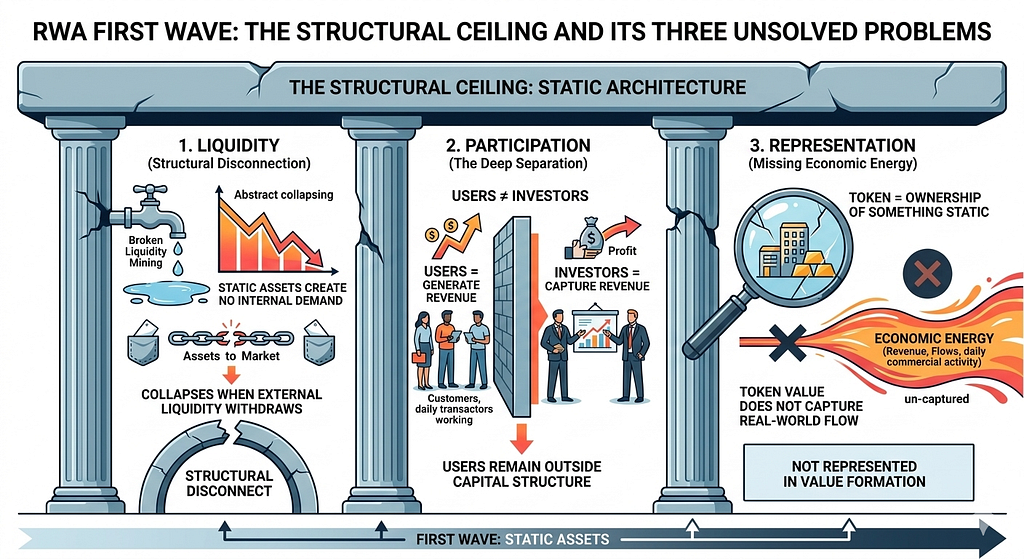
🧊 The Structural Ceiling of the First Wave
The assets that defined RWA’s first chapter share a common architecture.
They are static.
A tokenized bond pays a coupon on a fixed schedule. A tokenized building generates rent according to a lease. Gold simply sits there, denominated against currency fluctuations.
This staticness creates three problems that the First Wave never solved.
The first is liquidity. Static assets generate no internal demand for their own tokens.
Liquidity must be supplied externally — by market makers, liquidity mining incentives, or institutional participants willing to hold positions.
When those external participants withdraw, the market for the token collapses, regardless of the underlying asset’s value. The asset and its market infrastructure are structurally disconnected.
The second is participation. And here the separation runs deeper than most recognize:
Users ≠ Investors.
The people whose economic activity actually sustains an asset’s value — the tenants, the customers, the daily transactors — remain entirely outside the capital structure. They generate the revenue. They do not participate in what that revenue produces.
The third is representation.
A static asset token represents ownership of something that exists. It does not represent the economic energy flowing through it.
The revenue, the transactions, the daily commercial activity that gives the asset its real-world relevance — none of that is captured in the token’s value formation.
The First Wave tokenized the container.
It left the contents behind.
💸 What the Economy Actually Runs On
Here is what the First Wave missed:
economies do not run on assets.
They run on revenue flows.
A hotel is not valuable because of its concrete and steel. It is valuable because of its occupancy rates, its seasonal booking patterns, its repeat customer base.
A retail chain is not valuable because of its inventory. It is valuable because of the transactions it processes every day.
Strip away the revenue flow, and the static asset beneath it is just property.
Traditional finance has always understood this at the analytical level — cash flow modeling, discounted revenue projections, EBITDA multiples. But it has never been able to represent it structurally.
The capital market captures the asset;
the revenue flow remains invisible to the token.
This is the missing layer that the First Wave of RWA never addressed.
🌊 The Second Wave: When the Revenue Flow Becomes the Asset
Capital markets were built for assets.
The next phase belongs to revenue.
InterLink’s Digital Equity architecture proposes something the First Wave did not attempt.
Instead of tokenizing what a business owns, it tokenizes what a business does.
A merchant joining the ecosystem issues a Business Token tied not to a balance sheet entry, but to its live transaction flow. Every time a customer transacts within the ecosystem, a portion of that payment is automatically routed into the token’s liquidity pool through an AMM(Automated Market Maker) mechanism.
The token’s value formation is not a function of investor sentiment about the business’s future. It is a direct mathematical consequence of the business’s present activity.
The chain that the First Wave could never close now closes:
Business activity → transaction → liquidity → capital event.
This is not a refinement of RWA.
It is a different answer to the question of what deserves to be an asset in the first place.
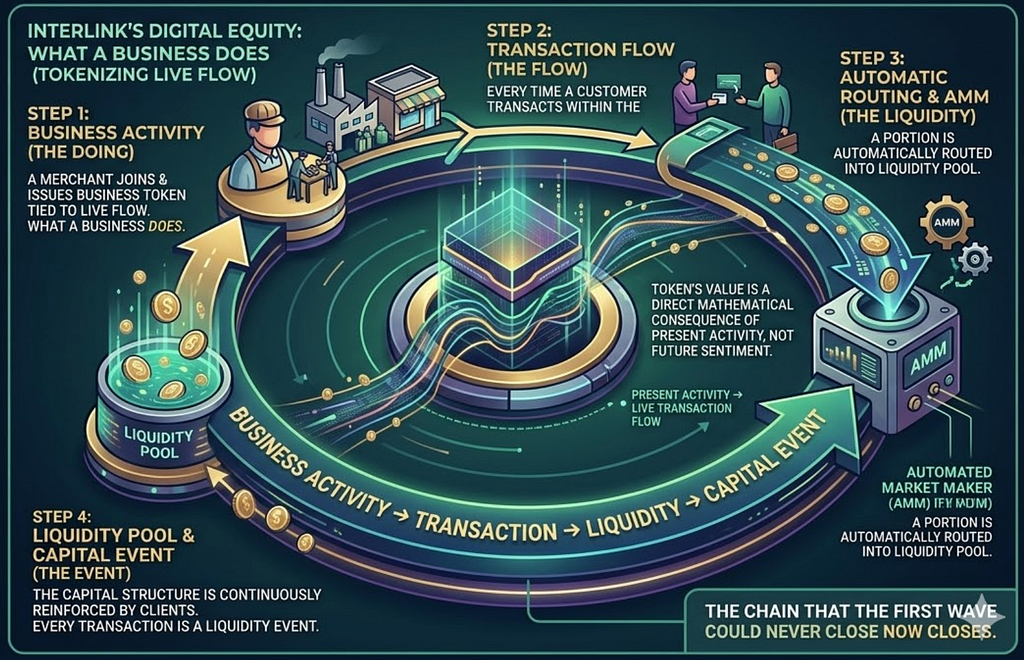
business activity → transaction → liquidity → capital.
🎯 Who This Actually Changes the Game For
The First Wave of RWA democratized access to existing assets. Anyone could now hold a fraction of a Manhattan office building or a US Treasury bond.
That was meaningful, but it preserved the underlying logic: you need capital to participate in capital markets.
The Second Wave changes that logic.
A business does not need to own a static asset to enter the capital layer. It needs to generate revenue.
A regional restaurant chain, a logistics operator, a service provider processing hundreds of daily transactions — none of these would qualify for traditional asset tokenization.
They have no property to pledge, no commodity to denominate.
But they have something the First Wave’s assets do not: continuous, verifiable, on-chain economic activity.
In an architecture where that activity directly generates liquidity and price discovery, participation replaces possession as the qualifying signal.
The barrier to capital markets moves from asset ownership to revenue generation.
Capital markets stop rewarding ownership.
They begin recognizing activity.
🏁 The Real Question
The First Wave asked: how do we put existing assets on-chain?
The Second Wave asks something harder.
When every transaction becomes a capital event — when the act of selling a product automatically deepens a liquidity pool, reinforces a price floor, and strengthens a settlement layer — what exactly counts as an asset?
The answer the First Wave gave was comfortable and familiar.
It pointed at things.
The answer the Second Wave is beginning to construct points somewhere else entirely.
It points at activity.
Source 1: https://x.com/kv_interlink/status/2031005898437788076?s=20
Source 2: https://x.com/itl_fdn/status/2031726449044910334?s=20
About the Author
Done.T is a Web3 analyst specializing in the InterLink ecosystem.
He unpacks the underlying logic of the Human Node economy, translating complex system design into actionable, data-driven insights for a global audience.
Reference
🔗 [Chapter 3. The Evolution — The Macro Thesis]
Disclaimer: This article provides a strategic analysis of InterLink’s publicly available infrastructure and documentation.
It is not financial advice. Readers should conduct their own due diligence.
From Assets to Revenue: The Next Phase of RWA was originally published in DataDrivenInvestor on Medium, where people are continuing the conversation by highlighting and responding to this story.