First Open and Public DAGKnight!
 Hoosat Network4 min read·Just now
--
After months of dedicated work, I’m proud to share that Hoosat Network has been running the first publicly available, open, and testable implementation of DAGKnight for over three months.
This was a significant technical challenge. DAGKnight, as described in Yonatan Sompolinsky’s paper, is a sophisticated upgrade to GhostDAG. It introduces dynamic ordering and substantially heavier computational demands compared to GhostDAG. Building a faithful implementation demanded meticulous attention to detail, extensive iterative testing, and rigorous validation.
My Development Journey
I began with a naive dynamic K version simply to measure the real-world performance impact in December 26, 2025 just after spending Christmas with my family.
From there, I progressed to a paper-faithful implementation, carefully cross-checking every major component to eliminate logical gaps and ensure full alignment with the papers specification.
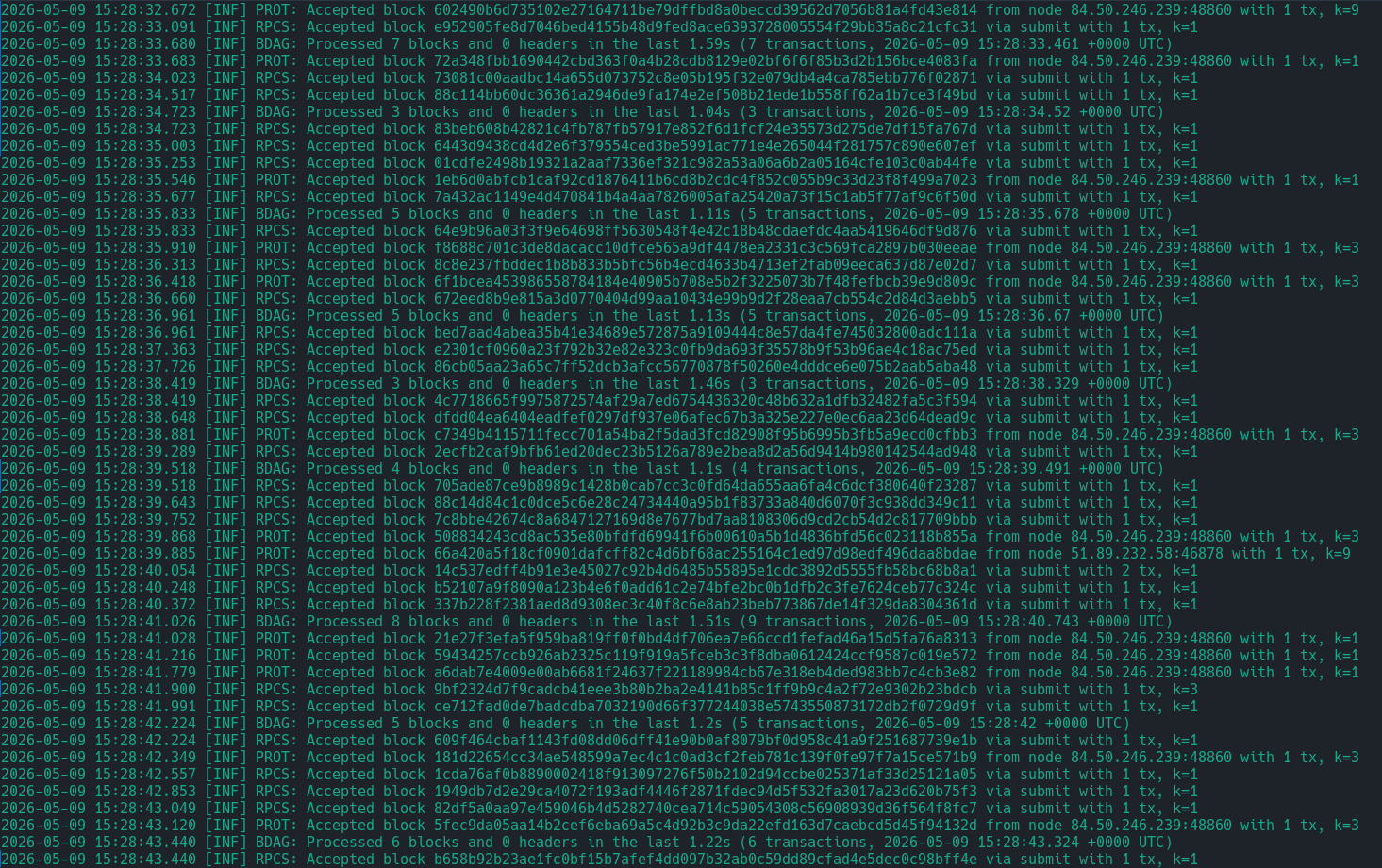
Once the core logic proved stable, I launched the testnet without aggressive caching or heavy optimizations in February 8, 2026 to observe how the protocol performs under realistic conditions of mining at 5 BPS.
The results have been very encouraging. Hoosat’s Golang-based node, forked and optimized from the Kaspa GOlang reference node, is already capable of sustaining +5 blocks per second, while running full DAGKnight consensus.
The testnet is live, stable, and I continue to fix bugs as they emerge.
Broader Context
Kaspa’s team has been working on DAGKnight for a long time, with their major Rust rewrite aimed at scaling the network. These are complex upgrades, and it’s completely understandable that high-quality, production-ready implementations require substantial time.
After DAGKnight paper, the Kaspa community rose $70M over 12 days in December 2022 for implementation of DAGknight. Coderofstuff started publicly audible work in February 27, 2026 at commit “[DK-protocol] Init full DK base implementation”
Today, the DAG-based consensus space has two coexisting live paths forward:
- Kaspa’s ongoing DAGKnight development (with a potential hard fork targeted for Q3/Q4 2026)
- Hoosat’s ready in testnet, open-source DAGKnight (with a mainnet Hard fork targeted for 20.6, 20.7 or 20.8 2026, depending on community vote)
I believe healthy competition and parallel experimentation will ultimately benefit the entire DAG-based consensus space.
A Different Direction
The “line in the sand” between Kaspa and Hoosat has now become clear. While both projects share the same foundational GhostDAG, DAGKnight consensus technology, they have chosen fundamentally different paths regarding growth, mining economics, and long-term decentralization.
Kaspa has achieved remarkable success. Its high-speed architecture and strong development ecosystem have attracted significant adoption, liquidity, and attention. However, this success has also accelerated ASIC deployment and industrial-scale mining. As a result, network hashrate can continue rising even during prolonged price drawdowns. Over time, this risks squeezing out smaller miners when increasing difficulty outpaces coin price appreciation.
Hoosat was created partly as a response to this challenge. As a Kaspa-derived GhostDAG/DAGKnight chain, Hoosat deliberately prioritizes Hoohash, an algorithm designed to maintain ASIC and FPGA resistance for as long as possible. The goal is to keep mining economically viable for everyday participants, from mobile phone CPUs to professional GPUs.
In my view, true decentralization is best preserved when mining power remains accessible to ordinary people rather than becoming concentrated among a small number of industrial operators.
This creates two distinct philosophies:
- Kaspa accepts the natural evolution toward specialized hardware (ASICs) as a necessary trade-off for maximum network security and global scale.
- Hoosat treats mining accessibility itself as a core, non-negotiable feature, even if that choice leads to slower market expansion or comparatively lower total hashrate in the short term.
Neither approach is inherently wrong; they simply reflect different priorities. Kaspa is optimized for rapid adoption and raw security through scale. Hoosat is optimized for long-term participatory decentralization and resistance to mining centralization pressures.
By keeping the testnet and DAGKnight implementation fully open and public, Hoosat offers the community a genuine alternative, one where the original cypherpunk ideal of “one CPU, one vote” is actively protected rather than gradually eroded.
If you’re interested in testing DAGKnight today, exploring the codebase, or running your own nodes, Hoosat Network’s testnet is open and welcomes participation. The hard fork date and name are now up for community voting.
This is just the beginning for Hoosat. Only 36.57 % mined in May 9, 2026. Excited to keep building.