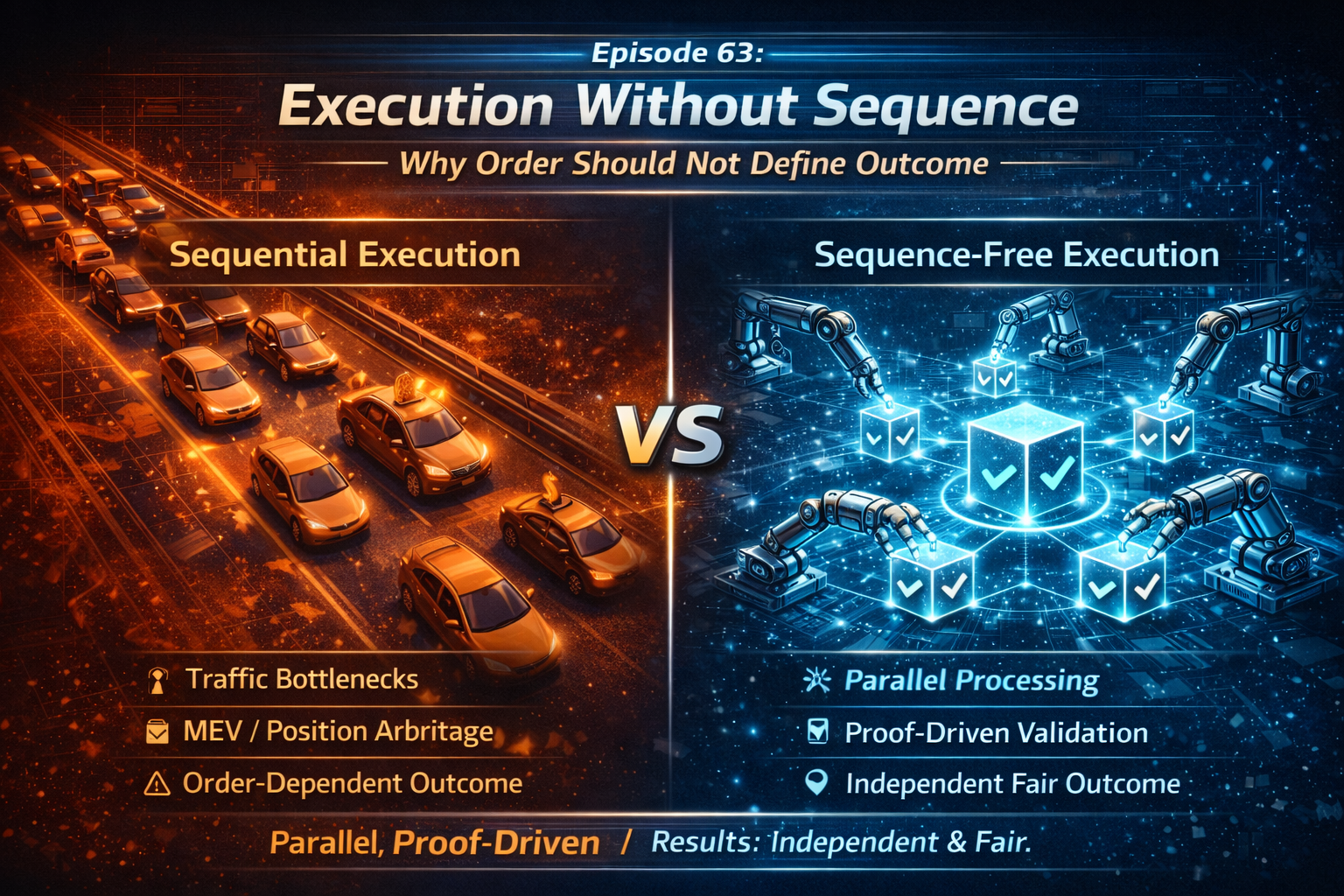
Execution Without Sequence — Why Order Should Not Define Outcome
--
Introduction
Modern systems assume one fundamental rule:
Execution must follow sequence.
- Step 1 → Step 2 → Step 3
- First this, then that
- Order defines outcome
But this assumption is not neutral.
If execution depends on order, then order becomes a point of control.
And wherever control exists, manipulation follows.
The Hidden Problem of Sequential Execution
Sequential systems create implicit dependencies:
- Later actions depend on earlier ones
- State evolves through ordered transitions
- Outcome = result of sequence
This introduces structural risks:
1. Order Manipulation
- Reordering inputs changes results
- Same data → different outcome
2. MEV / Priority Exploitation
- Whoever executes first gains advantage
- Value extracted purely from position
3. State Fragility
- One incorrect step corrupts the entire chain
- Recovery depends on rollback or correction
4. Bottlenecks
- Everything waits for prior execution
- Parallelism is artificially limited
Sequence is not just structure — it is constraint.
Rethinking Execution: Does Order Really Matter?
A fundamental question emerges:
Should outcome depend on execution order at all?
If two actions are both valid:
- Why must one come “before” the other?
- Why should ordering influence correctness?
This leads to a new model:
Execution without sequence
Execution Without Sequence
In a sequence-independent system:
- Actions are validated independently
- Execution is parallelizable
- Outcome is deterministic, not order-driven
The system no longer asks:
- “What happened first?”
It asks:
- “What is valid?”
Core Principles
1. Order Independence
- Valid actions do not depend on position
- Reordering does not change outcome
2. Parallel Validation
- Multiple actions verified simultaneously
- No global sequencing requirement
3. Deterministic Resolution
- Final state derived from validity rules
- Not from execution order
4. Conflict Isolation
- Conflicts resolved locally, not globally
- No cascading failure from sequence break
What Changes
Traditional ExecutionSequence-Free ExecutionOrder defines resultValidity defines resultSequential processingParallel validationGlobal dependencyLocal independenceTiming mattersTiming irrelevant
When order is removed, fairness increases and attack surfaces shrink.
Architectural Implications
To support sequence-free execution, systems must evolve:
1. Stateless Computation
- Each computation stands alone
- No reliance on prior execution history
2. Proof-Carrying Execution
- Each action includes proof of correctness
- Execution becomes verification
3. Composable Validity Rules
- System defines what is valid, not when
- Rules resolve outcomes deterministically
4. Minimal Coordination
- No global lockstep synchronization
- Reduced communication overhead
Relation to Emerging Systems
This model aligns with:
- Stateless blockchain designs
- Zero-knowledge proof systems
- Parallel computing architectures
- Conflict-free replicated data types (CRDTs)
All point toward the same direction:
Order is an implementation detail — not a source of truth.
Mytier Perspective (Architectural Alignment)
In a system designed around:
- Proof-first validation
- Non-interactive verification
- Off-chain execution + on-chain proof
execution naturally becomes order-independent.
- AI computes results off-chain
- Only verified outputs are committed
- Each output is self-validating
This removes:
- ordering advantage
- timing-based manipulation
- sequential bottlenecks
and replaces them with:
Parallel, proof-driven execution
Applied Scenario — What This Enables
- Fair transaction processing without priority wars
- Scalable systems without sequential bottlenecks
- AI verification pipelines without ordering bias
- Multi-chain interoperability without synchronization constraints
Summary
Sequential Model:
- Order defines execution
- Execution defines outcome
- Outcome depends on sequence
Sequence-Free Model:
- Validity defines execution
- Execution is parallel
- Outcome is deterministic
True systems do not depend on what happens first.
They depend on what is valid.