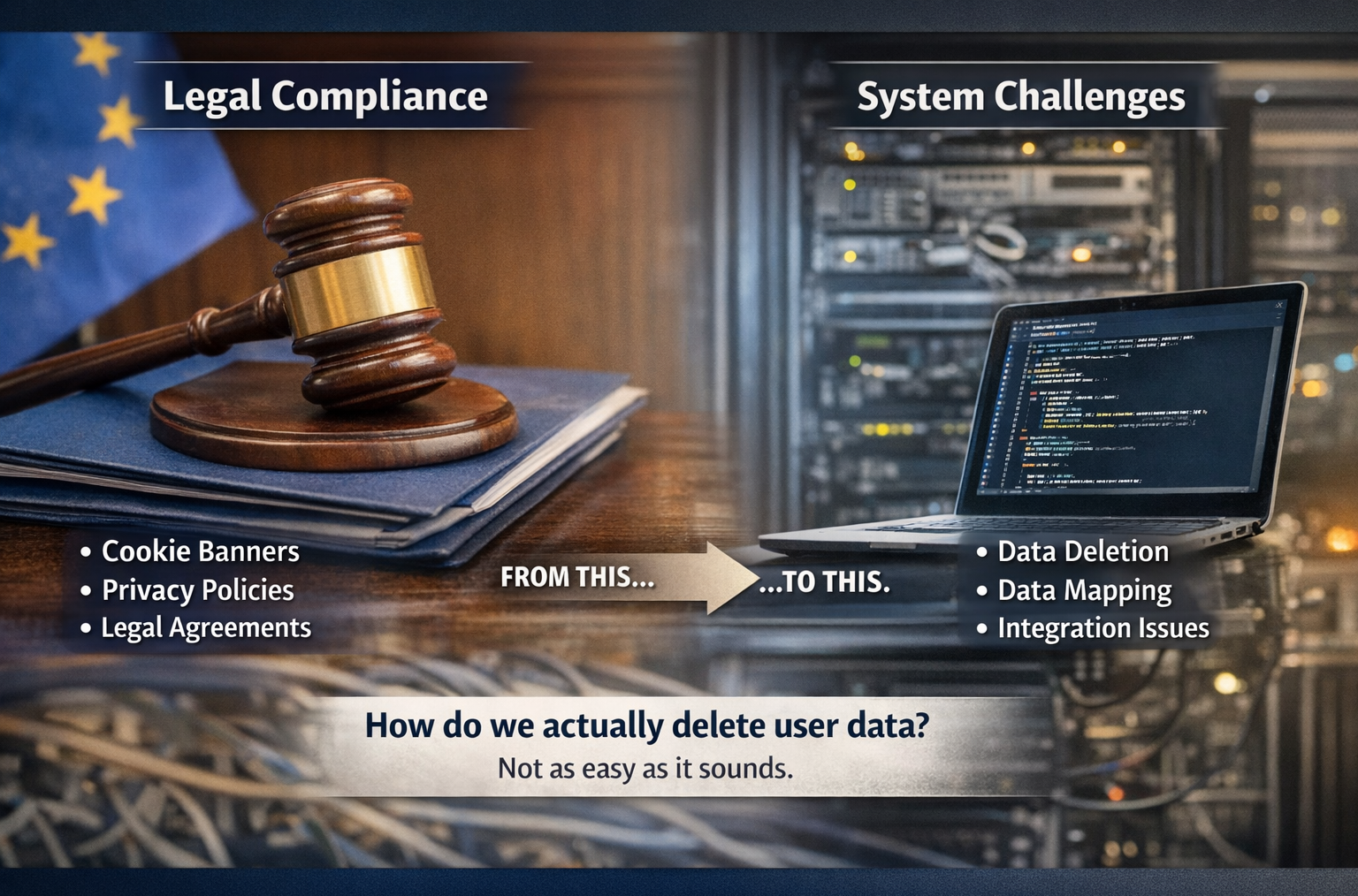
“Everyone Treats GDPR Like a Legal Problem. It’s Actually a System Design Problem.”
Why data protection laws are quietly reshaping how modern systems are built, not just how companies behave
 Pranjal4 min read·Just now
--
I remember the first time GDPR actually came up seriously in a team I was working with.
Not in a presentation.
Not in a strategy doc.
But in a slightly uncomfortable internal discussion.
Someone asked:
“Wait… if a user asks us to delete their data, can we actually do it?”
Silence.
Not because people didn’t care.
But because no one was completely sure.
And that was the moment it became clear — this wasn’t a legal problem anymore.
It Starts Simple (Or At Least It Feels Like It)
In the beginning, GDPR looks manageable.
You add a cookie banner.
You update your privacy policy.
Maybe you add a checkbox during signup.
It feels like progress.
There’s a sense that you’re “covered.”
And honestly, for a while, that illusion holds.
Then the System Grows
The real shift happens when your product starts evolving.
You add:
- Analytics tools
- Marketing integrations
- CRM systems
- Logging pipelines
- Support tools
And suddenly, user data isn’t sitting in one place anymore.
It’s everywhere.
Not in a chaotic way.
But in a very normal, “this is how modern systems work” kind of way.
The Question That Breaks Everything
At some point, a user requests data deletion.
Sounds straightforward.
But then the real questions start:
Where exactly is their data?
- Main database? Sure.
- Logs? Maybe.
- Analytics tools? Probably.
- Third-party integrations? Definitely.
And then someone asks:
“Do we delete it from backups too?”
That’s when things get uncomfortable again.
Because now you’re not dealing with policy.
You’re dealing with reality.
The Problem Nobody Mentions Early On
Most systems are built to:
Store data
Move data
Use data
Very few are built to:
Understand data lifecycle
That difference sounds small.
It isn’t.
Because once data starts flowing across services, it becomes hard to answer simple questions like:
- Why do we still have this data?
- Who owns it?
- Can we actually remove it completely?
And without those answers, GDPR becomes… interpretive.
What Actually Happens Inside Teams
Here’s what I’ve seen repeat across multiple companies.
At first:
“We just need to be compliant.”
Then later:
“Why is deletion so complicated?”
And eventually:
“We might need to rethink how this system is structured.”
That last part is where things get real.
Because now you’re not fixing a document.
You’re touching architecture.
The Hidden Cost Nobody Plans For
Retrofitting data control into an existing system is painful.
Not dramatic. Just slow and frustrating.
You find:
- Data duplicated across services
- No clear ownership
- Dependencies you didn’t fully map
And every small change feels risky.
Because you’re not just deleting data.
You’re potentially breaking something.
Scaling Makes It Worse (Quietly)
At small scale, teams can manage.
Manual work fills the gaps.
But as the system grows:
- More services get added
- More data gets generated
- More tools get connected
And suddenly, visibility drops.
Not because the team is careless.
But because complexity compounds faster than awareness.
The Teams That Handle This Better
The interesting part is this:
Some teams don’t struggle as much.
Not because they’re smarter.
But because they approach the problem differently.
They don’t start with:
“How do we comply?”
They start with:
“Do we actually need this data?”
That one question changes everything.
Because once you reduce unnecessary data, the system becomes easier to understand.
And when the system is understandable, compliance becomes simpler.
Small Shifts That Make a Big Difference
I’ve seen teams improve things just by:
- Limiting data collection upfront
- Being intentional about integrations
- Keeping data ownership clear between services
Nothing revolutionary.
But very deliberate.
And over time, those decisions compound.
The Subtle Reality
GDPR didn’t suddenly create complexity.
It exposed it.
For years, systems were optimized for growth.
Collect more data.
Use more tools.
Move faster.
Control wasn’t the priority.
Now it is.
If You Want a Simple Test
Ask your team this:
“If a user asks for complete data deletion today, how confident are we that we can actually do it?”
Not partially.
Not approximately.
Completely.
The hesitation in that answer usually tells you everything.
Final Thought
The biggest shift I’ve noticed is this:
Teams that treat GDPR as a checklist stay stuck.
Teams that treat it as a system design question start building better products.
Not just compliant ones.
Cleaner.
More predictable.
Easier to reason about.
And honestly, that benefit shows up everywhere — not just in audits.