European Union designs €30B carbon market tool to stabilize prices
The ETS Investment Booster will sell 400 million carbon allowances to fund clean energy while keeping permit prices from cratering.
Share
Add us on Google by Editorial Team Jun. 4, 2026The European Union is building a financial instrument worth €30 billion to funnel money into clean technology, and it’s doing so by tapping the very market designed to make pollution expensive. The mechanism, called the ETS Investment Booster, will sell 400 million allowances from the EU Emissions Trading System to raise capital for decarbonization projects across the continent.
How the Booster works
The EU Emissions Trading System is essentially a cap-and-trade scheme. Companies buy permits to emit carbon dioxide, and the total number of permits shrinks over time. Fewer permits means higher prices, which means burning fossil fuels gets progressively more painful for the bottom line.
The ETS Investment Booster takes 400 million of those allowances and sells them to raise roughly €30 billion. That money gets directed toward clean technology and decarbonization, with a particular emphasis on lower-income member states and industrial sectors that need help making the transition.
European Commission President Ursula von der Leyen unveiled the plan in March 2026 as part of a broader package of ETS reforms. Those reforms include updates to benchmark allocations and enhancements to the Market Stability Reserve, the EU’s existing mechanism for managing the supply of carbon permits.
AdvertisementThe MSR has been operational since 2019, and its job is straightforward: when there are too many permits floating around, it absorbs the surplus. When supply gets too tight, it releases them. The MSR amendment proposal was published on April 1, 2026.
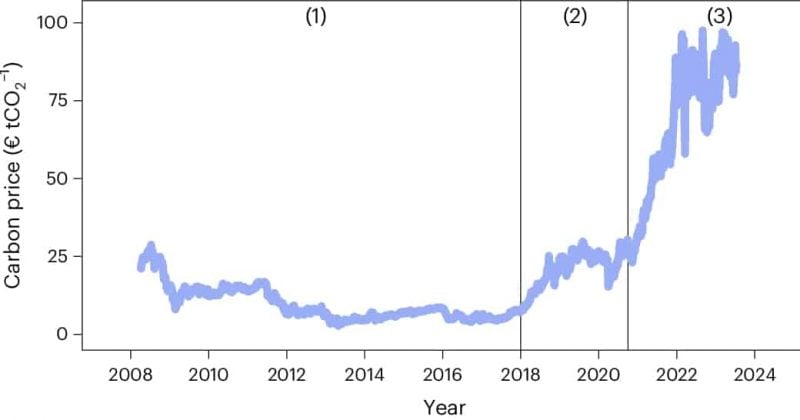
Carbon permits were trading at approximately €77 per tonne as of June 4, 2026. Dump 400 million new permits onto the market without guardrails and that number could fall sharply, undermining the entire economic logic of the ETS.
The balancing act
The EU carbon market has dealt with surplus problems before. In the years following the 2008 financial crisis, economic contraction reduced industrial emissions, which meant companies needed fewer permits, which meant prices cratered. The market spent nearly a decade recovering. The MSR was created specifically to prevent a repeat of that scenario.
The gradual sale approach is the EU’s answer. Rather than auctioning all 400 million allowances at once, the plan calls for a phased release designed to avoid shocking the market.
The focus on lower-income member states is also worth noting. Countries in Eastern and Southern Europe often have older, more carbon-intensive industrial bases and less capital to modernize them. The Booster effectively creates a transfer mechanism: wealthier nations and companies pay for permits, and the proceeds help fund the transition in countries that can least afford it.
What this means for investors
For carbon market traders and institutional investors, the ETS Investment Booster introduces a dual dynamic. On one side, €30 billion flowing into clean technology projects across Europe could accelerate the deployment of renewables, green hydrogen, and industrial decarbonization. On the other side, the EU’s explicit commitment to price stability suggests Brussels will intervene if permits start trading significantly below current levels. The enhanced MSR gives regulators a more powerful tool to absorb surplus supply.
The EU’s own climate targets arguably require prices well above €100 per tonne to drive the kind of systemic change needed to hit net-zero by 2050. Whether the Booster helps or hinders that trajectory depends entirely on whether the funds it generates actually deliver emissions reductions at scale.
Disclosure: This article was edited by Editorial Team. For more information on how we create and review content, see our Editorial Policy.